October 5, 2023 Quick space links

Courtesy of BtB’s stringer Jay.


7 comments

Texas medical college mandates ineffective COVID jab

Baylor College of Medicine: Where medicine is taught badly
Baylor College of Medicine: Where medicine
is intentionally taught badly

They’re coming for you next: In a demonstration that it almost certainly teaches its students bad medicine, the Baylor College of Medicine in Houston has now reinstated its mandates requiring all students, faculty, and employees to get the utterly ineffective but potentially unhealthy COVID booster shots.

The statement issued by the college stated “Baylor faculty, staff, and students must get the COVID vaccine, or request a medical, religious, or personal exemption by Nov. 30.” In 2022-23 this college had more 1,600 students [pdf], so this mandate effects a lot of young people, who according to numerous recent studies (here, here, here, here, here, and here) are also at greater risk of getting myrocarditus from these boosters, resulting in serious heart damage and even death.

What makes this even worse is that the boosters are generally useless in preventing COVID, with other research suggesting strongly that if anything, the jab increases the chances you will get the virus.

Not that this matters, since anyone who has read any of the recent studies on the mutation of COVID over time will also know that all the recent strains are generally harmless, especially to the young, producing nothing more than a very mild cold. No one need do anything to avoid it. In fact, it might even be better to get one of these mild strains to strengthen your immune system.

That a medical college seems entirely unaware of this research data tells us that it must be teaching its medical students badly. » Read more

16 comments

Distorted Martian craters

Overview map

Distorted Martian craters
Click for original image.

Cool image time! The picture to the right, rotated, cropped, reduced, and sharpened to post here, was taken on March 15, 2023 by the high resolution camera on Mars Reconnaissance Orbiter (MRO).

The white dot on the overview map above marks the location, on the west end of the 2,000-mile-long northern mid-latitude strip I label glacier country because almost every image suggests the presence of ice and glaciers.

Where this crater is located the terrain is shifting from mesas and criss-crossing canyons to the northern lowland plains. Thus, the features that suggest the presence of ice shift from glacial in nature (flowing down hollows and cliffsides or within canyons) to that of a near-surface ice sheet, which acts to distort impact craters and leave large splash aprons around them.

The straight depression cutting into the crater near the center top that is also aligned with craters to the southwest suggests that these craters are either sinkholes into a void created by a fault line, or the impacts all occurred at the same time, as the asteroid broke up while cutting through the Martian atmosphere.

Either could be true. The data is insufficient to determine which.

0 comments

Satellite data shows this year’s ozone hole one of the biggest on record

The uncertainty of science: New data from Europe’s Copernicus Sentinel-5P satellite has determined that the ozone hole this year over the south pole was one of the biggest on record.

The hole, which is what scientists call an โ€˜ozone depleting area,โ€™ reached a size of 26 million sq km on 16 September 2023. This is roughly three times the size of Brazil.

The size of the ozone hole fluctuates on a regular basis. From August to October, the ozone hole increases in size โ€“ reaching a maximum between mid-September and mid-October. When temperatures high up in the stratosphere start to rise in the southern hemisphere, the ozone depletion slows, the polar vortex weakens and finally breaks down, and by the end of December ozone levels return to normal.

Despite the claims of scientists that chlorofluorocarbons (CFCs) were creating the hole, requiring their ban in refrigerators, air conditioning, and aerosol sprays in 1987, the arrival of the ozone hole each year is actually a normal seasonal occurance caused by the interaction of the Earth’s tilt and the impact of solar radiation on the upper atmosphere. More interaction, and oxygen molecules break-up into ozone. Less interaction, and there is less ozone.

Thus, despite the ban of these products now for almost forty years, the size of the ozone hole continues to fluctuate significantly from year to year, for reasons that are not yet understood entirely. Some scientists attribute this year’s large size to a volcanic eruption in 2022, but this is merely a theory, not yet proved.

It also must be noted that when the ban was imposed in 1987, we only had data of the ozone hole going back a decade or so. Environmentalists posited then that the hole hadn’t existed before CFCs, but they really hadn’t known that. It will likely take a century of research to really get a good idea of the hole’s normal behavior from year to year. We might find that there was no reason to ban CFCs, that the hole is a natural seasonal occurance like snow in winter and heat in summer.

14 comments

A nearby active galaxy, viewed head on by Hubble

Active galaxy
Click for original image.

Cool image time! The picture to the right, reduced and sharpened to post here, was taken by the Hubble Space Telescope and is the third of a seven-day celebration of galaxies by the Hubble science team. Previous images in the series can be found here. From the caption for this particular image:

At the center of NGC 6951 lies a supermassive black hole surrounded by a ring of stars, gas, and dust about 3,700 light-years across. This โ€œcircumnuclear ringโ€ is between 1 and 1.5 billion years old and has been forming stars for most of that time. Scientists hypothesize that interstellar gas flows through the dense, starry bar of the galaxy to the circumnuclear ring, which supplies new material for star formation. Up to 40 percent of the mass in the ring comes from relatively new stars that are less than 100 million years old. Spiral lanes of dust, shown in dark orange, connect the center of the galaxy to its outer regions, contributing more material for future star formation.

This galaxy, located about 78 million light years away, has also seen six different supernovae in the past quarter century. Compare that with the Milky Way, which has not seen a supernova now in more than four hundred years.

4 comments

Northrop Grumman abandons its own proposed space station; partners with Voyager’s Starlab

Northrop Grumman today officially confirmed rumors from earlier this week: It is abandoning construction of its own proposed space station and will instead join Voyager Space’s Starlab station project, using an upgraded version of its Cygnus freighter to be the station’s cargo ferry.

As part of this new partnership, Northrop will provide cargo services to Starlab for up to five years. The upgrades will allow Cygnus to dock directly to a station port, rather than rendezvous and get berthed using a robot arm. This upgrade will also make Cygnus a more saleable product for providing cargo to other stations as well, as they come on line.

Northrop Grumman was one of four proposed private space stations projects that won NASA contracts, Axiom in 2020 and the other three in December 2021, with its award fixed at $125.6 million, of which $36.6 million has been paid to the company for meeting specific development milestones. NASA is now going to distribute the rest of that award among the remaining projects after some renegotiations.

0 comments

China to expand Tiangong space station

Tiangong-2 station after expansion

The new colonial movement: At the 47th International Astronautical Congress in Baku, Chinese officials yesterday revealed that they intend to expand their Tiangong space station, almost doubling it in size.

The graphic to the right illustrates this, with the proposed new modules in magenta at the top.

โ€œWe will build a 180 tons, six-module assembly in the future,โ€ Zhang said. Tiangong currently has three modules, each with a mass of around 22 tons.

A multi-functional expansion module with six docking ports will first be launched in the coming years to allow this expansion. This will dock at the forward port of the Tianhe core module. Full size modules can then be added to Tiangong. SpaceNews understands that the timeline for such launches is around four years from now. An expanded Tiangong would be just over a third of the mass of the roughly 450-metric-ton International Space Station (ISS).

The officials also said that they plan to add additional inflatable modules to the existing part of the station, as well as attachment points allowing for external experiments exposed to the environment of space.

1 comment

SpaceX successfully launches 22 Starlink satellites

SpaceX tonight successfully launched another 22 Starlink satellites, its Falcon 9 rocket lifting off from Cape Canaveral.

The first stage completed its eighth flight, landing on a drone ship in the Atlantic.

The leaders in the 2023 launch race:

70 SpaceX
45 China
13 Russia
7 Rocket Lab
7 India

American private enterprise now leads China in successful launches 81 to 45, and the entire world combined 81 to 72. SpaceX by itself trails the rest of the world (excluding American companies) by only 70 to 72.

SpaceX this year has now matched the record number of launches set by the U.S. in a single year that lasted from 1966 until last year. And it has done this with the year only 3/4s complete. Its goal of hundred launches this year is still well within reach.

3 comments

China launches classified remote sensing satellite

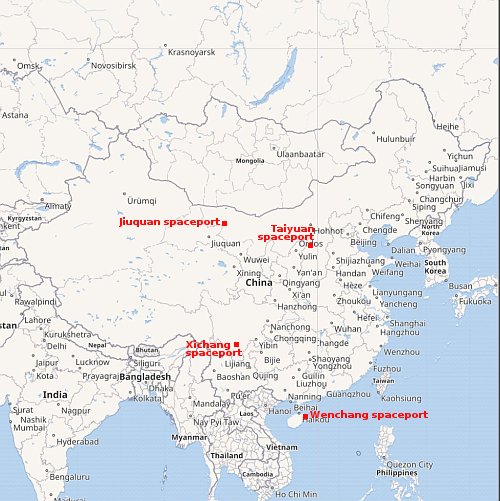
Using its Long March 2D rocket, fueled by toxic hypergolic fuels, China today launched another classified remote sensing satellite from its Xichang spaceport in the southwest of China.

No word where the rocket’s lower stages crashed inside China, or whether they landed near habitable areas.

The leaders in the 2023 launch race:

69 SpaceX
45 China
13 Russia
7 Rocket Lab
7 India

American private enterprise now leads China in successful launches 80 to 45, and the entire world combined 80 to 72. SpaceX by itself trails the rest of the world (excluding American companies) by only 69 to 72.

SpaceX however has another Starlink launch scheduled to lift off shortly. The good live stream can be found here, using no distracting announcers while also using SpaceX’s own X feed.

0 comments
1 45 46 47 48 49 196