
Starship/Superheavy launch aborted at T-0; launch scrubbed
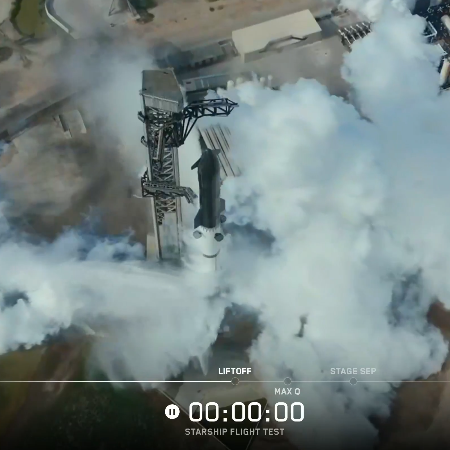
Starship/Superheavy today, just after engine abort
While all looked perfect right up until engine ignition at T-0 second in today’s attempt to fly the 13th test orbital flight of SpaceX’s Starship/Superheavy, the rocket then shut down, aborting the launch.
At T-0 the engines did ignite for a second, after the water deluge system had activated as planned. The company almost immediately announced they were scrubbing for the day. As many have noted below in the comments, once that deluge system runs, they can’t launch again that day. It takes too long to refill the tanks.
Subsequently we have learned that 4 Raptor engines in the inner ring of Superheavy did not light. Musk has since said that at least two will be replaced. I suspect after they inspect the engines they might replace all four. They will likely then do another full static fire test before attempting a launch. Expect a delay of about a week.
On Christmas Eve 1968 three Americans became the first humans to visit another world. What they did to celebrate was unexpected and profound, and will be remembered throughout all human history. Genesis: the Story of Apollo 8, Robert Zimmerman's classic history of humanity's first journey to another world, tells that story, and it is now available as both an ebook and an audiobook, both with a foreword by Valerie Anders and a new introduction by Robert Zimmerman.
The print edition can be purchased at Amazon or from any other book seller. If you want an autographed copy the price is $60 for the hardback and $45 for the paperback, plus $8 shipping for each. Go here for purchasing details. The ebook is available everywhere for $5.99 (before discount) at amazon, or direct from my ebook publisher, ebookit. If you buy it from ebookit you don't support the big tech companies and the author gets a bigger cut much sooner.
The audiobook is also available at all these vendors, and is also free with a 30-day trial membership to Audible.
"Not simply about one mission, [Genesis] is also the history of America's quest for the moon... Zimmerman has done a masterful job of tying disparate events together into a solid account of one of America's greatest human triumphs."--San Antonio Express-News

How much of this could be tested ahead of time? Repeating the propellant load and the static fire until everything works, time after time.
They already do static fires, but static fires donβt recreate conditions or stresses across the entire flight regime. The only way to get that data is to fly.
Yes, they have to fly. In this case the engines failed to start. Which repeated static fires would have detected.
Elon talks convincingly about Starship being an airline equivalent. When a jet engine fails to start the airline and manufacturer do not just replace the engine. They put in place fixes, whether procedure or design, which ensure that going forward all the engines always start.
Actually I am not critical of SpaceX. They have been working design, test and operations issues for years. What I want is to be better informed by the media. Yesterday NSF had its entire team doing a broadcast of the launch. Once the scrub was announced they soon shutdown the stream. No problem analysis. Same with the other YouTube channels.
You keep assuming they don’t do repeated static fire tests of Raptor-3, but this is utterly wrong. They have been doing such tests of the engine now for several years at their MacGregor facility, as they developed the redesign. You don’t have to have the engine on the rocket and on the launchpad to test it.
As for NSF and even BtB, it is good journalism not to do “problem analysis” when you have no information. It makes you like the propaganda press, which immediately KNOWS what happened based on their leftist narrative. I would rather wait a bit to find out what happened.
OTOH, repeated static fires could have caused the problem. You thump on machinery often enough and it decides not to work anymore. Cheers –
agimarc,
If repeated static fires were the cause of the problem, then that is something that SpaceX needs to know. The idea is for the engines to be reliable enough to launch many times between overhauls. If they are not there yet (and they probably are not), then SpaceX needs to find where the improvements are needed so that they can implement them.
The engines need to become thump-proof in the way that jetliner engines are.
Agree completely. Cheers –
Actually, my railroad machinist grandfather carried a monkey wrench in his hip pocket. If anything mechanical acted up. he’d give it a sharp rap with the wrench ‘to show it who was boss.’ Amazing the number of times that persuaded the device in question to work properly.
COL BEAUSABRE,
There is a scene in in the movie The Longest Day in which a beach master comes across a vehicle that won’t start. He does just that with his shillelagh(?), gives the machine a good bash (Youtube, 1/2 minute).
Can they quickly try again (on the same day) after gushing out all that water?
Nope. Once they activate the deluge system, that’s it. It takes hours to re-fill all the tanks and get it ready again.
Hyperion was to be a non-winged sled launch design.
https://en.wikipedia.org/wiki/Rocket_sled_launch
With a very long sled, an explosion doesn’t wipe the whole thing out…just move forward a bit on the rails with the next vehicle.
Maybe a slight deluge sled behind?
NASA engineer James Crocker came up with a Hubble servicing tool while marveling at European sliding shower fixtures:
https://www.baltimoresun.com/1993/11/30/idea-for-hubble-repair-device-born-in-the-shower/
Instead of a vertical tower–might not a horizonal, sliding system allow for less disruptions like that which devastated the Blue Origin pad?
See The Universe in a Mirror for the full story, from Crocker’s own lips, on how he came up with the concept for repairing Hubble’s focus problem.
Where are the fuel and oxygen tanks located? How long are the hoses?
Sliding forward seems to maybe fix one problem, but I doubt there’s enough of the launch infrastructure that’s either mobile or can reach your new zero point.
As for not launching because the deluge tanks take too long to refill, I’m not sure if this will happen often enough for it to actually be a problem. It would have to be a serious enough problem to abort at T-0, but still fixable on the launch pad.
For multiple launches from the same pad in a day you’d have to have quicker refilling, but I think that’s likely to need a more complete rebuild of the pad complex anyway. And probably a different method of getting the whole stack on there as well.
The solution to that limitation, of course, is more water tanks. I believe the deluge system tankage is in the process of being expanded.
Given that they want to launch hourly, their attention to detail with logistics, and the necessary lead time, I would expect such an upgrade both at Boca Chica and the Cape. Cheers –
agimarc,
The plan is not to launch hourly at each pad but to have 24 launches daily among all the pads.
I have trouble imagining that they have customers for that many flights, except during the Mars transit windows. It is during those windows that SpaceX wants to eventually have a great many launches in order to construct and populate their Mars Colony in a timely manner.
The customer for all of those flights will be SpaceX itself. Industrializing the Moon to make AI data center satellites is going to require a lot of stuff and a lot of people to be sent there. Each load will require several tanker flights to a depot ship to cache the propellant needed for each Moonward mission. Putting a million large Starmind satellites into Earth orbit will also require a lot of launches as will the expanded Starlink and Starlink Mobile constellations.
I want my money back for the excitement guarantee.
Musk, via X: “To be confident of a good flight, 2 Raptors will be removed & replaced. Most probable launch timing is early next week.”
nextspaceflight.com is now showing a revised launch date for Flight 13 of Monday, July 20.
Well, they tried on the launch anniversary of Apollo 11. I guess trying for a re-launch on the anniversary of the landing is appropriate.
SpaceX is lucky the FAA is not calling this a mishap. It was preflight, so not a mishap. But clearly, the equipment did not work as designed. Pretty borderline. The FAA could justifiably say the system failed, SpaceX has to explain what went wrong and why it will not fail in this way again.
SpaceX wants to know why things go wrong anyway. They would want to regardless of the FAAβs requirements, Starship hasnβt a prayer of meeting their goals if they were as laissez-faire as you sometimes seem to make them out to be.
The FAA can only require a mishap investigation if something actually flies and then has a problem. The FAA does not call “Mishap” every time a jetliner has a technical failure at the gate.
As Brewingfrog pointed out, once the deluge system is activated, an abort cannot be recycled.
Four engines failed to ignite and that caused the abort. Those engines were E5, E6, E12, and E13 on the ring of steerable engines. In replacing two engines, they will have to do a static fire and that will likely be a33 engine test.
Maybe. Given that booster 20 had already recently done a 20+ sec. static fire, a second static fire hardly seems any guarantee of full success with engine ignition on a second launch attempt. The ship and booster will have to be destacked and returned to the production site for the engine work, then rolled back out and restacked for a second launch attempt. SpaceX’s deal with the locals is no static fires or launches on weekends at the launch pads as these require beach closures. Rolling boosters and ships between the production site and the launch site is also not permitted during beach hours on weekends but can be done once the beach is closed on each day. nextspaceflight.com is now showing a Monday, July 20 date for the next Flight 13 launch attempt. All of the to-and-fro-ing of booster and ship between the launch and production sites can be accomplished at night over the weekend, but a second static fire can’t be done until Monday, July 20 at the earliest and that is already, it seems, marked out as the date for a second launch attempt. That strongly suggests there will be no second booster static fire.
Things are not boding well for Starship. 13th test flight, and four engines fail on start-up. This project is rapidly entering ‘needs-to-work’ territory. Now that there is a public scoreboard; increases the scrutiny.
Things are boding just fine. It’s clear to all paying attention that these are still TEST FLIGHTS. SpaceX does not work like NASA and others with years of analysis (and paralysis). They build, and try to fly. Sometimes things break. It’s part of the PLAN.
Each launch has many iterations of upgrades and improvements, and most are invisible to outside observers. We have no way of knowing what exactly happened unless SpaceX or Elon tells us, which happens far more frequently that we should have any right to expect, even for a now-public company.
Just 2 years ago was Starship test flight 4. Imagine 2 years hence when we’re watching an operational system on flight 40+, from 4 geographically-diverse operational launch pads.
By the way, exactly how many times has Artemis and New Glenn flown in the past 2 years, and how many do you think you’ll see in the next 2?
I support your general thesis. The only nit I would pick is that SpaceX will have at least five operational Starship pads two years hence – pads 1 and 2 at Starbase, the pad at LC-39A and the two pads at LC-37. If the deal for that big piece of land on Pecan Island closes soon, that total could easily be higher. The concrete never sets on Elon Musk’s empire.
He’s starting to go into Hoover Dam territory with these pours.
I do not know the anticipated scope of SpaceX’ Starship test program; nor do I know how much time is built into the schedule. I do know that there is a rocket two years in development, on it’s 13th test flight, sitting on the pad, because it could not get off the pad. It is superior to BO, in that it hasn’t suffered from premature ignition. The New Glenn and SLS programs are relevant to the overall American exploitation effort, but, practically speaking, have no influence on SpaceX development projects. My concern is that the next 30 months of ambitious space activity more-or-less rest on a vehicle that has, to date: not achieved orbit, not returned to base, not demonstrated on-orbit refueling, and not demonstrated crew support. There is no doubt that SpaceX will refine the design, but at some point, ‘Good Enough’, has to be good enough. Starship is a long way from there.
Tom D noted: “It [improvement] wonβt happen overnight, but I trust that Musk will persist until it becomes routine.”
Seeing as the Starship development timeline drives all others, let us hope that ‘routine’ happens sooner, than later.
Dick Eagleson observed: “The concrete never sets on Elon Muskβs empire.”
All the infrastructure build-out in the world won’t put a gram of payload into orbit. Makes it possible, sure, but the ‘go’ part is sitting on the pad.
Yes. Right up until it isn’t sitting on the pad anymore. At that point, all the new facilities that concrete will support will get quite a workout.
Blair Ivey,
You wrote: “I do not know the anticipated scope of SpaceXβ Starship test program; nor do I know how much time is built into the schedule. I do know that there is a rocket two years in development, on itβs 13th test flight, sitting on the pad, because it could not get off the pad. It is superior to BO, in that it hasnβt suffered from premature ignition. The New Glenn and SLS programs are relevant to the overall American exploitation effort, but, practically speaking, have no influence on SpaceX development projects. My concern is that the next 30 months of ambitious space activity more-or-less rest on a vehicle that has, to date: not achieved orbit, not returned to base, not demonstrated on-orbit refueling, and not demonstrated crew support. There is no doubt that SpaceX will refine the design, but at some point, βGood Enoughβ, has to be good enough. Starship is a long way from there.”
You seem to be impatient, wanting it now, similar to Veruca Salt from Charlie and the Chocolate Factory (or the Willy Wonka movie version). Patience is a virtue that rocket scientists and engineers express every time that they scrub a launch when the rocket shows signs of trouble.
Development is taking a while, because SpaceX is solving problems that even the U.S. government was not patient enough to solve. When the Space Shuttle did not work as intended, the government chose to accept that disappointing performance and go with what they had rather than improve it. When the Shuttle project was ended, the government chose to revert to 1960s technologies and methods, because doing it right might take a couple of years and a few billion dollars to develop. SpaceX is choosing to do the hard thing so that the efficiencies bring about a great revolution in space utilization and operations. Good for them. They are more serious about space than the government is.
Starship is not so far away from good enough. It may be only two development flights away from orbit, after proving that it can de-orbit itself rather than leaving itself as orbital debris. Once it achieves orbit, it can put payloads into orbit, and SpaceX can refine the design from there.
Actually, SpaceX demonstrated on-orbit refueling on an earlier test flight.
Perhaps the next 30 months of ambitious space activity do not rest on a vehicle that is still in development. Artemis III and IV do. So do Superbird-9 (June 2027) and Starlab (2028), right now, but neither requires Starship to return to base or use on-orbit refueling, and neither needs crew support. On-orbit refueling and crew support are not needed until 2028. SpaceX has demonstrated crew support with the Dragon spacecraft. It isn’t until the end of 2028 that good enough has to be good enough to get man back on the Moon, and good enough to get to Mars could always slip, if need be — a concept that was demonstrated this year, when that mission slipped for two years.
We need not worry that Starship is not the hare, because even as the tortoise it is still the only runner in the race to Mars. Its only competition to the Moon is Blue Moon, as the Chinese are farther behind than even Starship is. Slow and steady is good enough. Be patient. Even if it has to be expendable or has to take time for refurbishment, Starship is already capable of being an excellent resource for space exploration and utilization. All it has to prove now is that it can de-orbit and avoid being a hazard to low orbit navigation.
I think once they can keep the heat shield intact to their satisfaction, and bring back Starship consistently, weβll see more progress. That and the engines are the most important challenges right now.
My concerns expressed are not from personal desire, but in relation to published timelines. The 2027 – 2028 timeframe is next year, and the year after. That isn’t long, at all. While it’s true that Humans will venture forth as soon as some barely-suitable tech is developed (Polynesians, Apollo); there is, as you say, no reason to do so, here. I suspect the timeline will generally slip 6 – 12 months, unless SpaceX has a string of successes. The Chinese just might get back in The Race.
Need I remind everyone that I have been predicting for years now that the manned lunar landing will not take place before 2030. That prediction is not because I think SpaceX is failing at its job, it is based on a realistic assessment on getting all the components for the landing ready.
SpaceX is not the only object in the critical path, though it is a major one. So is Blue Origin. So are a host of other things with Orion that have to be demonstrated in orbit.
Blair Ivey,
“My concerns expressed are not from personal desire, but in relation to published timelines. The 2027 β 2028 timeframe is next year, and the year after. That isnβt long, at all.”
Two and a half years before Apollo 11, the Apollo project was not in good shape, either. I guess American ingenuity is lost on some people. Maybe Isaacman will do something like reorganize Artemis so that it has a chance of success. Perhaps SpaceX will finally get around to trying some innovation and ingenuity on its Starship project, which were what made Apollo work.
“I suspect the timeline will generally slip 6 β 12 months, unless SpaceX has a string of successes. The Chinese just might get back in The Race.”
I was unaware that the Chinese were out of The Race. They seem to be testing their own manned lunar lander in its development program.
Although timelines often slip, and Robert is probably right that Artemis won’t get anyone on the Moon during Trumps term, I’m not so worried about the Starship project, which will soon have three launch pads and two manufacturing facilities to support it.
The space suits that NASA doesn’t know how to build are another matter. We can only hope that they have not over specified them on the fixed-price contract that is building them.
Ah yes, the spacesuits. Axiom is proceeding well on its contract (our only option right now), but whether suits to walk on the Moon will be ready by 2028 is another matter.
2030 remains my prediction. A landing in 2029 is certainly possible, but I cannot see it happening in ’28 as predicted by Isaacman. What he is doing is the same as Musk, setting an aggressive schedule, to force action.
Having expressed my prediction, I must add that it is now based on a very different world compared to when I first made it. At that time, NASA was run by swamp-creatures whose only interest was maintaining the budget. The longer they could extend Artemis — without doing anything — the better. Moreover, under the old plan, landing on the Moon with Artemis-3, was absurd and certainly never going to happen.
Now Isaacman is using the private sector to energize Artemis. He wants to get there, and often, and is reshaping the program to actually do things, in a sensible manner with a coherent plan. Thus, lots will be happening in the next few years, even as the schedule gets delayed. A much more positive circumstance.
“Now Isaacman is using the private sector to energize Artemis. He wants to get there, and often, and is reshaping the program to actually do things, in a sensible manner with a coherent plan. Thus, lots will be happening in the next few years, even as the schedule gets delayed. A much more positive circumstance.”
I agree. Isaacman told Congress that he was committed to their goal of beating China to the Moon, which is why his reorganization has gone over so well. He is turning a mess of a plan into something that may be achievable and that can do things now rather than later. In using SLS-Orion, he allows SpaceX to focus on a lander version, whereas had he changed the plan to use a Starship or Dragon to get the crew to orbit, then SpaceX would be distracted by the complications of extra work on Starship or the workarounds to the limitations of the Dragon capsule.
Beat the Chinese now, then worry about making a sustained lunar base.
Schedules get delayed. That is the nature of development projects, and Artemis is a project that is developing a way to build, man, and sustain a lunar base. The Chinese schedule is likely to also be delayed, because they are in development, too. Many people think of Starship as just another rocket and Artemis as just another Moon shot, but both are more than we have had before, and it is that “more” part that needs to be figured out and developed into an operational system.
With luck, Isaacman will straighten out NASA so that it works well within America’s space program: commercial space (the private sector), as spearheaded by SpaceX (Space Exploration Technologies).
BillB wrote:
“As Brewingfrog pointed out, once the deluge system is activated, an abort cannot be recycled.”
They are going to have to solve that if they want high flight rates. In case of an abort due to a quickly solvable issue, they need to have water available so that they can immediately try again.
Is it a water reservoir problem? Or is there some issue with the deluge system that prevents multiple floods?
It is my understanding that they only built enough tankage for one launch deluge at a time. Presently there is no need for a lot of excess tankage because they are not performing any more than one launch at a time. They can always add to the available water tankage at a later time when it becomes necessary.
It wasn’t too long ago that they had to truck City of Brownsville Potable Water down to the old launch pad to fill the deluge system. They didn’t have a pipe going down Hwy 4 to fill such a system!
I will admit, my confidence in the whole Starship program is starting to waver, just a tiny bit. It seems awfully late in the game to *still* be having engine startup issues, especially since they’ve flown Raptors (of all generations) HUNDREDS of times already.
There were major changes to the engine igniter tech for Raptor 3. Among other things, the new tech is supposed to allow any Raptor 3 to be restarted an arbitrary number of times without needing any separately-stored and limited consumables. This both saves weight and reduces part count. I’m inclined to be tolerant of teething problems when tech advances of this scale are in play.
After SpaceX did their first successful landing of a Falcon 9 booster nothing seemed to be happening. When were they going to refly that booster? They recovered several other boosters. All of them seemed to disappear into a warehouse. When were they going to refly them? Was all that talk of reuse just talk? Eventually they did start reflying some of them. Most they scrapped. Now they refly nearly all boosters all the time at a surprisingly high rate, but it took them time to make it appear routine. I trust that they will figure out Starship too. It wonβt happen overnight, but I trust that Musk will persist until it becomes routine.
Apparently the only released results on the Blue Origin New Glenn explosion are that the explosion had been βlocatedβ to the rear end of the first stage. No kidding?
I think a advanced engine version (Raptor v3) that suffers an unreliable start anomaly on its second flight is much preferable to an engine of supposedly conservative design (BE-4) that wipes out the launchpad and booster on its second flight.
Might Beal’s non-cryogenic storables have supported a higher cadence. Kerosene/HTP means payloads take a hit, but you can use nitrogen for pressure and no pre-cooling needed.
I think it was R-9 that Korolev put up against hypergolic alternatives. He seemed to think he could speed load LOX as well, if I remember Siddiqui’s writings correctly.
No.
As I’ve reminded you before, both RP-1 and HTP are very expensive and niche chemicals compared to natural gas and LOX – and HTP is barely available anywhere. HTP also has a crummy shelf-life.
You keep recycling completely impractical ideas as though repetition will somehow improve their fundamental wrong-headedness. One might almost call it religious.
Respectfully disagree. RP-1 isn’t niche at all. It is rather a specific hydrocarbon molecule length.
The thing that makes it expensive is the mixture of various hydrocarbon molecule lengths. All hydrocarbon fuels are a mixture of hydrocarbon molecules, as that is what refining does. Think of a bell curve with the peak being the desired length. The better the fuel, the steeper the peak and less evident the tails on either side.
Want pure fuel? Specifically select desired molecule length. Fischer – Tropsch does this easily and can refine any input into the desired output molecule length, though the process needs to be designed to the input string (type of coal, type of crude, natural gas). The cool thing is that the desired molecule length for RP-1 is also the desired molecule length for diesel, AvGas, kerosene, and JP-8. Cheers-
Respectfully, yeah it is. Jet-A is plentiful, but RP-1 is a specialty chemical. I suspect SpaceX buys at least half of worldwide production in recent years.
And it’s not just a matter of molecular length. Any given fraction of petroleum has a lot of different isomers of identical molecular weight, but different physical configurations including branches and rings. Some of these are notably more prone to coking than others. RP-1 is more limited in what isomers are allowed than are other refined products of roughly the same average molecular weight. Achieving this requires extra processing steps not needed for, say, lamp kerosene.
Thanks Agimarc,
I seem to be hearing a lot about Chinese kerosene at Nasspaceflight.
Buran jets;
https://www.secretprojects.co.uk/threads/energia-buran-space-transportation-system.5656/page-19#post-920410
The reason I like kerosene is that a winged craft with jets can land at any airport, and self ferry back.
Stand it up, fill with payload and oxidizer and launch.
Perhaps a pad at the end of a runway?
Youβre making a marginal business even more marginal for limited benefit. Itβs not hard from a trajectory perspective to return an orbiting spacecraft to the launch site after an arbitrary number of orbits at a minor cost in propellant
To Nate,
What I am arguing for is flexibility, in that launch might have to come from one site, but recovery need not be. No barge, no chopsticksβ¦just airports.
Since the stage is nearly empty on return, lighter weight landing gear can be had.
With recent advances, wing weight and passenger comfort can both be had:
https://techxplore.com/news/2026-07-nasa-wing-limits.html
https://techxplore.com/news/2026-07-nasa-smoother-air-taxi.html
Jeff, you need to have a reason to land vehicles elsewhere in the first place. ‘Because I think it’s cool’ is not a good reason to expend the engineering hours or tie up skilled personnel. What need are you envisioning? What commercial advantage can be derived here? Have you considered the operating costs of having a vehicle operating in two different flight regimes and with two different propulsion systems? What is this supposed flexibility for? What customer?
