August 29, 2023 Quick space links

Courtesy of BtB’s stringer Jay.


0 comments

Pushback: Court rules against East Lansing’s attempt to blacklist Christian for following his beliefs

Country Mills Farms-banned!
The Tennes are a normal family! We must blacklist them!

They’re coming for you next: Today’s blacklist story is a follow-up on a August 2021 post, and is a victory, of a sort. As I reported then, after farmer Steve Tennes (shown to the right with his family) made the egregious error of stating his strongly held Christian belief that marriage is for a man and a woman only, and he would only rent his farm for such marriages, and not same-sex marriages, the city government of East Lansing decided to specifically write rules that would ban his farm from participating in its local farmer’s market.

The ban against their business, Country Mill Farms, was begun in 2016. Though a court quickly ruled that it was unconstitutional, the city renewed the ban in 2018 and has maintained it since, claiming the court’s ruling only applied to the 2017 season.

The logic of the East Lansing government is actually quite blatent: It believes it has the right to dictate what others can or cannot say in public, the first amendment be damned.

The city’s new rules quite clearly stated it was illegal for anyone to “make a statement which indicates that an individual’s patronage or presence at a place of public accommodation is unwelcome or unacceptable because of sexual orientation, gender identity, or expression.” You essentially had to agree to its queer agenda policies in all things, even if you were not in East Lansing or were doing business in a farm many miles away. And you better not express any dissent to those policies either!
» Read more

6 comments

Update on the ongoing research of the closest supernovae in a decade

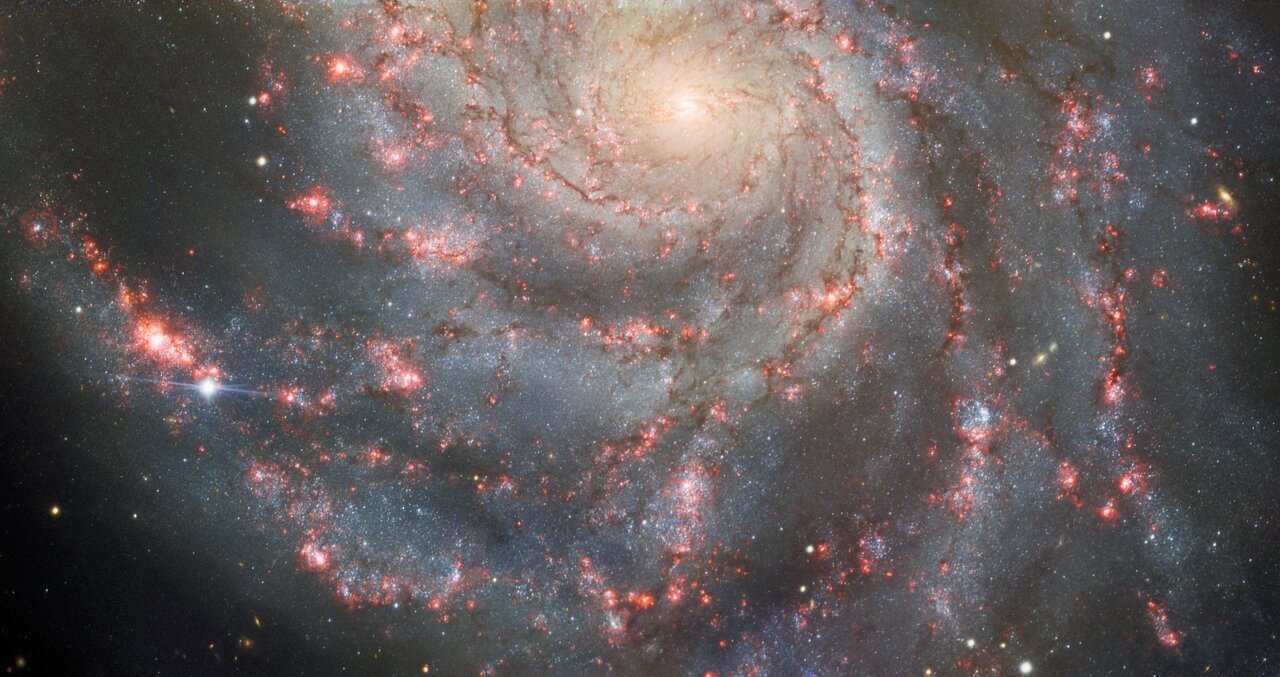
Gemini North image of supernova in Pinwheel Galaxy
Click for original image, taken by the Gemini North telescope in Hawaii.

Link here. Though the press release from UC-Berkeley focuses mostly of research being done by its astronomers, it also provides a very good overview of what all astronomers worldwide have been learning since Supernova SN 2023ixf was first discovered by amateur astronomer Koichi Itagaki in Japan on May 19, 2023 in the Pinwheel Galaxy, only 20 million light years away. This tidbit is probably the most significant:

Another group of astronomers led by Ryan Chornock, a UC Berkeley adjunct associate professor of astronomy, gathered spectroscopic data using the same telescope at Lick Observatory. Graduate student Wynn Jacobson-Galán and professor Raffaella Margutti analyzed the data to reconstruct the pre- and post-explosion history of the star, and found evidence that it had shed gas for the previous three to six years before collapsing and exploding. The amount of gas shed or ejected before the explosion could have been 5% of its total mass — enough to create a dense cloud of material through which the supernova ejecta had to plow.

Such data is going to help astronomers better predict when a star is about to go boom, by identifying similar behavior.

3 comments

The prevailing winds in Mars’ volcano country

The prevailing winds in Mars' volcano country
Click for original image.

Today’s cool image is actual one new picture and four past images, which taken together reveal something about the larger wind patterns on Mars. The picture to the right, cropped, reduced, and sharpened to post here, was taken on June 27, 2023 by the high resolution camera on Mars Reconnaissance Orbiter (MRO) and shows a tiny wind-swept section of the giant volcanic ash field dubbed the Medusae Fossae Formation, about the size of the subcontinent of India and thought to be source of most of the dust on Mars.

The innumerable parallel thin ridges here all suggest that the prevailing winds blow from the southeast to the northwest. As they blow, the scour the surface ash out, and sometimes reveal the underlying bedrock, which here shows up as those small peaks and a handful of northeast-to-southwest trending larger ridges. Note too that the picture shown is only a small section of the full image, which shows that this landscape continues for a considerable distance in all directions.
» Read more

0 comments

InSight team releases a global map of Mars’ seismic zones

Global map of quakes on Mars
Click for original image.

In a new paper that reviewed the entire archive of Mars quakes detected by the seismometer on InSight during its four years of operation on the Martian surface from 2018 to 2022, scientists have now released an updated global map showing the regions on Mars where seismic activity is most common. From the abstract:

Seismicity on Mars occurs mostly along or north of the boundary between the southern highlands and northern lowlands. Valles Marineris is seismically more active than previous catalogs of located events imply. Further, we show evidence that two events likely originate from the Olympus Mons region.

The map to the right is figure 6 from the paper, and shows clearly the sum total of InSight’s data. The yellow triangle marks InSight’s landing spot. The red line delineates the distant quakes from the nearby quakes detected by InSight. The green line is what the scientists identify as the border between the northern lowland plains and the southern cratered highlands. The data suggests that transition point could be linked geologically in some manner to the quakes themselves.

Though the majority of the detected quakes were in the Cerberus Fossae region, the data also suggests two other seismic active regions, one under the giant canyon Valles Marineris and the other south of Mars’ largest volcano, Olympus Mons.

0 comments

Boom begins taxi tests of a one-third scale prototype of its proposed supersonic passenger plane

Three years after it first unveiled the XB-1 prototype of its proposed supersonic passenger plane, Boom Supersonic is finally about to begin taxi tests.

At the Mojave Air & Space Port in Mojave in California, Boom has been conducting ground tests of its one-third scale XB-1 prototype supersonic jet as part of its project to develop its Overture supersonic airliner. The latest round has included taxi tests in the run up to its maiden flight.

In addition to the tests, the FAA has granted the XB-1 an experimental airworthiness certificate that will allow the test aircraft to make its first flight with Chief Test Pilot Bill “Doc” Shoemaker and Test Pilot Tristan “Gepetto” Brandenburg at the controls. Along with simulator work, the pilots are practicing with a T-38 trainer that will also act as a chase plane during the flight tests.

When the prototype was first unveiled in 2020 — after several years delay — the company said it planned to begin flight tests in 2021, with the full scale jet flying by 2024. The project has clearly been delayed since then. At the same time, the company has already gotten contracts and financial support from a number of major airlines, including United and Japan Airlines.

0 comments

NASA reveals three year delay in its New Frontiers planetary mission program

NASA last week revealed that because of “budget uncertainty” it will not begin accepting project proposals in its New Frontiers planetary mission program this fall as planned, and will in fact not begin accepting new proposals until 2026.

At a NASA SMD town hall meeting July 27, Lori Glaze, director of NASA’s planetary science division, warned a potential extended delay in the release of the New Frontiers AO. “If the planetary science funding levels that are anticipated as a result of this tight budget environment are actually realized over the next two or so years,” she said, “it is unlikely we’ll be able to solicit New Frontiers perhaps not before 2026.” That delay was made official with the release of the community announcement.

The draft AO sought proposals for missions on six topics, as recommended by the planetary science decadal survey in 2011: a comet surface sample return, a mission to Jupiter’s volcanic moon Io, a lunar geophysical network, a sample return mission to the moon’s South Pole-Aitken Basin, a mission to characterize the potential habitability of Saturn’s icy moon Enceladus and a probe of Saturn’s atmosphere.

The New Frontiers program previously funded the New Horizons mission to Pluto, the Juno mission to Jupiter, and the OSIRIS-REx asteroid mission to Bennu.

The article at the first link above as well as the NASA officials quoted attempt falsely to blame the budget problems on the Republican House leadership, which insisted that the committee which reviews the NASA budget as well as the budgets of Justice and Commerce cut 28.8% from among those agencies in its 2024 budget review. That committee (as well as the Senate) however was very generous to NASA, essentially giving it the same budget as previously, with only a 1% cut, while slashing budgets for departments in Justice and Commerce to make up the difference.

The real blame for this delay in NASA’s planetary program almost certainly falls on the Mars Sample Return mission, which has seen gigantic budget overruns that are apparently swallowing the entire future planetary program. NASA’s planetary budget can’t pay for any other new planetary missions as long as it must pay for the cost overruns for the sample return mission.

This is no surprise, as we’ve seen this movie before. When Webb’s budget ballooned 20x, from its proposed $500 million to $10 billion, it essentially shut down the rest of NASA’s astrophysics program, delaying or cancelling all other space telescope projects for more than a decade. Now the planetary program is experiencing its own version of this same pain.

The problem is the Mars Sample Return mission itself. Its design has been haphazard and sloppy and constantly changing. It is also reliant on older technology ideas that will soon be made obsolete by Starship/Superheavy. NASA would be wiser to delay that project to await the development of the launch capabilities that will make it cost effective, and let a fleet of other missions happen instead.

I guarantee however that NASA won’t do that, because it will require some boldness. The philosophy in Washington remains the same: Do the same failed thing over and over again in the vain hope it might work next time.

4 comments

Gerry & The Pacemakers – You’ll Never Walk Alone

An evening pause: The Rogers & Hammerstein classic from the 1945 musical Carousel. Pop groups in the 1960s routinely covered classics like this, because they knew their music history, used it to influence their own work, and also wished to celebrate it.

Hat tip Diane Zimmerman.

4 comments

August 28, 2023 Quick space links

Courtesy of BtB’s stringer Jay.


Jay also notes that China’s X feeds “have been quiet for the last two months on the technology fronts. They have been retweeting a lot of their old stories, especially now with Chandrayaan-3 landing, they are showing Yutu-2 pictures and videos,” which suggests to Jay something is impacting China’s pseudo companies. Possibly they are feeling the larger economic crunch that China is presently experiencing.

I also wonder if this is related to the way China’s state-run press purposely avoided mentioning the name of Galactic Energy in reporting its last two successful launches. Have the ChiCons decided its success meant it will soon be time to grab it? If so, this in turn will put a scare into all these pseudo-companies, which would certainly crimp their ability to function enthusiastically.

2 comments

Bank of America blacklists Christian nonprofit for what appears to be political reasons

Bank of America-eager to blacklist

They’re coming for you next: Despite operating two different bank accounts without problems since 2015, Bank of America suddenly shut down the bank accounts of the Christian charitable non-profit Indigenous Advanced Ministries in April 2023, with the bank’s letters announcing the shut down [pdf] exceedingly vague but suggesting that politics played a part.

The initial letters gave no specific reason for the closures, only stating that “upon review of your account(s), we have determined you’re operating in a business type we have chosen not to service at Bank of America.” A later letter said, without explanation, that Indigenous Advance “no longer aligns with the bank’s risk tolerance.” The nonprofit does not advocate for any political causes and has maintained the same mission since it first opened its account with Bank of America.

Officials of the non-profit suspect hostility to its mission was the reason for the cancellations, however, and they have filed a consumer complaint [pdf] against Bank of America with Tennessee’s attorney general, demanding an investigation and noting that the sudden nature of the bank’s action caused a great deal of disruption and the non-profit.
» Read more

2 comments

Residue ice in southern mid-latitude Martian crater?

Residue ice in the southern mid-latitudes of Mars?
Click for original image.

Cool image time! The picture to the right, rotated, cropped, reduced, and sharpened to post here, was taken on April 10, 2023 by the high resolution camera on Mars Reconnaissance Orbiter (MRO). It shows an unnamed 1.2-mile-wide crater at about 35 degrees south latitude with what appears to be residual glacial ice hugging its north interior wall.

As this is in the southern hemisphere, the ground immediately below the south-facing interior wall of the crater is going to be in shadow the most, and thus it will also be the place where any surface or near-surface ice will survive the longest. In this case it appears that from the bumpy nature of that residual ice it has also been sublimating away. Within it however remains the faint hint of multiple layers, suggesting about a dozen past climate cycles with each new cycle producing a new but smaller layer with less ice.

The material in the southern half of the crater floor appears to be dust formed into ripple dunes.
» Read more

0 comments

Vikram finds temperatures of lunar soil varies significantly, depending on depth

Temperature range of soil at Vikram landing site

Based on data from one of the instruments on India’s lunar lander Vikram, scientists have found that the temperatures of the lunar soil at the landing site vary significantly, depending on depth. The temperature dropped from 55 degrees Celsuis to -10 degrees Celsuis when going from about 10 millimeters above the surface to about 82 millimeters below the surface, as shown in the graph to the right.

That’s equivalent from going from a summer day in Death Valley of 131 degrees Fahrenheit to a winter day in Minnesota of 14 degrees Fahrenheit, in a distance of only about 3.5 inches. While it was expected that there would a temperature drop, it appears the quick temperature drop just below the surface was faster than expected.

13 comments
1 66 67 68 69 70 196