JAXA scrubs launch of X-Ray telescope & SLIM lunar lander due to high winds

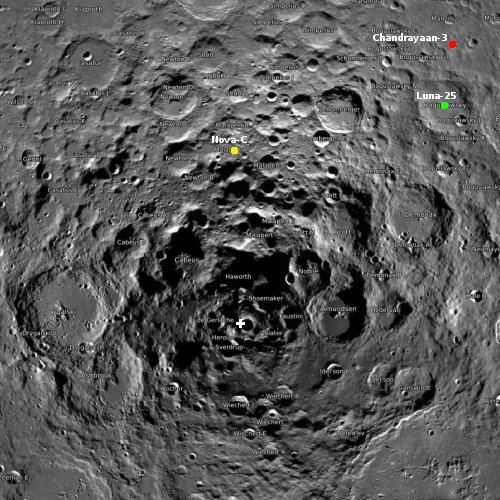
SLIM's landing zone
Click for interactive map.

Because of high winds, Japan’s space agency JAXA yesterday scrubbed the last launch of its H2A rocket, carrying the XRISM X-Ray telescope and the SLIM lunar lander.

A nice description of both payloads can be found here. XRISM is a simplified reflight of the Hitomi X-Ray telescope that failed immediately after launch in 2016.

Though SLIM carries a camera and two secondary payloads, both designed to hop along on the surface and obtain some data, its main mission is engineering, testing whether a robotic spacecraft can achieve a precision landing with a target zone of 100 meters, or 310 feet. The map to the right shows SLIM’s landing site, with the white dot in the close-up inset a rough approximation of that entire target zone. If successful this technology will make it possible to put unmanned planetary probes in places previously thought too dangerous or rough.

All three craft are designed to operate for only about fourteen days, during the daylight hours of the 28-Earth-day-long lunar day.

2 comments

Update on ESA’s much delayed Space Rider X-37B copy

Link here. Space Rider is essentially aiming to be another re-usable mini-shuttle like the X-37B and the unnamed classified version from China. While all three are government-owned and government-run, the X-37B and China’s both were built expressly to do military classified missions. There has been no effort in either case to make them available for commercial flights.

The European Space Agency (ESA) however is developing Space Rider instead for commercial customers. It also appears the government-owned and government-run nature of Space Rider is one of the main reasons it will not fly its maiden mission this year, and won’t fly until late 2025, at the earliest.

โ€œAs an outcome of the previous ministerial council of 2019, the Space Rider received quite significant financial support to cope with Phase C and D activities. However, the participating states contributed in a way that was not possible โ€” due to the need to comply with the Geo-return mechanism โ€” to keep the industrial consortium as it was operating up to that moment [end-2019],โ€ Galli said.

ESAโ€™s Geo-return mechanism was established to boost fairness among member states, ensuring that the nations that invest in the agency will generate a โ€œfair return.โ€ In a nutshell, participating states in an optional development program should receive industrial contracts in a proportional way with respect to their contribution to that program to ensure that money invested benefits the countries that actually contributed to that program. That is to say for example, if you put 30% of the funds into the program, you are expected to receive as close as possible to industrial contracts accounting for 30% of the overall program.

As the program must abide by the Geo-return mechanism, Galli explained that the initial consortium involved was required to significantly be rebuilt โ€œin compliance with the available funds and their member state relevant origin. … This caused first a not negligible delay in setting up the new industrial consortiumโ€ฆ that was finally concluded only in late 2020 with the signature of the new contract with the prime contractors. And then, a so-called bridging design phase was needed on the subsystems affected by the change of industrial supplier, resulting in a longer-than-expected completion of the design phase.

In other words, Space Rider can’t just sell payload space to anyone. Only private businesses in those nations who help finance it can bid, and the customers don’t match well with the ESA’s nations that had been doling up the money. The consequence apparently has been a lot of complex negotiations and jury-rigging to make the two match, all of which has nothing to do with producing a viable product that makes money.

12 comments

SpaceX launches another 22 Starlink satellites

In its second launch from Cape Canaveral in less than 24 hours, SpaceX today placed another 22 Starlink satellites into orbit, using its Falcon 9 rocket.

The first stage completed its third flight, landing successfully on a drone ship in the Atlantic.

The leaders in the 2023 launch race:

59 SpaceX
37 China
12 Russia
7 Rocket Lab

In the national rankings, American private enterprise now leads China in successful launches 68 to 37. It also leads the entire world combined, 68 to 60, while SpaceX by itself now trails the rest of the world (excluding American companies) 59 to 60 in successful launches.

11 comments

SpaceX launches four astronauts to ISS

Using its Falcon 9 rocket lifting off from Cape Canaveral, SpaceX early this morning put four astronauts into orbit for a six month mission to ISS.

The Dragon capsule, Endurance, was making its third flight. The first stage, flying for the first time, landed successfully back at Cape Canaveral.

The leaders in the 2023 launch race:

58 SpaceX
37 China
12 Russia
7 Rocket Lab

In the national rankings, American private enterprise now leads China in successful launches 67 to 37. It also leads the entire world combined, 67 to 60, while SpaceX by itself now trails the rest of the world (excluding American companies) 58 to 60 in successful launches.

10 comments

August 25, 2023 Quick space links

Courtesy of BtB’s stringer Jay.


2 comments

Reality strikes: Democrats in Democratically-controlled cities complain about the consequences of Democratic Party policies

The Democratic Party, always failing but always voted for
The Democratic Party, though always failing it remains
the only party the voters in these cities can support

You get what you vote for: The utter disaster of the Marxist policies of the modern radical Democratic Party are now coming home to roost in numerous cities across America, making them all increasingly “unlivable” in ways that are savage, violent, and devastating. Crime is up, shoplifting is now a sports event, and murderers go free while local prosecutors indict ordinary citizens for simply defending themselves.

These facts are not news however. Since the 1960s Democratic Party policies have routinely done damage to the livability of American cities. What makes this collapse in civilization now even more significant however is who is noticing, as shown by three recent articles in the past week.

Let’s start with Minneapolis, where numerous videos document a formerly pleasant midwest city that has now become a hellhole.
» Read more

26 comments

SpaceX completes successful 6-second static fire test of Superheavy

screen capture during static fire test
Screen capture during static fire test

SpaceX today successfully completed a full 5-second static fire test of all 33 Superheavy Raptor-2 engines as well as the deluge system of the launchpad at Boca Chica.

The link goes to the live stream, which is still on-going. The static fire test occurs at about 42 minutes, if you wish to see it.

According to the narrators of the live stream, Elon Musk tweeted that the static fire was a success. It certainly appeared to go for the full five seconds, and it certainly appeared more robust than the previous test. We will have to wait however for confirmation that all 33 engines fired as planned.

The company clearly appears just about ready to do an orbital test flight. Too bad the Biden administration still stands in the way. There is yet no word on when the FAA will approve a launch license, and the decision of the Justice Department yesterday to file a bogus discrimination lawsuit against SpaceX strongly suggests the White House is working hard to figure out ways to squelch this private effort by an American citizen and his company.

Hat tip to Jay, BtB’s stringer.

32 comments

Flow channels on Mars

Flow channels on Mars
Click for original image.

Cool image time! The picture to the right, rotated, cropped, reduced, and sharpened to post here, was taken on May 13, 2023 by the high resolution camera on Mars Reconnaissance Orbiter (MRO). It shows what the scientists call a “channel and depression”, though to my eye everything looks like flow channels, descending to the east.

The drop from the narrow northern channel to wider southern channel is about 200 feet, with the small crater on the left sitting about halfway between. To our Earthbound eyes, something clearly flowed downhill from that northern channel into the wider channel. What we don’t know now is what the material was that did the flowing?

Was it liquid water? Glaciers? The overview map below provides some context, though it doesn’t actually provide an answer.
» Read more

0 comments

Both Vikram and Pragyan functioning as planned on the Moon

Pragyan on the Moon
Click to see full movie.

According to tweets from India’s space agency ISRO, both the Vikram lander and the Pragyan rover are functioning as planned on the lunar surface, with the rover successfully activating its two science instruments.

The image to the right, taken by Vikram, shows the rover as it completed its roll down the ramp onto the lunar surface. This is a screen capture from a movie showing that roll down, which you can see by clicking on the picture. Since then it has moved another 26 feet from the lander.

I must add once again that Vikram did not land “on the south pole”, as too many so-called news organizations have been falsely claiming. It landed at about 69 degrees south latitude, quite a distance from that pole, in a flat region with no permanently shadowed craters. It is not specifically looking for water, though its instruments might help explain the orbital data that suggests there are areas on the surface of the Moon where hydrogen is somehow present.

If so many news outlets can’t seem to get these very basic facts about this mission correct, one must ask what else do they get wrong routinely? I don’t ask, because I always assume their information is wrong, check it constantly, and find repeatedly that they get numerous basic facts incorrect, especially when it comes to reporting on politics.

6 comments

China launches remote sensing satellite using rocket from pseudo-company

The Chinese pseudo-company Galactic Energy completed another successful orbital launch today, using its Ceres-1 rocket solid-fueled rocket carrying a remote sensing satellite and lifting off from the Jiuquan spaceport in the northwest interior of China.

As with the pseudo-company’s previous launch, the state-run press made no mention of the company in its reporting, underlining the fact that it really is simply another government-controlled entity that simply adds private investment and the profit-motive to its operations.

No word on where the rocket’s lower stages crashed within China.

The leaders in the 2023 launch race:

57 SpaceX
37 China
12 Russia
7 Rocket Lab

In the national rankings, American private enterprise still leads China in successful launches 66 to 37. It also leads the entire world combined, 66 to 60, while SpaceX by itself now trails the rest of the world (excluding American companies) 57 to 60 in successful launches.

0 comments
1 67 68 69 70 71 196