National Science Foundation decides to fund only one giant telescope

The National Science Foundation (NSF) has decided that its astronomy program does not have sufficient funds for building both the Thirty Meter Telescope (TMT) in Hawaii and the Giant Magellan Telescope (GMT) in Chile, and will decide in May which one it will choose.

The GMT and TMT—both backed by consortia of universities, philanthropic foundations, and international partners—set out to build their next generation instruments in the early 2000s. But this privately funded approach, which during the 20th century produced the twin 10-meter Keck telescopes in Hawaii and the two 6.5-meter Magellan telescopes in Chile, stumbled when it came to multibillion-dollar projects. Although design work and mirror casting forged ahead, both projects failed to amass enough funding to complete construction. (A dispute with Native Hawaiians over the Hawaii site has also slowed the TMT.)

I predict that this decision puts the final nail in TMT’s coffin. That telescope was on schedule in 2015 — when construction was set to begin — to be already operational now, well ahead of GMT. The opposition in Hawaii by a minority of leftist protestors, who also had the backing of the state government (run entirely by the Democratic Party), blocked that construction even as the building of GMT’s mirrors proceeded.

Almost a decade later, while TMT sits in limbo, unbuilt, GMT is nearing completion, with its last mirror presently being fabricated and construction at its site now more than half done. It is expected to be finished by 2028, and is almost certainly going to get that NSF funding.

As I noted however in July 2023,

Not that any of this really matters. In the near term, ground-based astronomy on Earth is going to become increasingly impractical and insufficient, first because of the difficulties of making good observations though the atmosphere and the tens of thousands of satellites expected in the coming decades, and second because new space-based astronomy is going to make it all obsolete. All it will take will be to launch one 8-meter telescope on Starship and [GMT] will become the equivalent of a buggy whip.

The great tragedy of TMT is that the astronomers themselves at the project were not willing to fight that tiny minority of protesters, whose protests were based on the essentials of critical race theory that makes whites the devils and all other minorities saints. As academics trained in these insane ideas, the astronomy community accepted this bigoted premise, and out of guilt allowed those protesters to rule.

1 comment

Russia launches weather satellite plus eighteen smallsats

Russia yesterday successfully launched a new weather satellite as well as eighteen smallsats, including one for Iran, its Soyuz-2 rocket lifting off from its Vostochny spaceport in the far east of Russia.

The rocket’s stages crashed in several designated drop zones within Russia and the Arctic Ocean.

The leaders in the 2024 launch race:

18 SpaceX
9 China
3 Russia

American private enterprise still leads the entire world combined 21 to 18 in successful launches, while SpaceX by itself is now tied with the the rest of the world (excluding other American companies) 18 all.

0 comments

Inspector General: Mars Sample Return mission in big trouble

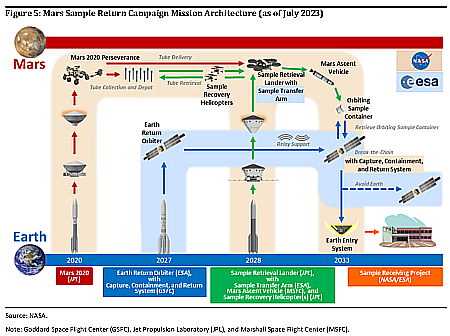
The present plan for Mars Sample Return

Though the audit published today [pdf] by NASA’s inspector general of the NASA/ESA Mars Sample Return mission partnership tries to couch its language positively, the conclusion one reaches by reading the report is that the project is a mess and will almost certainly not fly when scheduled in 2029, and might even get delayed so much that the Perseverance rover on Mars — an essential component of the mission plan — might no longer be operational at that time.

First the budget wildly out of control.

The trajectory of the MSR Program’s life-cycle cost estimate, which has grown from $2.5 to $3 billion in July 2020, to $6.2 billion at KDP-B in September 2022, to an unofficial estimate of $7.4 billion as of June 2023 raises questions about the affordability of the Program.

In addition, the audit noted that this is not the end, and that based on another independent review the budget could balloon to $8 to $11 billion before all is said and done. (I will predict that as presently designed, that budget will likely reach $15 billion.)
» Read more

6 comments

Today’s blacklisted American: “Progressive” leftists in Seattle can’t even take a joke, blackballing four comedians

Cancelled comedians
Click for original video.

They’re coming for you next: Not surprisingly, a comedy club located in the heart of Seattle, in the very same CHAZ neighborhood (Capitol Hill Autonomous Zone) that leftist Antifa thugs took over in 2020 after the death of George Floyd, has cancelled the scheduled appearance of four comedians, apparently because all four were considered too moderate and not “progressive” enough for that radical community of close-minded fascists. As rationalized in an email to the comedians, comedy club officials explained:

Capitol Hill is known for its progressive values, and we’ve received significant feedback expressing concerns about the alignment of these upcoming shows with the neighborhood’s ethos. This feedback includes concerns from local advocacy groups that are deeply embedded in our community and work towards upholding its values.

Given the feedback and to avoid any potential negative impact on both our club and the artists involved, as well as to maintain the harmony within our community, we believe the most responsible course of action is to not move forward with the shows for Dave Smith on April 11th, Luis J Gomez for May 31st-June 1st, Jim Florentine for September 20th-21st and sadly Kurt Metzger on October 11th-12th as well.

The email also added most dishonestly, “We truly value the art of comedy and the diverse perspectives it brings to our lives.”

What a crock. » Read more

17 comments

“Thar’s gold in them there asteroids!”

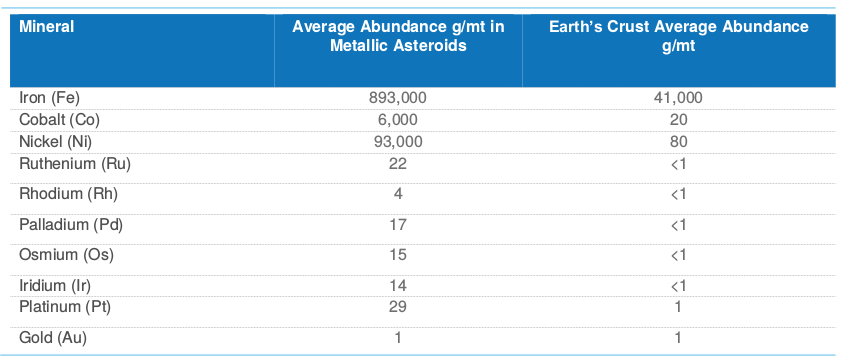
Actually, the “gold” in the quote refers less to the actual element and more to the potential wealth lurking within the resources available in many asteroids in space. I base this optimistic assessment, which is looking at the very long term and not the near future, based on the following chart, just published in a new white paper report [pdf] dubbed “Asteroid Mining: Key to Large-Scale Space Migration or Rocky Road?” The chart itself comes from this October 2023 research paper.

The estimated resources in the metallic asteroids, compared to Earth

Except for gold, the estimated abundances in metallic asteroids of all these important minerals exceeds the entire reserves contained on Earth, by many times. And even though the asteroid reserves of gold do not exceed that of Earth, that in-space gold is likely far easier to access and mine. As the report notes:
» Read more

24 comments

Rocket Lab unveils a family of four different service modules for all kinds of satellites

Rocket Lab continues to expand its product line beyond just rockets, today unveiling a family of four different types of service modules, designed to provide maneuvering, communications, and power to satellites.

The four service modules, dubbed Photon, Lightning, Pioneer, and Explorer, are each designed to serve different types of satellites, from low orbit to geosynchronous. The company is also developing a larger rocket, Neutron, in addition to its Electron rocket.

Presently only Electron and Photon are operational, both having serviced multiple customers. Neutron is still scheduled for a first launch later this year, though a delay into 2025 is expected. It is not clear when Lightning, Pioneer, and Explorer will make their first flights.

0 comments

Update on Starship/Superheavy preparations at Boca Chica

Link here. After two separate but aborted dress rehearsal countdowns, the rocket has been destacked with Superheavy rolled back to the assembly building.

After two Wet Dress Rehearsal (WDR) aborts, SpaceX opted to destack Ship 28 before removing Booster 10 from the Orbital Launch Mount (OLM). The Booster has since rolled back to the Production Site, while Ship 28 conducted standalone testing on Pad B, opening with a Spin Prime test on Monday.

A March launch of Flight 3 for Starship is still possible, pending the completion of full stack testing and approval from the FAA.

While the aborts suggest some technical issues occurred that need addressing, the destacking and additional work could also be for other reasons. The FAA has still not issued a launch license, and is demanding certain actions before doing so. It could be that the company is being forced to make certain upgrades on these prototypes it would have rather left to the next test launch with more advanced prototypes.

Either way, it now appears that a March launch is possibly threatened.

3 comments

Astra’s founders slash their offer price to buy the company

The two founders of the startup Astra have now slashed their offer price from $1.50 to $0.50 per share to buy the company and take it private.

Kemp and London cited several reasons for cutting the share price. They included continued cash burn by the company since they tendered the original offer and higher “non-operating expenses” as the company used multiple third-party advisers to assess options. They also said the special committee, as well as customers and investors, sought a plan that ensured a sufficient cash balance to support company operations once the deal closed.

It appears that they are willing to let the company go into bankrupty rather than pay their original offer. The new offer of $0.50 per share however remains significantly below the present trading price of about $1.76.

1 comment

ULA begins stacking Atlas-5 rocket for launching the first manned mission of Starliner

ULA has begun to assemble the Atlas-5 rocket that will hopefully launch Boeing’s Starliner capsule on its first manned mission to ISS, presently targeting a late April lift-off.

The rocket’s main stage was transferred from the nearby Advanced Spaceflight Operations Center to the integration facility Wednesday, Feb. 21, where it will await integration with the rocket’s upper Centaur stage and Starliner. The spacecraft will carry NASA astronauts Suni Williams and Butch Wilmore to the orbiting laboratory for a short stay of about one to two weeks before returning to a landing site in the southwest United States.

The late April date appears to be a slight delay from previous announcements.

5 comments

Major layoff expected at Northrop Grumman’s facility at Redondo Beach, California

On February 26, 2024 Northrop Grumman issued a required notice to its employees at its facility at Redondo Beach, California, that a major layoff of about a thousand employees, about 14% of its workforce at this location, is upcoming.

No reason was given for the cuts, nor did the notice indicate what divisions at the facility would be most affected. However, the cancellation only two weeks ago of a $733 million satellite contract with the Space Force — due to scheduling issues and budget overages — is likely a factor. In addition, the cost overruns in building the habitable module for NASA’s Lunar Gateway space station probably also contributed.

The company has also had problems with its Antares rocket, which relied on Russian engines and a Ukrainian-built first stage. It is presently grounded while Firefly designs and constructs a new American-built first stage. Northrop has had to also spend extra money to buy launch services from SpaceX to get its Cygnus cargo capsule to ISS.

0 comments
1 159 160 161 162 163 191