Odysseus’ tip-over likely caused because it landed without good elevation data

It appears that the improvised switch to a NASA range finder instrument just before landing only partly worked during Odysseus’s landing attempt on the Moon, causing the spacecraft to hit the ground at too great a speed with too much laterial motion, resulting in the snapping of one leg and the lander tipping over.

Apparently, Odysseus could no longer process altitude data from the NASA instrument once it was within 15 kilometers of the surface. It had to rely on its optical cameras, a poor substitute.

By comparing imagery data frame by frame, the flight computer could determine how fast it was moving relative to the lunar surface. Knowing its initial velocity and altitude prior to initiating powered descent and using data from the inertial measurement unit (IMU) on board Odysseus, it could get a rough idea of altitude. But that only went so far. “So we’re coming down to our landing site with no altimeter,” Altemus said.

Unfortunately, as it neared the lunar surface, the lander believed it was about 100 meters higher relative to the Moon than it actually was. So instead of touching down with a vertical velocity of just 1 meter per second and no lateral movement, Odysseus was coming down three times faster and with a lateral speed of 2 meters per second.

Though the spacecraft landed upright, the high speed and sideways motion caused one leg to snap, and the spacecraft then fell over. In this sideways position Odysseus’ main solar panel could not get enough sunlight, forcing the mission to end prematurely.

A final press conference summing up the mission is scheduled for 2 pm (Eastern) today.

Was the mission a success? The failures and problems during touchdown illustrated engineering and management issues that must be addressed before the next flight. At the same time, the mission’s number one goal was to soft land on the Moon, and it did do so, even with those serious engineering problems.

More important, this flight’s first and foremost goal was an engineering test of that technology. In this sense that mission succeeded brilliantly, revealing those last technical issues.
5 comments

Tonight’s Space Show cancelled due to computer hack

My appearance tonight on the Space Show with David Livingston has been unfortunately cancelled because the Space Show website was hacked early this morning. David is struggling to get some live stream system working, hopefully by tomorrow, with me being the guest. Stay tuned.

In the meantime, his show could use some financial help to fix this problem. Even though I doing on my own fund-raiser for Behind the Black at present, I feel compelled to ask my readers to consider helping the Space Show as well. In the past two decades I have been on that show more than any other guest. It has helped spread the word about capitalism in space more than any other outlet. Here is the donation information:

Online through Paypal at www.paypal.me/thespaceshow. Using Zelle, email your donation to [david at onegiantleapfoundation dot org]. You will need to convert the “at” and “dot”. Or send a check payable to and mailed to One Giant Leap Foundation, C/O Dr. David Livingston, 11035 Lavender Hill Dr. Ste. 160-306, Las Vegas, NV 89135.

Please help if you can, especially if you have listened to the show over the years.

2 comments

A recent volcanic eruption on Mars?

A recent volcanic eruption on Mars?
Click for original image.

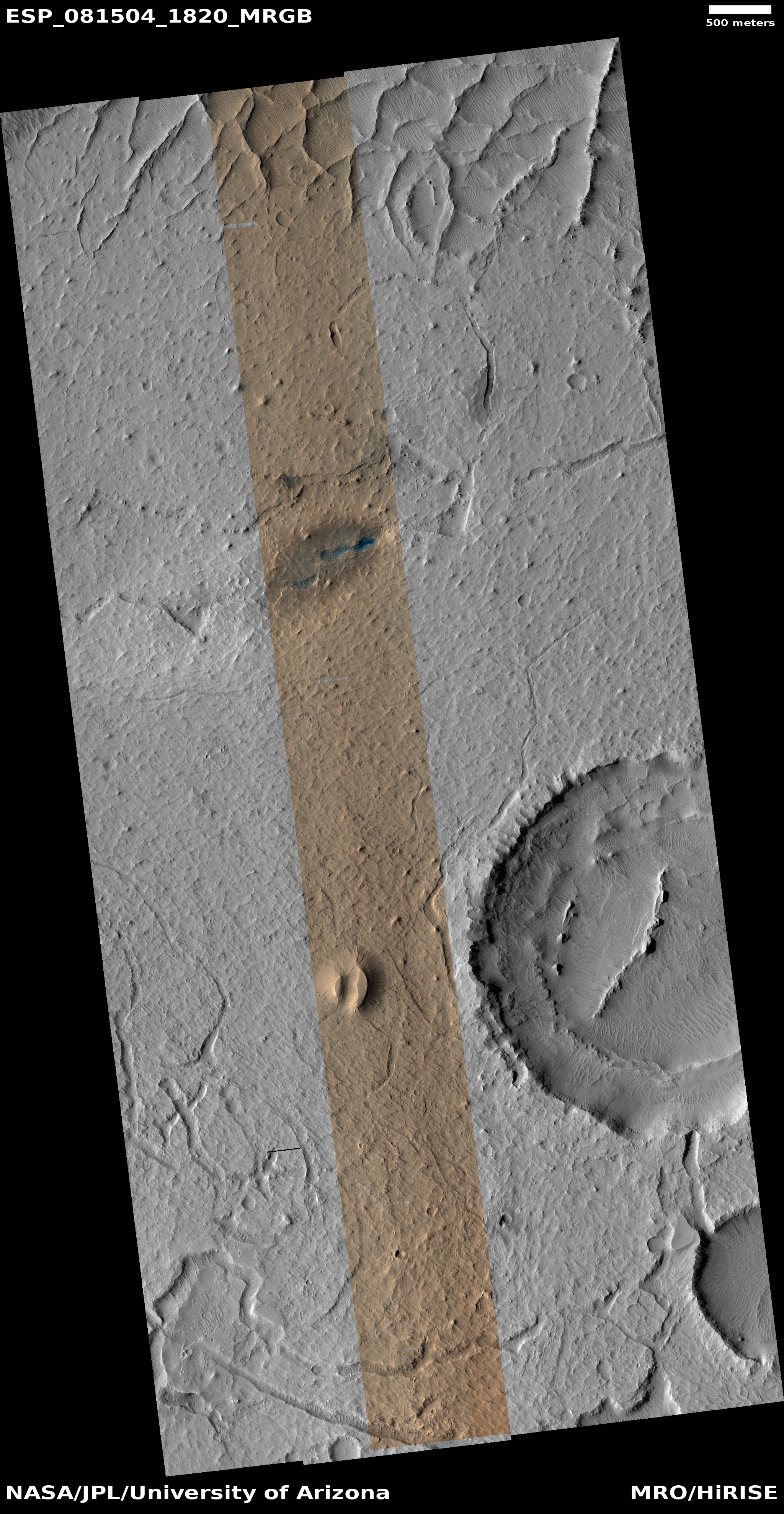
Cool image time! The picture to the right, cropped, reduced, and sharpened to post here, was taken on December 16, 2023 by the high resolution camera on Mars Reconnaissance Orbiter (MRO). The science team labels the two darkened patches in the picture “plume-like features,” suggesting that the dark material was eruptive material thrown out from the depressions in a volcanic venting, that then settled on the nearby surrounding terrain.

Is that a correct interpretation? It is certainly strengthened by a different feature located about 550 miles to the northwest that looks almost the same. There, researchers theorize that the dark material surrounding a surface fissure was caused by a small volcanic event that occurred somewhere between 50,000 to 210,000 years ago. For that other location, scientists concluded as follows:

After careful comparison of this symmetrical dark feature with other dark wind-caused streaks in this region, the scientists concluded that it was not caused by wind, but is the remains of a relatively recent volcanic eruption that laid down a thin layer of material only about one foot thick.

» Read more

0 comments

FAA announces it has rubber-stamped SpaceX’s investigation of the November Starship/Superheavy test launch

The FAA yesterday announced that it has completed its review of SpaceX’s investigation of the November Starship/Superheavy test launch and has approved the company’s conclusions.

The Federal Aviation Administration has concluded its review of SpaceX’s investigation of the second Starship launch in November, with the regulator saying Monday that it accepted the “root causes and 17 corrective actions” identified by the company.

While this means the investigation is now closed, SpaceX must implement all the corrective actions and apply for a modified launch license before it can fly Starship again. “The FAA is evaluating SpaceX’s license modification request and expects SpaceX to submit additional required information before a final determination can be made,” the regulator said in a statement Monday.

You can read a SpaceX update of its investigation here. As previously reported, when Starship vented the extra oxygen carried to better simulate a payload it caused “a combustion event” and fires that cut off communications.

This resulted in a commanded shut down of all six engines prior to completion of the ascent burn, followed by the Autonomous Flight Safety System detecting a mission rule violation and activating the flight termination system, leading to vehicle breakup. The flight test’s conclusion came when the spacecraft was as at an altitude of ~150 km and a velocity of ~24,000 km/h, becoming the first Starship to reach outer space.

Despite SpaceX’s report, which states the company “has implemented hardware changes” to prevent a reoccurance, the FAA has still not yet issued a launch license. Based on these updates and Elon Musk’s own prediction, it appears a license will be forthcoming in the next two weeks, matching my December prediction of a March launch. Expect SpaceX to quickly launch, as it has “more Starships ready to fly,” and it wants to fly them fast in order to refine the engineering so as to move to operational flights.

It is also possible that the FAA will continue to slow-walk its approvals, and SpaceX might be left hanging for more than two weeks. Had the government not been involved, all signs suggested that SpaceX would have done its third test flight in January, and would have now been gearing up for its fourth flight. That was the kind of pace SpaceX set when it was doing its first Starship test flights during the Trump administration. The government under Joe Biden’s presidency however is not allowing that kind of launch pace.

9 comments

India names four astronauts, three of whom will fly on its first manned mission

Prime Minister Narendra Modi of India today revealed the four astronauts training for its first manned mission, dubbed Gaganyaan and targeting a launch next year.

Prime Minister Narendra Modi on Tuesday announced the names of four pilots who are undergoing training for the country’s maiden human space flight mission ‘Gaganyaan’. The pilots are – Group Captain P Balakrishnan Nair, Group Captain Ajit Krishnan, Group Captain Angad Pratap, and Wing Commander S Shukla.

Though all four are training for the mission, only three will fly. The mission itself will orbit the Earth for three days. More information about each man can be found here. All have already received astronaut training in Russia.

1 comment

First image from Odysseus on the lunar surface

Odysseus' view on the Moon
Click for original image.

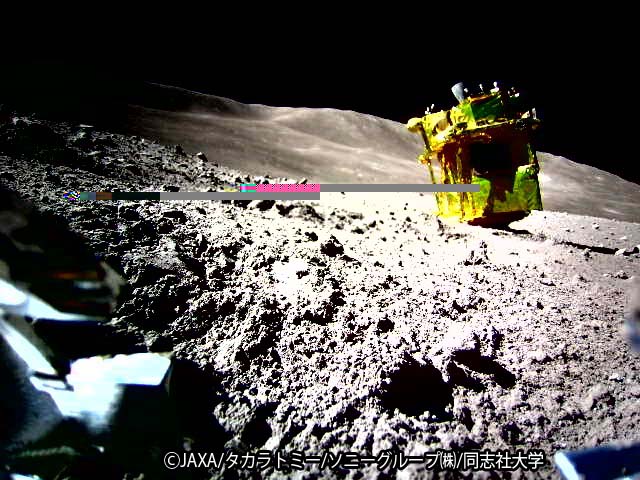
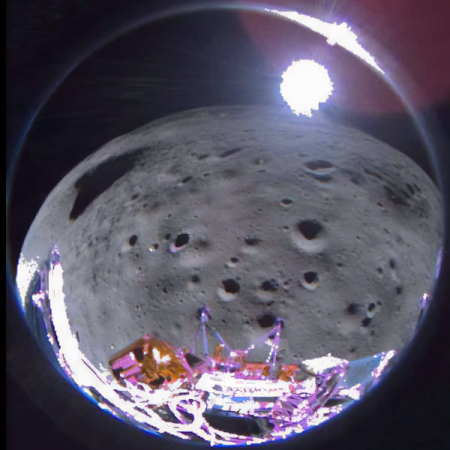
Engineers have managed to finally download several images from Intuitive Machines’ Odysseus lunar lander, lying on its side on the Moon several hundred miles from the south pole. Five pictures were taken as the lander approached the ground. A sixth, to the right and cropped and reduced to post here, was taken after landing using a fish-eye lens. You can see two of the lander’s legs, and I think the bright spot on the horizon is the Sun.

Odysseus captured this image approximately 35 seconds after pitching over during its approach to the landing site. The camera is on the starboard aft-side of the lander in this phase.

Unfortunately, the lander’s fallen position appears to be limiting the amount of sunlight its solar panels are receiving, and thus engineers expect to shut the spacecraft down sometime today in anticipation of the lunar night. It is very doubtful Odysseus will survive that night and resume operations during the next lunar day.

1 comment

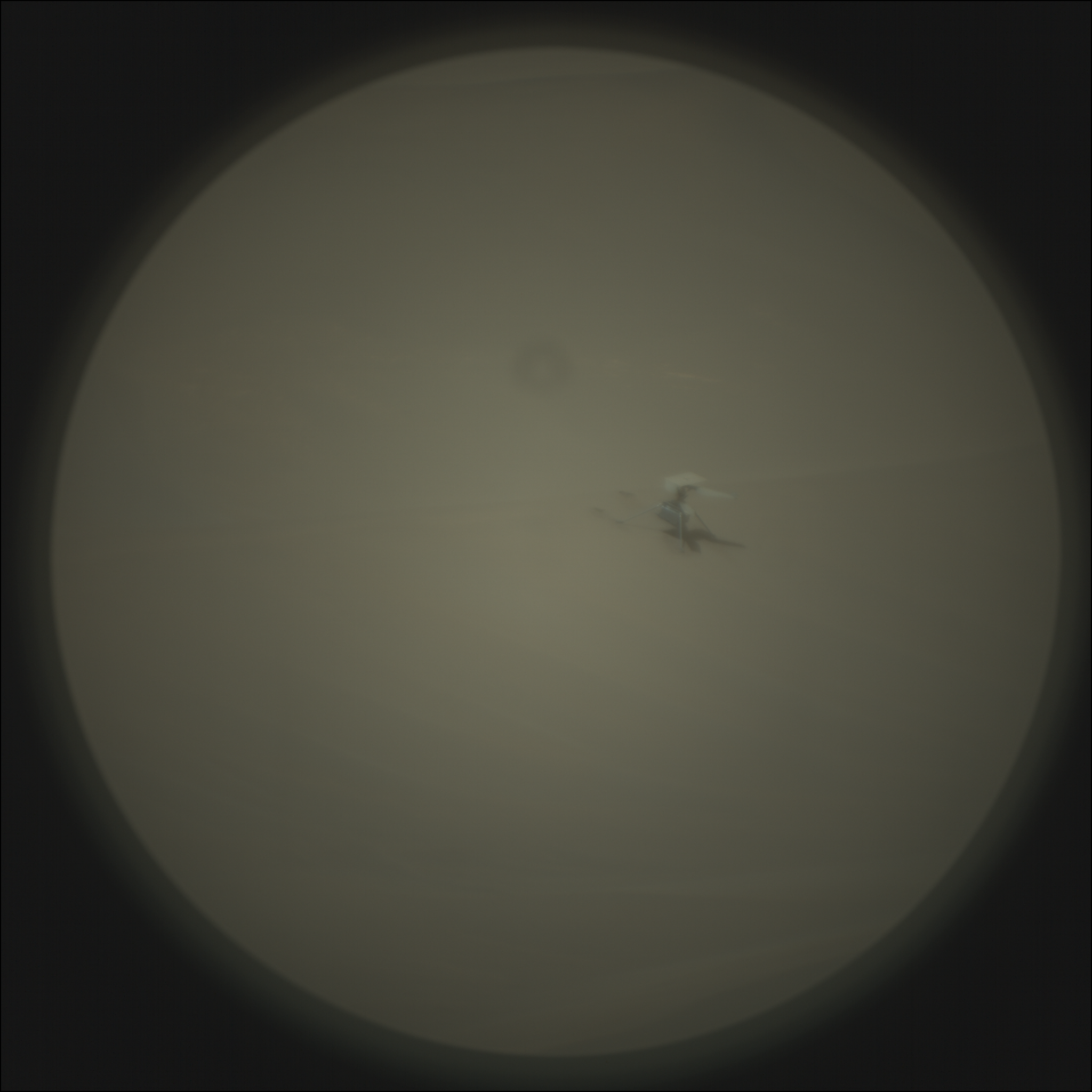
Ingenuity broke off one blade entirely

Ingenuity with missing blade
Click for original image.

Images using a camera on Perseverance originally designed to look closely at rocks nearby but was found capable of doing distant photography (by engineers running the rover Curiosity), Perseverance has obtained the first good close-up picture of Ingenuity since its last flight, and found that one half of one propeller blade apparently broke off during or at the end of its last flight.

That image is to the right, cropped and sharpened to post here. It was taken on February 25, 2024 by Perseverance’s Supercam camera. A second Supercam image spotted the broken blade about fifty feet away, on the sand.

Why the blade broke off remains unknown. You can see from the tracks on the ground that Ingenuity jumped downhill and sideways after landing, but if the blade had hit the ground while spinning that jump would probably have been more violent. The pictures instead suggest it broke off not from contact with something else but because it broke on its own.

The Ingenuity engineers will of course do some very careful analysis of both pictures, and possibly determine better what happened.

4 comments

Have modern space engineers forgotten the importance of keeping things simple?

SLIM on its side
The Japanese lander SLIM, on its side.
Click for original image.

In the past four years a number of different companies and nations have attempted eight times to soft land an unmanned lander on the Moon. Sadly, the track record of this new wave of lunar exploration, the first since the 1960s space race, has not been good, and might possibly suggest some basic fundamental design errors, based not so much on engineering but on our modern culture and management. To review:

  • April 11, 2019: Beresheet, built by an Israeli non-profit, failed just before touchdown when a command from the Earth caused its engines to shut down prematurely.
  • November 21, 2019: India’s government-built Vikram lander failed just before touchdown when it began to tumble and ground controllers could not regain control.
  • April 25, 2023: Hakuto-R1, built by the commercial Japanese company Ispace, failed just before touchdown when its attitude sensors mistakenly thought it had reached the surface when it was still three miles high and shut down the engines, causing it to crash.
  • August 20, 2023: Luna-25, built by Russia, crashed on the lunar surface when its engines fired for longer than planned when it began its descent, due to quality control errors during construction.
  • August 23, 2023: India’s succeeded on its second landing attempt, its Vikram lander touching down several hundred miles from the Moon’s south pole and successfully releasing its Pragyan rover. Both operated for about two weeks, until the onset of the harsh lunar night.
  • January 8, 2024: Peregrine, built by the private company Astrobotic, experienced a major fuel leak shortly after launch, making a landing attempt on the Moon impossible. It managed to operate in space for several days, reaching the distance of lunar orbit before coming back to Earth and burning up in the atmosphere.
  • January 25, 2024: SLIM, built by Japan’s space agency JAXA, successfully touched down, though it landed on its side because the nozzle on one of its engines fell off during descent, causing an unbalanced thrust. The spacecraft still functioned, and has now even survived one lunar night, something no one expected.
  • February 23, 2024: Odysseus, built by the private company Intuitive Machines, touched down somewhat softly on the Moon near the south pole, but upon landing then fell over on its side, blocking some antennas so that full communications has so far not been possible (though the spacecraft is functionable and in touch with Earth). This issue has meant that no significant data or images from the lander have so far been transmitted to Earth.

Of these eight attempts, only one mission has been entirely successful, India’s second. Of the seven others, five crashed or failed before even reaching the Moon, while two managed to soft land but with significant problems.
» Read more

28 comments

The coming April 8, 2024 total eclipse

The next eclipses to cross the U.S.
Map by Michael Zeiler (GreatAmericanEclipse.com). Click for original.

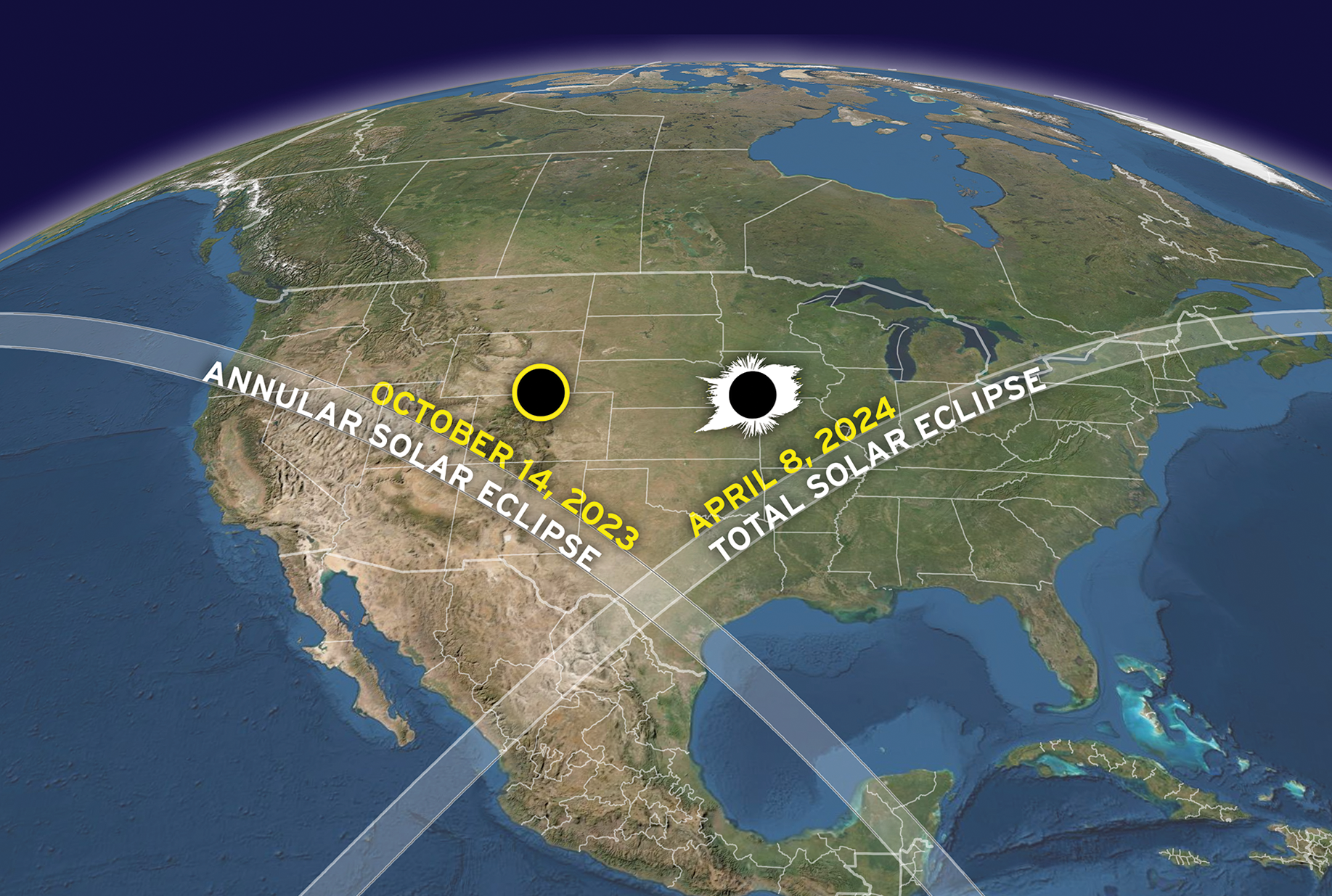
On April 8, 2024 a large swath of the United States, from Texas to Maine, will have the opportunity to witness personally a total eclipse of the Sun by the Moon.

If you have never experienced a total eclipse, then you must do whatever you can to see this event, since the next eclipse within the United States will not happen again until 2044. Diane and I made a special trip to Idaho Falls, Idaho in 2017 to see that eclipse, and without doubt it was an experience that is difficult to describe. As I wrote afterward:

Totality was amazing. I was amazed by two things. First, how quiet it became. There were about hundred people scattered about the hotel lawn, with dogs and kids playing around. The hotel manager’s husband set up speakers for music and to make announcements, but when totality arrived he played nothing. People stopped talking. A hush fell over everything. Moreover, I think we somehow imagine a subconscious roar from the full sun. Covered as it was, with its soft corona gleaming gently around it, it suddenly seemed still.

Secondly, the amazing unlikeliness of the Moon being at just the right distance and size to periodically cause this event seemed almost miraculous. Watching it happen drove this point home to me. And since eclipses themselves have been a critical event in the intellectual development of humanity, helping to drive learning and our understanding of the universe, it truly makes me wonder at the majesty of it. I do not believe in any particular religion or their rituals (though I consider the Bible, the Old Testament especially, to be a very good manual for creating a good life and society), but I do not deny the existence of a higher power. Something made this place, and set it up in this wonderous way. Today’s eclipse only served to demonstrate this fact to me again.

» Read more

13 comments

NASA high altitude science balloon sets new endurance record

GUSTO's flight path
Click for continuous tracking of GUSTO’s flight path

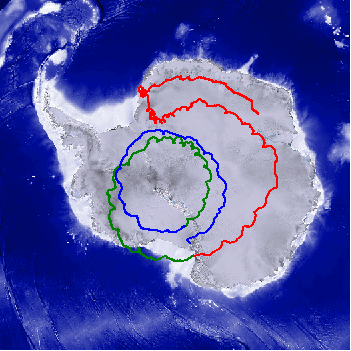
NASA’s GUSTO high altitude science balloon has now set a new endurance record for the most days of flight of a NASA balloon, flying more than 57 days over the continent of Antarctica at the south pole.

The map to the right shows GUSTO’s entire journey. The blue line was its first phrase of travel, the green its second phase, and the red its present stage.

GUSTO was launched at 1:30 a.m. EST Dec. 31 from the Long Duration Balloon Camp near McMurdo Station, Antarctica. The balloon mission not only broke the flight record but continues its path circumnavigating the South Pole. The stadium-sized zero-pressure scientific balloon and observatory are currently reaching altitudes above 125,000 feet. “The health of the balloon and the stratospheric winds are both contributing to the success of the mission so far,” said Hamilton. “The balloon and balloon systems have been performing beautifully, and we’re seeing no degradation in the performance of the balloon. The winds in the stratosphere have been very favorable and have provided stable conditions for extended flight.”

The previous NASA record was a balloon that it flew in 2012. GUSTO itself is being used to map the Milky Way’s carbon, oxygen, and nitrogen that is found between the stars in gas clouds.

0 comments
1 160 161 162 163 164 191