FCC approves use of Starlink for direct cell-to-satellite T-Mobile service

Despite objections from all of SpaceX’s competitors, the FCC has now approved the use of its Starlink constellation for direct cell-to-satellite service as part of T-Mobile’s cellular network.

The decision noted that many technical issues still must be cleared.

There are a few limitations on how this type of service (which the FCC calls “supplemental coverage from space,” or SCS) can work. Right now it officially has to operate as an extension of an existing terrestrial provider, in this case T-Mobile. That’s because the regulations on how you broadcast stuff in space are different from those for how you broadcast stuff to and from a phone (as opposed to a base station antenna). AT&T, for its part, is partnering with AST SpaceMobile.

SpaceX must also be sure that its service does not interfere with other services on the ground, while the ground services do not have to worry about whether they might interfere with the satellite signals.

Nonetheless, this approval likely means that soon users of T-Mobile (as well as AT&T) will no longer have any dead zones. When there are no cell towers available, their phones will simply access the orbiting constellations of either Starlink or AST SpaceMobile.

1 comment

ESA flies suborbital rocket from Swedish spaceport

Proposed spaceports surrounding Norwegian Sea

The European Space Agency (ESA) yesterday successfully flew a small suborbital rocket from the Esrange spaceport in Sweden, completing the sixteenth such flight since 1987.

The rocket reached an altitude of 256 km before falling back to Earth and providing approximately six minutes of microgravity to six scientific experiments onboard.

…All systems performed well during the flight and the valuable payloads were recovered by helicopter soon after landing. Flight samples of the experiments will now be returned for further analysis to science teams from Sweden, Germany and Finland, after more than two years of preparations.

This suborbital launch is only a preliminary of much bigger things to come. The rocket startup Firefly is building a launchpad at Esrange for orbital launches. Furthermore, the European startup MaiaSpace, a subsidary of ArianeGroup, plans to do tests of its partly reusable Maia rocket there in 2025.

0 comments

Judge dismisses lawsuit against SpaceX by activists

A federal judge has now thrown out a lawsuit that had been filed by anti-Musk activists in an attempt to halt all launches by SpaceX of its Starship/Superheavy rocket at Boca Chica.

U.S. District Judge Rolando Olvera issued his ruling last Thursday in response to the request filed by Save RGV on Oct. 9. The group has alleged that SpaceX’s water deluge system is releasing untreated industrial wastewater during launches and sought to halt the launches.

The water deluge system is designed to dampen the effects of Starship’s rocket engine blasts during liftoff and static fire engine testing.

“At the beginning of the Starship-Super Heavy Launch System’s development, it became evident that a deluge water system was necessary to protect the launch site and surrounding areas during launches,” Olvera wrote in the order. “A deluge water system sprays large quantities of potable water at the base of the spacecrafts during launch to prevent fires and reduce dispersal of dust and debris.

“Because of these dangers, Defendant cannot launch its spacecrafts without the deluge water system.”

SpaceX had argued that environmental reviews by both federal and state agencies had determined that the deluge system caused no harm. Olvera concurred, and also noted that to block launches would do significant harm to SpaceX and NASA’s entire lunar program.

This activist group, which represents almost no one in southern Texas, has no real interest in the environment. It filed this and other lawsuits simply as lawfare to try to stymie SpaceX for political reasons, knowing that we have more than seven decades of data at spaceports in Florida and California that prove rocket launches and deluge systems cause no environmental harm. In fact, they help wildlife by creating a large refuge where that wildlife can thrive.

Expect further similar lawsuits, all of which will be summarily dismissed afterward.

What I wonder is who is paying for this lawfare? SaveRGV likely doesn’t have the resources.

8 comments

Engineers restore Voyager-1 after communications issue

The Voyager missions
The routes the Voyager spacecraft have
taken since launch.

Engineers have now manged to resume normal communications with the Voyager-1 interplanetary probe after it had shut down its main communications channel last month due to low power levels.

Earlier this month, the team reactivated the X-band transmitter and then resumed collecting data the week of Nov. 18 from the four operating science instruments. Now engineers are completing a few remaining tasks to return Voyager 1 to the state it was in before the issue arose, such as resetting the system that synchronizes its three onboard computers.

The X-band transmitter had been shut off by the spacecraft’s fault protection system when engineers activated a heater on the spacecraft. Historically, if the fault protection system sensed that the probe had too little power available, it would automatically turn off systems not essential for keeping the spacecraft flying in order to keep power flowing to the critical systems. But the probes have already turned off all nonessential systems except for the science instruments. So the fault protection system turned off the X-band transmitter and turned on the S-band transmitter, which uses less power.

The S-band transmitter had not been used since 1981, so it took awhile for ground engineers to find the very weak signal. Once found however it was possible to recover operations, though those operations will likely continue for only another year or two. The spacecraft’s power supply is expected to finally run out sometime in ’26 or ’27.

0 comments

Two launches early today

China and SpaceX successfully completed launches early today.

First, the Chinese pseudo-company Landspace launched a new version of its Zhuque-2 methane-fueled rocket, lifting off from the Jiuquan spaceport in the northwest of China. The mission placed two test satellites into orbit, but more important, the launch tested the rocket’s new fuel-loading systems that copies SpaceX’s, loading the fuel quickly and cooling it to a lower temperature to increase its density and thus allow more to be packed into its tanks.

No word on where the rocket’s first stage crashed inside China.

SpaceX then placed 24 Starlink satellites into orbit, its Falcon 9 rocket lifting off from the Kennedy Space Center in Florida. The first stage completed its fifteenth flight, landing on a drone ship in the Atlantic.

The leaders in the 2024 launch race:

122 SpaceX
55 China
14 Russia
13 Rocket Lab

American private enterprise now leads the rest of the world combined in successful launches 141 to 82, while SpaceX by itself leads the entire world, including American companies, 122 to 101.

0 comments

November 26, 2024 Quick space links

Courtesy of BtB’s stringer Jay. This post is also an open thread. I welcome my readers to post any comments or additional links relating to any space issues, even if unrelated to the links below.

6 comments

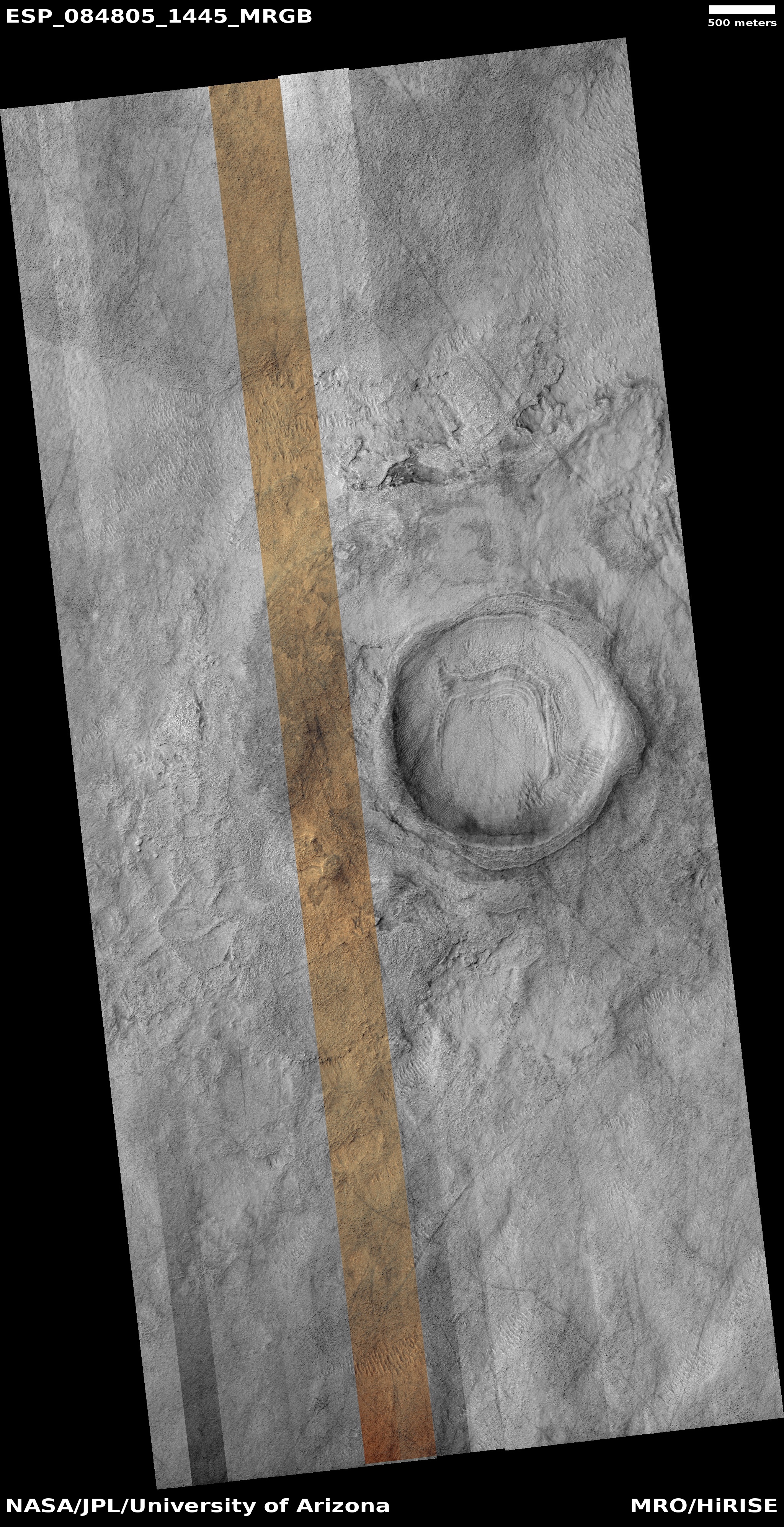
Etched terrain on Mars

Etched terrain on Mars
Click for original image.

Today’s cool image is another example of what I call a “What the heck!” image. The picture to the right, simply cropped to post here, was taken on September 22, 2024 by the high resolution camera on Mars Reconnaissance Orbiter (MRO).

It shows what the scientists label as “etched terrain,” an incredibly twisted and eroded landscape that to me actually defies description. In trying to research what scientists have learned and theorized about this terrain, it appears they think it is material that flowed over older terrain (thus its lack of many craters) that was subsequently eroded by later processes.

Why it eroded so strangely however is not really understood. It could have been caused by near-surface ice sublimated to the surface and thus causing many breaks, but since this terrain is located right on the equator in the dry tropics, it is a very long time since water was present here.
» Read more

1 comment

Hubble vs Webb, or why the universe’s secrets can only be uncovered by looking at things in many wavelengths

Hubble view of Sombrero galaxy
Click for original image.

Time for two cool images of the same galaxy! The picture above shows the Sombrero Galaxy as taken by the Hubble Space Telescope in 2003. The picture below is that same galaxy as seen by the Webb Space Telescope in the mid-infrared using false colors. From the press release:

In Webb’s mid-infrared view of the Sombrero galaxy, also known as Messier 104 (M104), the signature, glowing core seen in visible-light images does not shine, and instead a smooth inner disk is revealed. The sharp resolution of Webb’s MIRI (Mid-Infrared Instrument) also brings into focus details of the galaxy’s outer ring, providing insights into how the dust, an essential building block for astronomical objects in the universe, is distributed. The galaxy’s outer ring, which appeared smooth like a blanket in imaging from NASA’s retired Spitzer Space Telescope, shows intricate clumps in the infrared for the first time.

Researchers say the clumpy nature of the dust, where MIRI detects carbon-containing molecules called polycyclic aromatic hydrocarbons, can indicate the presence of young star-forming regions. However, unlike some galaxies studied with Webb … the Sombrero galaxy is not a particular hotbed of star formation. The rings of the Sombrero galaxy produce less than one solar mass of stars per year, in comparison to the Milky Way’s roughly two solar masses a year. Even the supermassive black hole, also known as an active galactic nucleus, at the center of the Sombrero galaxy is rather docile, even at a hefty 9-billion-solar masses. It’s classified as a low luminosity active galactic nucleus, slowly snacking on infalling material from the galaxy, while sending off a bright, relatively small, jet.

In infrared the galaxy’s middle bulge of stars practically vanishes, exposing the weak star-forming regions along galaxy’s disk.

Both images illustrate the challenge the universe presents us in understanding it. Basic facts are often and in fact almost always not evident to the naked eye. We always need to look deeper, in ways that at first do not seem obvious. This is why it is always dangerous to theorize with certainty any explanation too soon, as later data will always change that explanation. You can come up with an hypothesis, but you should always add the caveat that you really don’t know.

By the way, this concept applies not just to science. Having absolute certainty in anything will almost always cause you to look like a fool later. Better to always question yourself, because that will make it easier for you to find a better answer, sooner.

We need only look at the idiotic “mainstream press” during the months leading up to the November election to have an example of someone with certainty who is now exposed as an obvious fool.

The Sombrero Galaxy as seen by Webb
Click for original image.

4 comments

Firefly’s Blue Ghost lunar lander now targeting mid-January launch window

Landing sites on Moon

According to a media update from NASA yesterday, Firefly’s Blue Ghost lunar lander now targeting mid-January launch window for its unmanned mission to the Moon.

A six-day launch window opens no earlier than mid-January 2025 for the first Firefly Aerospace launch to the lunar surface.

The Blue Ghost flight, carrying 10 NASA science and technology instruments, will launch on a SpaceX Falcon 9 rocket from Launch Complex 39A at the agency’s Kennedy Space Center in Florida. Media prelaunch and launch activities will take place at NASA Kennedy.

The first quarter of 2025 will be a busy time for unmanned missions to the Moon. In addition to Firefly’s mission, the American startup Intuitive Machines also hopes to launch its Athena lander to the Moon’s south pole in February. Though it will launch after Blue Ghost, it will get to the Moon first, as it is taking a more direct week-long route compared to Blue Ghost’s 45-day journey. In addition, the Japanese company Ispace is targeting its own January launch for its Resilience lander.

If all three lift off as planned, there will be three landers heading for the Moon in early 2025.

0 comments

Engine for Japan’s new Epsilon-S rocket explodes during static fire test

For the second time in a row an engine for Japan’s new Epsilon-S rocket has exploded during a static fire test.

The test was conducted inside of the restricted area at Japan’s Tanegashima Space Center in southwestern Japan, and the Japan Aerospace Exploration Agency is investigating, Chief Cabinet Secretary Yoshimasa Hayashi told reporters.

An Epsilon project manager, Takayuki Imoto, told an online press conference from Tanegashina that the explosion occurred 49 seconds into the planned two-minute test, causing fire and scattering broken parts of the engine and damaging the facility.

The Epsilon-S is being built by Japan’s space agency JAXA. It is intended to replace the solid-fueled Epsilon rocket that was initially conceived in 2013 to lower launch costs and provide JAXA with a rocket that could complete with the many new smallsat rocket startups worldwide. That rocket however only launched six times and never achieved its goals. JAXA had been targeting March for the first launch of Epsilon-S, but that is now unlikely, especially considering these two engine failures during tests.

1 comment

France to resume suborbital launches at French Guiana

Now that France’s space agency CNES has taken the management of its French Guiana spaceport back from the European Space Agency’s Arianespace government company, it has been moving to make the spaceport more attractive to multiple future launch customers. Previously it announced that it is offering launchpads to multiple new rocket startups. Now it has announced that has signed a contract with the French startup Optus Aerospace to reopen its closed suborbital launchpad for the first time in decades.

Officially inaugurated in 1968, the Ensemble de Lancement Fusées-Sondes (ELFS) launch complex hosted the Guiana Space Centre’s first launch on 9 April 1968, with a Véronique sounding rocket that reached an altitude of 113 kilometres. Between 1968 and 1992, more than 350 sounding rockets were launched from the facility.

On 25 November, CNES announced that it had signed a contract with Opus Aerospace to use the ELFS facility for the launch of its Mésange rocket.

In other words, under the control of a government entity, Arianespace, which also controlled all European launches for decades, the variety of launches declined. As soon as control was lifted from this government monopoly however the possibilities expanded quickly.

4 comments
1 16 17 18 19 20 191