
Returning to the Canyon again today
No posting again for much of today, as my trip to the Grand Canyon continues. We return to Tucson tonight, so things will return to normal tomorrow.
No posting again for much of today, as my trip to the Grand Canyon continues. We return to Tucson tonight, so things will return to normal tomorrow.
SpaceX today successfully launched twice. First a Falcon 9 rocket lifted off from Kennedy Space Center in Florida, placing a South Korean communications satellite in geosynchronous orbit. The first stage completed its 23rd flight, landing back at Cape Canaveral.
Then, several hours later, a Falcon 9 lifted off from Cape Canaveral, placing 24 Starlink satellites in orbit. The first stage completed its 12th flight, landing on a drone ship in the Atlantic.
UPDATE: China also completed a launch earlier today, its Lijian-1 rocket lifting off from its “commercial” launchpad at its Jiuquan spaceport in northwest China. No word on where the lower stages crashed inside China. The payload was fifteen satellites, including a remote-sensing satellite for Oman.
The leaders in the 2024 launch race:
112 SpaceX
51 China
13 Russia
12 Rocket Lab
American private enterprise now leads the rest of the world combined in successful launches 130 to 76, while SpaceX by itself leads the entire world, including American companies, 112 to 94.
An evening pause: Performed sometime in the 1970s.
Hat tip Doug Johnson.
Expect no posts until tonight, as I take my brother and his wife to see the big ditch for their first time.
Skynet-1A, a British satellite launched in 1969 and out of commission since the 1970s, has now been found in an unexpected location in geosynchronous orbit, and no one knows how it got there.
Launched in 1969, just a few months after humans first set foot on the Moon, Skynet-1A was put high above Africa’s east coast to relay communications for British forces. When the spacecraft ceased working a few years later, gravity might have been expected to pull it even further to the east, out over the Indian Ocean.
But today, curiously, Skynet-1A is actually half a planet away, in a position 22,369 miles (36,000km) above the Americas. Orbital mechanics mean it’s unlikely the half-tonne military spacecraft simply drifted to its current location. Almost certainly, it was commanded to fire its thrusters in the mid-1970s to take it westwards. The question is who that was and with what authority and purpose?
The article attempts to suggest the orbit change was done for some nefarious purpose, but the most likely explanation is that at some point the British engineers who operated it ordered the required engine burns, but the records of that work are now lost.
Though the present location poses some problems for other geosynchronous satellites, Skynet-1A also now offers a great opportunity for a mission demonstrating a way to clean up junk in these orbits.
China today successfully launched four new remote-sensing satellites, its Long March 2C rocket lifting off from its Jiuquan spaceport in northwest China.
No word on where the rocket’s lower stages, which use very toxic hypergoic fuels, crashed.
The leaders in the 2024 launch race:
110 SpaceX
50 China
13 Russia
12 Rocket Lab
American private enterprise still leads the rest of the world combined in successful launches 128 to 76, while SpaceX by itself still leads the entire world, including American companies, 110 to 94.
SpaceX tonight launched another 20 Starlink satellites, its Falcon 9 rocket lifting off from Vandenberg in California.
Of the 20 satellites, 13 were the direct-to-cellphone version. The first stage completed its eleventh flight, landing on a drone ship in the Pacific.
The leaders in the 2024 launch race:
110 SpaceX
49 China
13 Russia
12 Rocket Lab
American private enterprise now leads the rest of the world combined in successful launches 128 to 75, while SpaceX by itself now leads the entire world, including American companies, 110 to 93.
Embedded below the fold in two parts. Both segments are specifically focused on looking at the changes in America’s space policy due to the election of Donald Trump.
To listen to all of John Batchelor’s podcasts, go here.
» Read more
An evening pause: Performed live 1980. A good song to start the weekend.
Hat tip Judd Clark.
With the first launch of Sierra Space’s first Dream Chaser reusable unmanned cargo mini-shuttle, Tenacity, now scheduled for May 2025, the company has announced that it is beginning work on a second cargo spaceplane, dubbed Reverence, along with a mission control center to operate its fleet in orbit.
Sierra Space spokesperson Alex Walker shared the new May 2025 estimate and said work on Reverence, also known as DC-102, will resume once the team returns to Colorado — but declined to clarify when that would happen. At that point, Walker said, it will likely be another 18 months before the second spaceplane is complete. In addition to the fleet of cargo-carrying craft, Sierra Space is also working on a crewed variant of the vessel, labeled the DC-200 series, and a national security DC-300 variant.
Company officials say each mini-shuttle is good for 15 flights, so having both vehicles gives the company a total of 30 flights to sell to various space station and orbital customers.
Selling to others outside NASA may be necessary, because Tenacity is four-plus years behind schedule. By the time it begins flying ISS will already be approaching retirement in only a few short years.
The company intends these new Dream Chaser projects to work in tandem with its LIFE inflatable modules, which are presently being developed as part of the Blue Origin-led Orbital Reef space station. And while much of work on the rest of that station appears moribund, it appears that Sierra is developing everything needed for its own space station. We should therefore not be surprised if Sierra decides to bid on NASA’s next space station funding round independent entirely of the Orbital Reef partnership.
It certainly is assembling all the pieces needed for a station, without any help from Blue Origin.
Courtesy of BtB’s stringer Jay. This post is also an open thread. I welcome my readers to post any comments or additional links relating to any space issues, even if unrelated to the links below.
My posting continues to be light for numerous reasons. Though all is generally well, the present condition of my eyes sometimes makes reading and writing difficult. Today was a particularly bad day, the double vision and blind spot making if very hard to see the words I put on the screen. Sorry.
Note too that next week posting will also be light, because I have relatives visiting from Israel and I am taking them to see the Grand Canyon for their first time. I might be able to post, but can make no guarantees.
My apologizes to my loyal readers for all this. but sometimes life gets in the way.
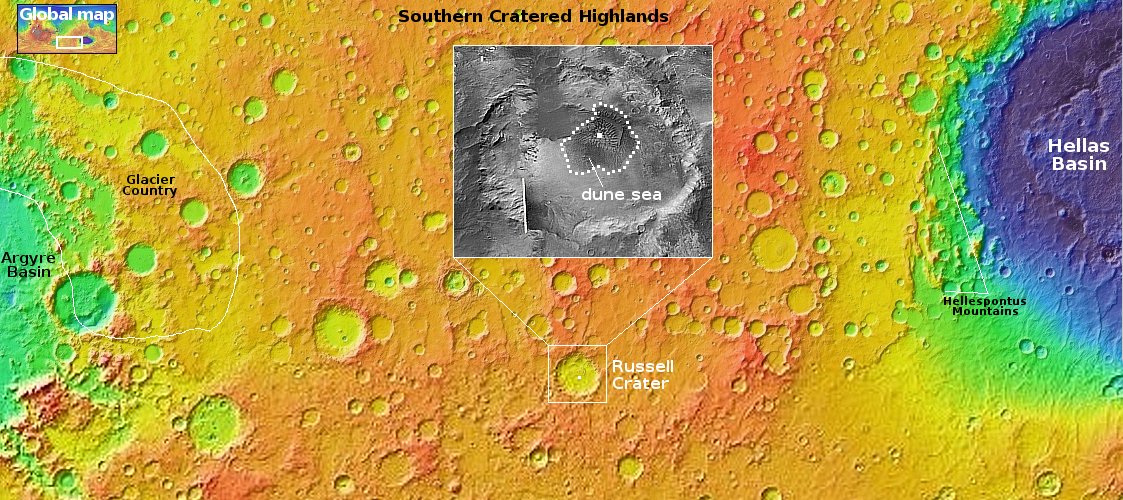

Cool image time! The picture to the right, cropped, reduced, and sharpened to post here, was taken on July 17, 2024 by the high resolution camera on Mars Reconnaissance Orbiter (MRO).
The white dot on the overview map above marks the location, inside a thirty-mile-wide dune sea, or erg, that sits in the center of the floor of 80-mile-wide Russell Crater.
That erg is interesting in that it appears the dunes get larger and larger as you move from the perimeter to its center. Thus, the dunes in the picture are called mega-dunes, about 200-feet-high. They dwarf the smaller dunes at the erg’s edge.
This picture was taken as part of a long term monitoring program to track the coming and going of seasonal dry ice frost on these dunes. It is summer when this picture was taken, so there is relatively little visible frost, though the bright blue areas in the color strip could possibly be the last remnants from winter. In winter, data suggests the entire surface of these dunes is covered by dry ice frost.
As the location is at 54 degrees south latitude, it likely sits at the northernmost edge of the southern dry ice mantle that in winter covers each of the Martian poles, down to about 60 degrees latitude.
After the Daily Mail in the UK reported that it appeared that Sunita Williams on ISS appeared “gaunt” in recent pictures and might have health issues due to her unexpectedly long stay in space, NASA today issued a denial, stating unequivocally that she “is in good health.”
The pictures used to suggest she is “gaunt” are mostly based on the shape of her face, but this means nothing. Weightlessness shifts things about. The Daily Mail report used the analysis of those photos by a doctor in Seattle.
While the two have put on a positive front in their public comments and interviews, a recent photo tells a different story, according to Dr Vinay Gupta, a pulmonologist and veteran in Seattle. Dr Gupta told DailyMail.com: “What you’re seeing there in that picture is somebody that I think is experiencing the natural stresses of living at a very high altitude, even in a pressurized cabin, for extended periods. Her cheeks appear a bit sunken – and usually it happens when you’ve had sort of total body weight loss,” Dr Gupta added.
“I think what I can discern by her face and her cheeks being sunken in is that [she] has probably been at a significant [calorie] deficit for a while.”
As a general rule, it is considered to be unethical for a doctor to make any diagnosis from a distance based on press reports. Gupta might be right, but more likely he is basing these opinions on very incomplete data. In this case I would generally trust NASA’s denial, especially becauase Williams is a very experienced astronaut who has done previous long missions on ISS.
The space station startup Vast has announced it has now signed an agreement with the Czech government to possibly fly one of its astronauts to the company’s Haven space stations, either the smaller Haven-1 or the full size Haven-2 to follow.
Any future mission with Vast could see Aleš Svoboda, one of 12 reserve astronauts selected by the European Space Agency in November 2022, become the second Czech astronaut. Svoboda has been a focal point for the Czech government’s efforts to stimulate growth in the Czech space industry and inspire the country’s young people to pursue STEM careers, crystallized by the launch of the Czech Journey to Space project in June 2024.
In September 2024 the Czech government had signed a similar agreement with Axiom. Under that agreement, Svoboda would fly to ISS. This new deal opens the possibility he will fly elsewhere.
It is very possible the Czechs want to do both, and are covering their bets by signing both agreements. In either case, no mission dates have been set.
An evening pause: From the heart of the 1960s and 1970s.
Hat tip Cotour.
SpaceX today launched 23 Starlink satellites, its Falcon 9 rocket lifting off from Cape Canaveral.
The first stage completed its third flight, landing on a drone ship in the Atlantic.
The leaders in the 2024 launch race:
109 SpaceX
49 China
13 Russia
12 Rocket Lab
American private enterprise now leads the rest of the world combined in successful launches 127 to 75, while SpaceX by itself now leads the entire world, including American companies, 109 to 93.
Courtesy of BtB’s stringer Jay. This post is also an open thread. I welcome my readers to post any comments or additional links relating to any space issues, even if unrelated to the links below.
Posting today will continue to be light. I am wearing bandaging on one wrist that makes typing very slow and extremely difficult. All will go back to normal tomorrow.
SpaceX today announced its plan to fly the next and sixth orbital test flight of its Starship/Superheavy rocket on November 18th, less than two weeks from today.
The next Starship flight test aims to expand the envelope on ship and booster capabilities and get closer to bringing reuse of the entire system online. Objectives include the booster once again returning to the launch site for catch, reigniting a ship Raptor engine while in space, and testing a suite of heatshield experiments and maneuvering changes for ship reentry and descent over the Indian Ocean.
The success of the first catch attempt demonstrated the design feasibility while providing valuable data to continue improving hardware and software performance. Hardware upgrades for this flight add additional redundancy to booster propulsion systems, increase structural strength at key areas, and shorten the timeline to offload propellants from the booster following a successful catch. Mission designers also updated software controls and commit criteria for the booster’s launch and return.
As noted earlier, the FAA has made it clear that no new license is required since this flight plan is essentially the same as the fifth flight.
I will be unavailable until the afternoon, due to a non-emergency medical procedure.
An evening pause: One of the sharpest and clearest performances of this classic Dire Staits song.
Hat tip Mike Nelson.