Eric Burdon & War – Spill The Wine
An evening pause: Some funk performed live 1970.
Hat tip Ferris.
An evening pause: Some funk performed live 1970.
Hat tip Ferris.
Courtesy of BtB’s stringer Jay, except for the first, which came from several readers. This post is also an open thread. I welcome my readers to post any comments or additional links relating to any space issues, even if unrelated to the links below.

Figure 1 from the study, and possibly its most
damning datapoint. ACA stands for Affordable
Care Act, Obamacare’s official name.
A new study comparing the promises made about Obamacare by President Barack Obama and the Democrats in 2010 with the real world results more than a decade later shows that either those promises were a pack of lies, or were pushed by politicians so ignorant of the basic facts of economy that we would have been better off having the legislation written and approved by blind voles.
“Obamacare has failed in every particular – it failed to make health care more affordable; it failed to improve the health of Americans; it piled on an enormous amount of additional debt on taxpayers; it has principally enriched massive insurance company conglomerates, and it now serves as a major impediment to real heath care reforms that would empower patients and doctors,” Phil Kerpen, American Commitment and Unleash Prosperity president and one of the study’s co-authors, told the DCNF. “As we show in this paper, every single promise that was made to pass this law turned out to be false.”
You can read the actual study here. From its executive summary:
» Read more
In voting yesterday to reject a plan by the military to increase the number of launches at Vandenberg Space Force Base in California, members of the California Coastal Commission admitted openly they did so because they do not like Elon Musk and his publicly stated political preferences.
The California Coastal Commission on Thursday rejected the Air Force’s plan to give SpaceX permission to launch up to 50 rockets a year from Vandenberg Air Force Base in Santa Barbara County.
“Elon Musk is hopping about the country, spewing and tweeting political falsehoods and attacking FEMA while claiming his desire to help the hurricane victims with free Starlink access to the internet,” Commissioner Gretchen Newsom said at the meeting in San Diego.
…“I really appreciate the work of the Space Force,” said Commission Chair Caryl Hart. “But here we’re dealing with a company, the head of which has aggressively injected himself into the presidential race and he’s managed a company in a way that was just described by Commissioner Newsom that I find to be very disturbing.”
It must be noted that this vote is not legally binding on the military. Though it has always tried to work in cooperation with this commission, it has the right to decide for itself how many launches it wants to allow out of Vandenberg. Whether it will defy the commission however is uncertain, and likely depends entirely on who wins the presidential election. If Harris wins, she will likely order the Space Force to not only obey the commission but to further limit launches by SpaceX at Vandenberg. If Trump wins, he will likely tell the Space Force to go ahead and expand operations, ignoring the immoral political machinations of these commissioners.
And it must be emphasized how immoral and improper these commissioners are. Their task is to regulate the use of the California coast in order to protect it for all future users, from beach-goers to rocket companies. It is not their right to block the coast’s use to certain individuals simply because those individuals have expressed political views they oppose. Not only does this violate Musk’s first amendment rights, it is an outright abuse of power.
If anyone in California reading this article wishes to tell these commissioners what they think of their actions yesterday, you can find their contact information here.
In an obvious attempt to block SpaceX’s effort to do the fifth Starship/Superheavy orbital test launch this coming weekend, a fringe activist group dubbed Save RGV has now sued the company, accusing it of using industrial wastewater in the launchpad’s deluge system that acts to minimize damage to the pad.
The suit, filed Wednesday in U.S. District Court for the Southern District of Texas, Brownsville Division, under the Clean Water Act (CWA), seeks declaratory and injunctive relief, the imposition of civil penalties and “other appropriate relief” to bring a halt to SpaceX’s “recurring, unpermitted discharges of untreated industrial wastewater from the deluge system at the SpaceX Boca Chica Launch Site into waters of the United States,” according to the suit.
According to SpaceX, water in the deluge system is potable drinking water. Moreover, in previous launches the company obtained all the proper licenses for its use, only to have the EPA subsequently step in and claim SpaceX had “violated the Clean Water Act in deploying the deluge system. The EPA did not assess a fine, but did order SpaceX to comply with federal regulations.” That action has forced the FAA to delay issuing any further launch licenses, even as of today.
I call Save RGV a fringe group because it has almost no support from within the Rio Grande Valley surrounding Boca Chica and Brownsville. That community is overwhelming in support of SpaceX’s efforts, and wants it to grow and expand, because of all the jobs and money it is bringing to the region.
This suit is clearly an attempt to forestall any launch license approval the FAA might want to issue for SpaceX’s desire to launch this weekend, on October 13, 2024. SpaceX is ready to go that day, and is now merely waiting for the FAA to “go!”.
During the on-going manned test flights of Boom’s one-third scale prototype supersonic plane, dubbed XB-1, the maximum flight speeds have been steadily increased as they company tests the plane’s design and structure.
[On October 7th on the fifth manned flight] Chief Test Pilot Tristan “Geppetto” Brandenburg set a record for the XB-1 shod with GE J85-15 turbojet engines, taking it up to 17,800 ft (5,425 m) and as fast as Mach 0.69 (428 knots / 492 mph / 791 km/h, true airspeed) over its 50-minute-long test flight, marking the highest and the fastest it’s flown so far.
Boom tested its flutter excitation system (FES) at Mach 0.6 … which must be unnerving for a test pilot. The FES is a system that deliberately induces vibrations into an aircraft’s airframe to help engineers find potential structural issues, particularly at higher speeds. They do this so structural issues (that could cause flutter) don’t rear their ugly head mid-flight.
The plan is to do five more test flights before attempted to break the sound barrier.
At the completion of this testing the company will then begin manufacture of its full scale supersonic passenger plane, dubbed Overture, that will carry up to 80 passengers and will sell to airlines. It already has contracts and financial support from a number of major airlines, including United and Japan Airlines.
Arianespace today announced that the next Vega-C launch is now scheduled for December 3, 2024, the first in more than two years since a launch failure in 2022.
The failure was caused by a design flaw in the rocket’s upper stage engine nozzle. In attempting to fix the problem, the first redesign failed as well during a static fire test in 2023. The second redesign has now passed all engine tests.
This launch — of a European Space Agency (ESA) radar satellite — is being managed by Arianespace, the commercial arm of ESA that is presently being phased out. Beginning late next year the rocket’s manufacturer, Avio, will regain complete control of its rocket and will be able to market it internationally, no longer required to deal with this unneeded government middleman. Expect the launch price to drop at that point to make Vega-C more competitive.
Capitalism in space? NATO officials at a meeting this week proposed issuing a new space strategy next year, designed to deal with the changing relationship in space between government and private enterprise.
During the Commercial Space Forum at NATO, participants discussed the threats they face, from cyber-attacks against ground systems, to jamming or spoofing of GPS and other satellite communications signals. They also addressed the importance of further investment in areas such as cybersecurity and sharing information about threats.
NATO Assistant Secretary General for Defence Investment, Ms Tarja Jaakkola, highlighted the need for a new relationship between the military and the commercial sector, “where both sides can learn from another, and where we can support and harness the entrepreneurial spirit and technological innovation essential to keep our defences strong and effective.”
More information here. It appears that NATO officials have realized that they can no longer do things as they have for the past half century, whereby they design, build, and own the space assets they launch. They must instead do what NASA and the Pentagon has been doing, become the customer that buys such products from the private enterprise.
Capitalism in space: The United Arab Emirates (UAE) yesterday announced that it has awarded the launch contract for its first unmanned probe to the asteroid belt to the Japanese company Mitsuibishi and its new H3 rocket.
The UAE Space Agency (UAESA) announced Oct. 10 it selected Mitsubishi Heavy Industries to launch its Emirates Mission to the Asteroid Belt (EMA) on an H3 rocket in the first quarter of 2028. Terms of the contract were not disclosed.
The spacecraft, also known as MBR Explorer after Sheikh Mohammed bin Rashid Al Maktoum, Crown Prince of Dubai, will fly by six main belt asteroids between 2030 and 2033 before rendezvousing on a seventh, Justitia, in 2034, later deploying a lander.
This mission is the third that the UAE has selected MHI to launch. An H-2A rocket launched the Emirates Mars Mission, a Mars orbiter, in 2020, while KhalifaSat, a remote sensing satellite, launched as a secondary payload on another H-2A in 2018.
What makes this launch contract different from the previous two is that the winner is Mitsubishi. Previous awards went through Japan’s space agency JAXA, which appeared to manage the H2A entirely. Now, Mitsubishi is in control, and is working directly with its customer.
This change proves that Japan’s government effort to promote private enterprise in space is real, that though it has been slow to wrest bureaucratic control from JAXA, that wresting is happening nonetheless.
An evening pause: Performed live 2019.
Hat tip Judd Clark.
Courtesy of BtB’s stringer Jay, who also deserves thanks for cluing me on the Vast, EPA, and Chinese launch stories posted earlier. This post is also an open thread. I welcome my readers to post any comments or additional links relating to any space issues, even if unrelated to the links below.
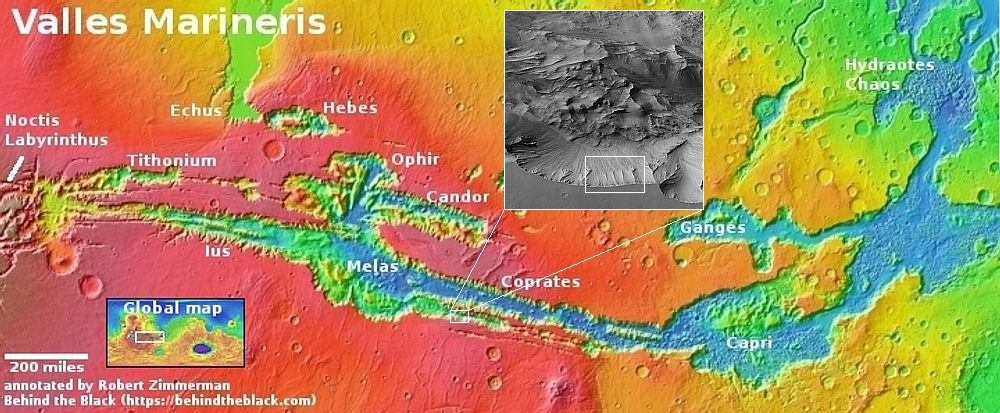
Cool image time! The picture to the right, cropped, reduced, and sharpened to post here, was taken on May 21, 2024 by the high resolution camera on Mars Reconnaissance Orbiter (MRO). Labeled merely as a “terrain sample,” it was likely taken not as part of any specific research project but chosen by the camera team to fill a gap in the camera’s schedule in order to maintain its proper temperature.
When they do this they try to pick a target that is somewhat interesting, though it is not always possible. In this case it appears they succeeded in capturing a location filled with lots of puzzling stuff, including low 60-to-80-foot-high mesas with either flat- or hollow-tops, shallow craters that appear almost buried, and other craters that appear so deep and shadowed that it is even possible these are skylights into underground caves.
In between these features the flat landscape has a scattering of ripple dunes, all oriented in the same direction and thus implying that the prevailing winds are or were blowing from the northeast to the southwest.
» Read more