
Emerson Lake & Palmer – Show Me the Way To Go Home
An evening pause: Hat tip James Street.
An evening pause: Hat tip James Street.
Courtesy of BtB’s stringer Jay. This post is also an open thread. I welcome my readers to post any comments or additional links relating to any space issues, even if unrelated to the links below.
Though the tweet congratulates SpaceX for the 300th reuse of a Falcon 9 first stage this past weekend, the video (which is quite excellent) is of a landing earlier this year.
The agency was created out of an older government agency, the National Advisory Committee for Aeronautics (NACA). Eisenhower had not been enthused by this idea (seeing it as another example of the military-industrial complex teaming up with the federal bureaucracy for their own crony deals), but the politics of the Cold War forced it upon him.

Click for original image.
Cool image time! The picture to the right, rotated, cropped, reduced, and enhanced to post here, was taken on February 9, 2024 by the high resolution camera on Mars Reconnaissance Orbiter (MRO). It shows a good example of the typically rough region inside the southern cratered highlands of Mars.
Note the ripple dunes that fill the low areas. The volcanic ash from Mars’ past volcanic history has become trapped here, with those ripple dunes suggesting the direction of the prevailing winds to the southeast.
The bright areas also suggest there is interesting mineralogy just below the surface. The 100-foot-high mesa near the picture’s top suggests a lot of erosion has occurred here, with its top suggesting the elevation of the surface a long time ago.
The most interesting feature however is the meandering ridge that starts at the lower right and weaves to the upper left.
» Read more

Reason 2,458,210,539 to stop using Google: We now have solid evidence that Google monitors and censors emails sent out using either Gmail or to Googlegroup listservs, because it censored emails discussing Robert F. Kennedy’s independent candidacy for the presidency.
The story at the link describes how the author, Lori Wentz of the Brownstone Institute, on June 27, 2024 emailed to a Googlegroups listserv a link to an X livestream where Kennedy would give his own answers to the questions in the live debate between Trump and Biden on June 28, 2024. In doing so the author also included some of her own thoughts, which resulted in an exchange on the political listserv about the subject. She subsequently got the following notice from Googlegroups:
“We’re letting you know that we’ve permanently removed [your] content…An external report flagged the content for illegal or policy violations. As a result, our legal content and policy standards team removed the content for the following reason: unwanted content.”
Wentz had no way of finding out what that “unwanted content” was, as Googlegroups did not provide this essential information, instead informing her that she would simply have “to pursue your claims in court.”
» Read more
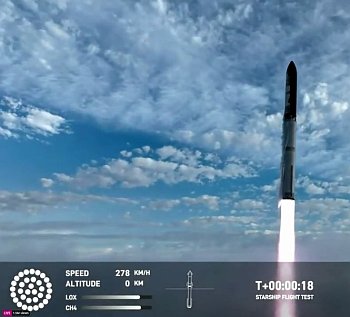
Superheavy/Starship lifting off on March 14, 2024
In advance of several planned public meetings, the FAA today released [pdf] its proposed environmental assessment of SpaceX’s proposal to increase the number of orbital launches allowed per year from Boca Chica from 5 to 25.
The report makes for some fascinating reading. First and foremost it indicates the FAA’s general approval of this new launch cadence. That approval however must also be given by the public in comments at those meetings, as well as by the National Park Service (NPS), U.S. Fish and Wildlife Service (USFWS), the U.S. Coast Guard (USCG), and the National Aeronautics and Space Administration (NASA). Expect serious objections from the NPS and USFSW, both of which have acted to slow or stop SpaceX in the past, when each was given the opportunity. Both have a new opportunity here.
» Read more
Surprise, surprise! As expected after NASA proposed major cuts in several missions, such as the Chandra Space Telescope and the OSAM demo robotic refueling mission, the subcommittee of the Senate Appropriations Committee has rejected those cuts and instead proposed that NASA not only get everything it asked for, it be forced to take more money than it requested.
I am certain that NASA is not going to complain, as this was its plan from day one. The cancellation of Chandra was intended as a toddler’s tantrum that our weak Congress was certain to bow to and come up with the cash. It has now done so.
The report directs NASA to spend at least $98.3 million on Hubble and up to $72.1 million on Chandra, similar to the budgets for those missions in recent years, emphasizing the ability of the telescopes to work in conjunction with the James Webb Space Telescope.
In this case the Senate action makes some sense, as these cuts would have been penny wise and pound foolish. But NASA knew that. If the Senate was really interested in controlling the budget (which it is not) it would have funded Chandra and Hubble as described, but demanded cuts from NASA elsewhere.
Instead the Senate committee not only demands that these telescopes be maintained, it doles out extra money the nation doesn’t have for other projects that NASA wanted to cut for entirely legitimate reasons. OSAM for example was conceived more than a decade ago as a mission designed to demonstrate robotic refueling in space. After spending a billion and a decade, it had still not flown, and during that time private companies had not only successfully demonstrated this capability several times for far less, they had done so in a far simpler and more profitable manner. The technical need for OSAM was gone. Why spend the additional billion we can’t afford for a project that will prove nothing?
Congress, especially the Senate, likes wasting money however, and so the appropriations committee in an entirely bi-partisan effort is pushing to revive OSAM, as well as several other projects that have either gone over budget or NASA had deemed correctly were unaffordable.
The dark age has already begun in many ways, but its official start will be marked by future historians by the date the United States undergoes a full financial collapse, due to its government’s unwillingness to rein in a national debt that is now in the many many trillions and growing uncontrollably each day.
Boeing announced today that engineers have successfully completed a full series of static hot fire engine burns testing all of Starliner’s attitude thrusters while still dockecd to ISS.
The one-pulse firings were designed to confirm the performance of each thruster. Aft-facing thrusters were fired for 1.2 seconds and all others for .40 seconds. Between each firing, the team reviewed real-time data and all thrusters performed at peak thrust rating values, ranging from 97-102%. The helium system also remained stable. Additionally, an RCS oxidizer isolation valve that was not fully seated previously, was cycled several times during today’s testing and is now operating normally.
This is the second time the spacecraft has been hot fired successfully while docked, an integrated operation the station and Starliner teams will also conduct during future long-duration missions.
This result is not a surprise, based on the information provided during the most recent briefing. It confirms the data obtained during previous hot fire tests both on a Starliner on the ground and the Starliner docked to ISS. Not only does it appear that Boeing has enough information to fix this problem so it does not occur again, it has proven unequivocally that these thrusters as well as the helium leaks inside the thruster systems pose no unusual risk for a return in the capsule.
NASA and Boeing have a planned review of these results this coming week, when we should expect them to name a return date, likely sometime in the first two weeks of August.
I had my days wrong last night. In the previous post I said that SpaceX had another launch scheduled for later tonight. In actuality that launch was today, but in the wee hours early this morning. Four hours after a Falcon 9 placed 23 Starlink satellites into orbit from Cape Canaveral, another Falcon 9 placed 20 Starlink satellites into orbit from Vandenberg in California. That’s three launches in just one day.
The first stage completed its seventeenth launch, landing on a drone ship in the Pacific.
The leaders in the 2024 launch race:
74 SpaceX
31 China
8 Rocket Lab
8 Russia
American private enterprise now leads the rest of the world combined in successful launches 86 to 47, while SpaceX by itself leads the entire world combined, including American companies, 74 to 59.
SpaceX tonight completed its second launch in two nights since resuming launches after a two-week halt after the July 11th upper stage launch failure, its Falcon 9 rocket lifting off from Cape Canaveral and placing another 23 Starlink satellites in orbit.
The first stage completed its fourteenth launch, landing on a drone ship in the Atlantic.
The leaders in the 2024 launch race:
73 SpaceX
31 China
8 Rocket Lab
8 Russia
American private enterprise now leads the rest of the world combined in successful launches 85 to 47, while SpaceX by itself leads the entire world combined, including American companies, 73 to 59.
SpaceX has another launch scheduled for tomorrow night.
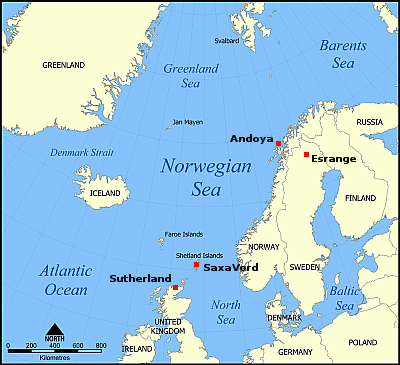
Proposed spaceports surrounding Norwegian Sea.
An effort by the proposed Sutherland spaceport on the north coast of Scotland to place a tracking dish on a nearby peak — where other telecommunication dishes are already installed — is now being fought by local billionaire landowner Anders Holch Povlsen, who had previously tried and failed to stop construction of the spaceport entirely.
The spaceport’s main customer, the rocket startup Orbex, has already experienced endless red tape from the United Kingdom’s Civil Aviation Authority (CAA). It applied for a launch license in February 2022, and almost two-and-a-half years later still has not gotten an approval. It had previously announced a first launch that year, and has been stymied since, not only by the CAA but by local authorities who have demanded it make many changes to its construction plans.
Povlsen, who has himself invested in the competing Saxavord spaceport on the Shetland Islands, has repeatedly acted to block Sutherland, so far with no success. This new suit is especially absurd — claiming the new dish would harm the local landscape — which is why the local councils appear ready to reject it.
» Read more
As part of the changes SpaceX is instituting to the de-orbit procedures of its Dragon capsules in order to end any chance parts of the service module will fall in inhabited areas (as has happened several times in the past few years) the company will be shifting all manned splashdowns to the Pacific Ocean.
Repeated issues with large chunks of debris from Dragon — “trunks” where the fuel and electrical supplies are held — have repeatedly crashed down in areas ranging from Australia to North Carolina. One measure to fix that will be tasking future spacecraft after Crew-9, perhaps as soon as Crew-10, to splash down on the U.S. Pacific coast, SpaceX said during a press conference today (July 26).
“What we’ll do is we’ll implement a software change to complete the deorbit burn before jettisoning the trunk, like we did with Dragon-1, and then the trunk will intentionally land […] in an unpopulated area of the ocean,” Sarah Walker, SpaceX’s director of Dragon mission management, said in the livestreamed briefing. “So to make this change possible, we’ll move a Dragon recovery vessel to the Pacific sometime next year.”
Crew-9 is now scheduled to launch to ISS on August 18th on a six month mission, landing sometime in February 2025. Crew-10 would launch about that time and land sometime in August, 2025.
Side note: The announcement yesterday of August 18th for the launch of the next Dragon manned mission suggests NASA is now confident it can determine a date prior to that for returning Starliner. This reinforces the fact that the astronauts and Starliner are not “stranded” on the station, and any news source that states or even implies such a thing indicates it is a place where you are likely getting junk news, on all its stories.
SpaceX tonight successfully resumed launches of its Falcon 9 rocket after a July 11, 2024 launch was a failure due to an engine leak in the upper stage. The rocket lifted off from the Kennedy Space Center in Florida, successfully placing 23 Starlink satellites into orbit.
The first stage completed its seventeenth flight, landing on a drone ship in the Atlantic.
The leaders in the 2024 launch race:
72 SpaceX
31 China
8 Rocket Lab
8 Russia
American private enterprise now leads the rest of the world combined in successful launches 84 to 47, while SpaceX by itself leads the entire world combined, including American companies, 72 to 59.
SpaceX has additional launches scheduled for tomorrow and the next day, so these numbers are only temporary.
Embedded below the fold in two parts.
To listen to all of John Batchelor’s podcasts, go here.
» Read more
An evening pause: Something to start the weekend, brought to you by a six-year-old. Performed live 2013.
Hat tip Mike Nelson.
Courtesy of BtB’s stringer Jay. This post is also an open thread. I welcome my readers to post any comments or additional links relating to any space issues, even if unrelated to the links below.
This is not their actual first stage, but an engineering test stage for learning how to land vertically.
The author notes that with the September 29th launch date closing in, the lack of paint is intriguing. If this component is for that launch, it seems very late to only now be delivering it for assembly.

Kamala Harris as she enthusiaticallly joked on television
about killing Donald Trump, Mike Pence, and Jeff Sessions
A just released scathing and horrifying report put together by the National Alliance of Retired and Active Duty FBI Special Agents and Analysts has found extensive nationwide evidence that local law enforcement officers so distrust the FBI they will no longer cooperate with it in any way.
You can read the report here. It came to the following ten conclusions:
For conservatives who have been paying attention for the past decade, none of these conclusions are a surprise. The FBI, as well as the CIA, ATF, the Secret Service as well as the entire intelligence and security community in the federal government have not only demonstrated obvious incompetence in their basic jobs since Obama was president, these agencies have clearly become partisan weaponized tools for the Democratic Party.
» Read more

Click for original image.
A press release from JPL yesterday described an intriguing rock (image to the right) that the Mars rover Perseverance science team has recently been studying, and in doing so repeatedly hinted that its features suggest the possibility of past Martian life. From its first two paragraphs:
A vein-filled rock is catching the eye of the science team of NASA’s Perseverance rover. Nicknamed “Cheyava Falls” by the team, the arrowhead-shaped rock contains fascinating traits that may bear on the question of whether Mars was home to microscopic life in the distant past.
Analysis by instruments aboard the rover indicates the rock possesses qualities that fit the definition of a possible indicator of ancient life. The rock exhibits chemical signatures and structures that could possibly have been formed by life billions of years ago when the area being explored by the rover contained running water. Other explanations for the observed features are being considered by the science team, and future research steps will be required to determine whether ancient life is a valid explanation.
Not surprisingly the press immediately went crazy. Here are just a few headlines:
» Read more

Click for original image.
The uncertainty of science: Scientists have done a new analysis of Johannes Kepler’s three drawings of sunspots on the Sun in 1607, and have concluded that the solar cycle at that time — just before the start of the Maunder grand minimum of no sunspots for decades — was about the same length, 11 years, that has been measured since the 1700s onward.
You can read the peer-reviewed paper here. The drawing to the right is figure 1 in that paper, and shows Kepler’s first drawing of the Sun’s surface showing sunspots. From the paper’s conclusion:
In combination with sunspot drawings in the 1610s–1620s, it is reasonable to suppose that the duration of the Solar Cycle −13 was between 11 and 14 yr. This does not support Miyahara et al.’s claim of anomalously long/short durations for Solar Cycle −13 (16 yr) and Solar Cycle −14 (5 yr) but supports Usoskin et al.’s reconstruction of regular durations of Solar Cycle −13 (11 yr) and Solar Cycle −14 (14 yr).
In other words, the solar cycle prior to the sixty-plus yearlong Maunder Minimum, when few to none sunpots occurred, was about eleven years long, like now, and not five years or sixteen years long, as some scientists have theorized. Knowing the length and nature of the cycle before the Maunder grand minimum would help scientists predict when the next minimum might occur. It would also help them better document the Sun’s long term behavior.
There is however great uncertainty in this result, since there really is so little data about sunspots prior to the Maunder Minimum. Before Galileo’s first use of the telescope in astronomy in 1609, such observations like Kepler’s were rare and very difficult. The conclusions here are intriguing, but hardly convincing.
In fact, it is really impossible to get a defiinitive answer from this data. We really won’t know how the Sun behaves just prior to a grand minimum until it happens again and scientists can use modern technology to observe it.
An evening pause: Classic American.
Hat tip Diane Zimmerman.
SpaceX today issued an update outlining completion of its investigation of July 11 Falcon 9 second stage failure, noting that it had located the problem and instituted fixes throughout its fleet.
It turns out the upper stage was not destroyed when it restarted its engine.
During the first burn of Falcon 9’s second stage engine, a liquid oxygen leak developed within the insulation around the upper stage engine. The cause of the leak was identified as a crack in a sense line for a pressure sensor attached to the vehicle’s oxygen system. This line cracked due to fatigue caused by high loading from engine vibration and looseness in the clamp that normally constrains the line. Despite the leak, the second stage engine continued to operate through the duration of its first burn, and completed its engine shutdown, where it entered the coast phase of the mission in the intended elliptical parking orbit.
A second burn of the upper stage engine was planned to circularize the orbit ahead of satellite deployment. However, the liquid oxygen leak on the upper stage led to the excessive cooling of engine components, most importantly those associated with delivery of ignition fluid to the engine. As a result, the engine experienced a hard start rather than a controlled burn, which damaged the engine hardware and caused the upper stage to subsequently lose attitude control. Even so, the second stage continued to operate as designed, deploying the Starlink satellites and successfully completing stage passivation, a process of venting down stored energy on the stage, which occurs at the conclusion of every Falcon mission.
For near term upcoming flights, they have removed the sense line and the sensor, stating that neither is essential and can be covered by other sensors.
This SpaceX update implies that the rocket can now resume launches, but I have yet to see a confirmation from the FAA. Since July 19th SpaceX has scheduled launches to begin the next day, and with each day shifted that schedule back 24 hours. Right now it has a Starlink satellite launch scheduled for tomorrow at 9:21 pm from Florida. We will have to wait to see if it gets an official okay from the FAA before then.
UPDATE: The FAA has approved SpaceX to resume launches. Apparently it accepted SpaceX’s request that because no public safety issues remain, it can allow launches to resume even though the FAA has not yet retyped SpaceX’s report to make it sound as if the FAA has concluded its own investigation.