NASA: Perseverance observed the first visible-light aurora in March 2024

According to a NASA/JPL press release today, Perseverance successfully observed the first visible-light aurora on another world when in March 2024 it photographed a faint aurora overhead, caused by a strong solar flare.

The images at the link are quite unexciting, so much so that I don’t see a reason to include it here. The aurora observed is barely noticeable. Moreover, this is not really a new discovery. Previous observations in the ultraviolet had determined that Mars does have a weak aurora. That in rare circumstances a strong solar event can have it also appear in visible wavelengths is hardly news.

Normally I would have considered this story unimportant enough to list merely as a quick link at the end of the day, but I post it now because of how the mainstream propaganda press has latched onto it as if it is a big deal. The New York Times, the Washington Post, and the Associated Press all posted stories, giving it far more play than it deserves.

My impression from all these articles is that their reporters know almost nothing about Mars and the research that is going on there, and were easily bamboozled by the press people at NASA and JPL to report this relatively minor story loudly. They no longer have anyone who covers science and space on a regular basis and thus understand the larger context, so therefore their coverage is often shaped entirely by the public relations departments at NASA.

More proof that in today’s internet world, if you want good information the last place you should go is the old dinosaur press.

5 comments

Gilmour scrubs launch attempt today

The Australian rocket startup Gilmour Space has scrubbed its first attempt to launch its Eris rocket from its own Bowen spaceport on the eastern coast of Australia.

Our team identified an issue in the ground support system during overnight checks. We’re now in an extended hold to work through it. Our next target is the Friday morning launch window.

The company has a two week launch window extending through the end of the month. If it can’t launch in that window then it will try again in the second half of June, assuming the bureaucracy of the Australian Space Agency issues a revised licence. It took that government three years to issue this license, so assuming it will work quickly to issue a revision is a dangerous thing.

The company is not providing a live stream of the launch, though it has said it will release a full video after the fact.

3 comments

Norway signs the Artemis Accords

Norway today became the 55th nation to sign the Artemis Accords, the second nation to do so since Donald Trump assumed the presidency.

The full list of nations now part of this American space alliance: Angola, Argentina, Armenia, Australia, Austria, Bahrain, Bangladesh, Belgium, Brazil, Bulgaria, Canada, Chile, Colombia, Cyprus, Czech Republic, Denmark, Dominican Republic, Ecuador, Estonia, Finland, France, Germany, Greece, Iceland, India, Israel, Italy, Japan, Liechtenstein, Lithuania, Luxembourg, Mexico, the Netherlands, New Zealand, Nigeria, Norway, Panama, Peru, Poland, Romania, Rwanda, Saudi Arabia, Singapore, Slovakia, Slovenia, South Korea, Spain, Sweden, Switzerland, Thailand, the United Kingdom, the United Arab Emirates, the Ukraine, the United States and Uruguay.

Unlike previous announcements, the only official public announcement (so far) was from the State Department. NASA has not yet issued its own statement. Also, and maybe far more important, unlike the previous announcement in April when Bangladesh signed, the text of the announcement made no mention of the Outer Space Treaty, as had been routinely stated during the Biden administration.

When Trump in his first term had created the Artemis Accords, the goal had been to create an American alliance of nations that supported private property and capitalism, which could also become strong enough to either get around the Outer Space Treaty’s restrictions on these concepts, or work to revise that treaty entirely to allow nations to establish such laws on other worlds. During Biden’s term that goal was abandoned. NASA announcements of new signatories would always state bluntly the exact opposite, that the accords were designed to support the Outer Space Treaty, using this language:

The Artemis Accords are grounded in the Outer Space Treaty and other agreements including the Registration Convention, the Rescue and Return Agreement, as well as best practices and norms of responsible behavior that NASA and its partners have supported, including the public release of scientific data.

Today’s State Department announcement makes no mention of the Outer Space Treaty at all, instead placing the focus on the accords’ principles of private enterprise.

With an alliance now of 55 nations (which is also likely to grow), the present Trump administration is well positioned to force some action on changing or eliminating the Outer Space Treaty’s limitations on private property and the ownership of territory on other worlds. Obviously this is not the most important item on Trump’s plate, but it does need to be addressed if Americans (and everyone else) are to have the freedom to establish colonies on other planets, protected by the same laws that protect Americans on Earth.

Hopefully the subtle language change seen today in this State Department press announcement is a signal that the Trump administration intends to do so.

UPDATE: It appears that NASA still wants this alliance to uphold the Outer Space Treaty. Late today it released its own press release announcing Norway’s signing, and included the boilerplate that I quote above that it began using during the Biden administration.

I wonder when (or if) Marco Rubio or any of the higher ups in the Trump administration (including Trump) will ever take an interest in this issue. So far it does not appear they have.

1 comment

Axiom’s next commercial manned flight to ISS delayed at least one week

NASA and Axiom have delayed the launch of the company’s fourth commercial manned flight to ISS by at least a week, from May 29 to June 8, at the earliest.

The NASA press announcement was decidedly vague about the reason:

After reviewing the International Space Station flight schedule, NASA and its partners are shifting launch opportunities for several upcoming missions. The schedule adjustments provide more time to finalize mission plans, spacecraft readiness, and logistics.

This report speculates that SpaceX might have had additional issues getting its brand new manned Dragon capsule ready on time, without out any clear evidence. The capsule has taken longer to build than originally predicted, but giving SpaceX one extra week seems insufficient if the capsule had some outstanding technical issues.

More likely it is exactly as NASA states, the delay is to accommodate the complex coming and going of vehicles to ISS.

The mission will launch one Axiom command pilot and three passengers, government astronauts from India, Poland, and Hungary.

This new manned Dragon, as yet unnamed, will bring SpaceX’s fleet of manned capsules to five, assuming it does not retire one of the older capsules. The company will thus have the largest manned spacecraft fleet ever, exceeding NASA’s four shuttle fleet that existed in the 1990s.

0 comments

Kabardinka Ensemble – Dance of the Black Sea Circassians

An evening pause: From the webpage:

A collection of various Circassian dance figures and influenced by the Western Adyghe tribes Ubykh, Natukhay and Shapsug who once used to populate the Black Sea coasts of the Northwest Caucasus for thousands of years with their Abkhazian cousins before they were completely exiled from the region by Russian Empire in 1864.

The solo dances are especially hypnotic. There are also many elements that resemble Irish dance.

Hat tip Judd Clark.

2 comments

May 14, 2025 Quick space links

Courtesy of BtB’s stringer Jay. This post is also an open thread. I welcome my readers to post any comments or additional links relating to any space issues, even if unrelated to the links below.

  • On this day in 1973 the last Saturn 5 rocket launched, carrying the first American space station, Skylab, into orbit
    Three crews in 1973 occupied the station, for 28, 59, and 84 days respectively. The first mission however had to do major improvised repairs to make the next two missions possible, because during launch a heat shield on the hull ripped off, destroying one solar panel and preventing a second from deploying. Astronauts on that first mission, led by Apollo astronaut Pete Conrad, had to install a new umbrella shield to control the station’s internal temperature, and during a spacewalk released the remaining solar panel. More details in Leaving Earth.
8 comments

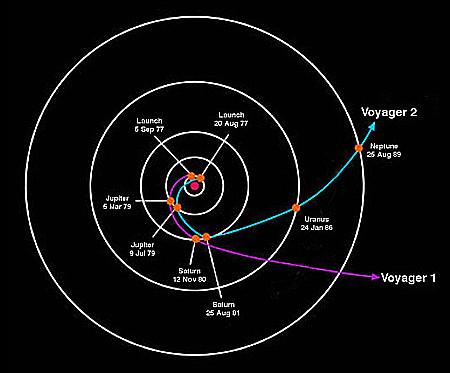
Engineers reactivate thrusters on Voyager-1 that have been out of commission since 2004

The Voyager missions
The routes the Voyager spacecraft have
taken since launch. Not to scale.

Because of an anticipated pause in communications due to upgrade work on the antennas of NASA’s Deep Space Network — used to communicate with interplanetary missions — the engineers operating the two Voyager spacecraft that are now in interstellar space after almost a half century of travel have improvised a repair that reactivated thrusters on Voyager-1 that were deemed inoperable in 2004.

Since then the spacecraft had been dependent solely on its backup thrusters. The engineers wanted the spacecraft to have two sets of thrusters again in case something went wrong during that pause in communications, running from May 2025 to February 2026.

The repair required getting two heaters switched back on, and carried with it the risk of an explosion that would destroy Voyager-1. The command to reactivate the heaters was sent on March 20, 2025, and two days later (after the command traveled at the speed of light for 23 hours to reach Voyager-1 and then 23 hours to return) the spacecraft signaled that all was well and that the heaters and thrusters were now working again.

Both Voyagers are expected to run out of power sometime in the next two years. The goal now is try to make both last at least until 2027, so that they will mark a full half century of operation since their launch in 1977.

7 comments

SpaceX committing millions to develop the town of Starbase at Boca Chica

Even though the newly minted town of Starbase at Boca Chica is essentially a “company town,” with almost all its residents employees of SpaceX, the company is not treating the town in a traditional company town manner, which in the past meant the company used its monopoly control to the detriment of its employees.

Instead, it appears SpaceX is committing millions to develop the town of Starbase at Boca Chica into a very classy place to live.

The newly minted Starbase, Texas will soon have a $22 million community center, according to online records from the Texas Department of Licensing and Regulation. The community center is being designed by a Pennsylvania design firm called AE7, and will be located at 41028 Quicksilver Ave. immediately north of a bend in the Rio Grande. It will include a 20,000-square-foot building and pool, with construction aiming to start in June and be completed by June 2026, according to the TDLR records.

…Earlier this year, Starbase officials registered several other community projects with state regulators, including a $20 million school “housing children from infancy to grade 12,” whose construction was set to get underway in April. Other projects include a 2,555-square-foot medical clinic, a $2 million multifamily construction featuring a 111,745-square-foot “new parking garage and multifamily” development at 52163 Memes St.

SpaceX is also building a $100 million office building for its operations. It has also filed plans to create a $13.5 million recreation center and sushi restaurant. Another plan to build a $15 million retail plaza was proposed earlier, but has remained stalled.

Under the leadership of Elon Musk (“the new Hitler” according to the brainless Democratic Party and its media propagandists), the employees of SpaceX at Starbase will be living in an up-to-date modern and very upper middle class environment, comparable to the best suburban communities found anywhere in the United States.

10 comments

Astronomers observe cloud changes above the northern polar lakes of Titan

Changes seen in Titan's atmosphere
Click for full resolution image.

Using data from both ground- and space-based telescopes, astronomers have now observed clouds rising in the thick atmosphere of the Saturn moon Titan.

The team observed Titan in November 2022 and July 2023 using both Keck Observatory and the James Webb Space Telescope. Those observations not only showed clouds in the mid and high northern latitudes on Titan — the hemisphere where it is currently summer — but also showed those clouds apparently rising to higher altitudes over time. While previous studies have observed cloud convection at southern latitudes, this is the first time evidence for such convection has been seen in the north. This is significant because most of Titan’s lakes and seas are located in its northern hemisphere and evaporation from lakes is a major potential methane source. Their total area is similar to that of the Great Lakes in North America.

The image to the right shows these methane clouds, indicated by the arrows, as seen by Webb on July 11, 2023 and then three days later by Keck. The clouds appear to have shifted downward during these observations.

The data suggests we are seeing one small aspect of Titan’s atmospheric methane cycle, where the liquid methane in the lakes evaporates to form clouds, which later than condense to rain back down. Though superficially similar to the water cycle here on Earth, the details suggest it will be very different on Titan.

0 comments

China and SpaceX complete launches

Two launches so far today. First, China successfully launched the first 12 satellites for proposed orbiting computer constellation dubbed the “Three-Body Computing Constellation,” its Long March 2D rocket lifting off from its Jiuquan spaceport in northwest China.

As is usual for China’s state-run press, it revealed little useful information about this constellation.

Each satellite in this initial batch is equipped with a domestically developed 8-billion-parameter AI model capable of processing satellite data across levels L0 to L4 (with L0 referring to raw data directly collected by the satellite), CGTN learned from the lab. The constellation also supports full inter-satellite connectivity. In addition to AI-powered data processing, the satellites will carry out experimental missions, including cross-orbit laser communication and astronomical science observations.

The press also provided no information about where the rocket’s lower stages, using very toxic hypergolic fuels, crashed inside China.

Next, SpaceX placed another 28 Starlink satellites into orbit, its Falcon 9 rocket lifting off from Cape Canaveral in Florida. The first stage completed its fourth flight, landing on a drone ship in the Atlantic.

The leaders in the 2025 launch race:

58 SpaceX
26 China
5 Rocket Lab
5 Russia

SpaceX still leads the rest of the world in successful launches, 58 to 43.

0 comments

AST SpaceMobile: It will be launching satellites almost monthly in the second half of ’25

Though it did not state the all the specific rockets the company will use, the satellite-to-cellphone company AST SpaceMobile revealed this week that it plans to launch its BlueBird satellites every month or two beginning in July 2025.

India’s GSLV rocket is slated to carry AST SpaceMobile’s first Block 2 BlueBird satellite, which the operator said is scheduled to ship from its Texas facility in June. At three times the size of each of the five Block 1 BlueBirds launched last year on a SpaceX Falcon 9 rocket, the satellite would surpass its predecessors to become the largest commercial antenna ever deployed in low Earth orbit.

Abel Avellan, AST SpaceMobile founder and CEO, said that from the second or third launch this year, Block 2 BlueBirds would feature in-house developed chips to support peak data rates of up to 120 megabits per second at 10 times the capacity of Block 1. Subsequent launches would also deploy between three and eight Block 2 satellites at a time, depending on the rocket, Avellan told investors during the company’s earnings call.

Avellan did not give an update on other launch missions that would leverage SpaceX’s Falcon 9 and Blue Origin’s New Glenn rockets, whose larger fairings can accommodate up to eight Block 2 satellites per flight.

Whether AST SpaceMobile will be able to fulfill this schedule however is a big question. SpaceX could provide the rockets for all these launches, but the availability of its Falcon 9 rocket might be limited due to other customer contracts as well as its own needs to launch Starlink satellites. Blue Origin’s New Glenn could certainly use the business, but that rocket has only launched once, and the company has been very slow about doing its second launch, now scheduled for later this month. It is very unclear whether it could do more than one of these launches this year.

India’s GSLV rocket could grab the business, but once again it is unclear it has the capacity to do more than two such launches before the end of the year.

All in all, it appears the demand for rocket launches exceeds the supply, a situation that is very good for the launch industry.

0 comments
1 114 115 116 117 118 182