ULA and Amazon schedule first Kuiper satellite launch for April 9, 2025

The launch of the first 27 satellites in Amazon’s 3,200-plus satellite Kuiper internet constellation has now been scheduled for April 9, 2025, using ULA’s Atlas-5 rocket lifting off from Cape Canaveral.

The Kuiper constellation, intended to compete directly with SpaceX’s Starlink constellation, was first conceived at about the same time as Starlink. Since then — while Amazon moved slowly launching only two test satellites — SpaceX launched thousands and signed up millions of customers, grabbing market share that it will be difficult for Kuiper to re-capture.

The launch will also be the first in 2025 for ULA, which had hoped to do as many as 25 launches this year with its old soon-to-be-retired Atlas-5 and new Vulcan rocket. The six-month delay in getting the Pentagon to finally certify Vulcan for commercial military launches has put a damper on that plan. Right now ULA will be lucky if it can complete half those launches.

4 comments

Webb infrared data increases odds asteroid 2024 YR4 will impact Moon in 2032

Asteroid 2024 YR4 as seen by Webb in the mid-infrared
Asteroid 2024 YR4 as seen by Webb in the
mid-infrared. Click for original image.

Using new infrared images and data from the Webb Space Telescope, astronomers have further refined the orbit and size of the potentially dangerous asteroid 2024 YR4.

The image of 2024 YR4 to the right was taken by Webb’s mid-infrared camera, and provides information on its thermal surface characteristics.

First, the Webb data narrowed the uncertainty about the asteroid’s size, suggesting it is about 200 feet in diameter. You can read the paper outlining this result here. The data also suggested nature of the asteroid’s surface, which is important in determining its future path. The pressure from sunlight can change the orbits of small asteroids, but figuring out how much is extremely difficult without knowing the rotation of the asteroid and the reflective qualities of its entire surface.

Second, based on this new data, other astronomers are increasingly certain 2024 YR4 will not hit the Earth in 2032, but the odds of it impacting the Moon have now increased to 4%.

0 comments

Update on the private Fram2 manned orbital spaceflight

The crew of Fram2 in weightlessness

In the past day the crew of the private Fram2 manned orbital spaceflight have released several updates, describing their initial experience in weightlessness as well as releasing some images of themselves inside the Resilience capsule.

First, on April 1, 2025 the mission commander, Chun Wang, the billionaire who paid for the flight, posted a tweet describing how all four crew members experienced space sickness the first day in orbit.

The first few hours in microgravity weren’t exactly comfortable. Space motion sickness hit all of us—we felt nauseous and ended up vomiting a couple of times. It felt different from motion sickness in a car or at sea. You could still read on your iPad without making it worse. But even a small sip of water could upset your stomach and trigger vomiting.

Things however quickly settled down, allowing them to open the nose cone so that they could see out the large cupola window. They released the first images of the Antarctic, and followed soon after with the first images of themselves inside Resilience. The picture to the right, taken by Wang, shows is three crewmates, Jannicke Mikkelsen, Rabea Rogge, and Eric Philips clearly now enjoying the experience of weightlessness.

Still no word on a return date. The mission was initially supposed to last 3 to 5 days. We are now on day three, with no indications of a planned return date.

0 comments

Senate schedules hearing to review Jared Isaacman’s nomination as NASA administrator

After months of delays, the Senate Committee on Commerce, Science, and Transportation yesterday finally announced it has scheduled for April 9, 2025 the confirmation hearing for Jared Isaacman’s nomination as NASA administrator.

I have previously speculated that the delay in scheduling this hearing was because there was opposition to Isaacman among Republicans both in the Senate and inside the White House, based on his past donations to the Democratic Party as well his previously strong support for Divesity, Equity, and Inclusion in his companies. It appears Isaacman must have eased those concerns when he began face-to-face private meetings with several Senate Republicans in the last two weeks, thus allowing the hearing to be scheduled.

Isaacman has been in Washington in recent days for one-on-one meetings with senators, a standard part of the confirmation process before a formal hearing. That included Sen. Jerry Moran (R-Kansas), who chairs the committee’s subcommittee on aviation, space and innovation, as well as the Senate Appropriations Committee’s subcommittee on commerce, justice and science, which funds NASA.

Moran said in an April 1 social media post that he met with Isaacman and discussed topics such as exploration and “a shared desire to beat our adversaries back to the Moon” as well as work on science and technology at NASA. “I am eager for the Commerce Committee to quickly conduct a confirmation hearing on his nomination to lead NASA,” Moran stated.

It now appears likely that this opposition is dissolving, and that Isaacman’s confirmation is likely.

0 comments

China launches radar-related satellite

China today successfully launched a technology satellite designed to calibrate “ground-based radar equipment”, its Long March 6 rocket lifting off from its Taiyuan spaceport in northern China.

No word on where the rocket’s lower stages crashed inside China.

The leaders in the 2025 launch race:

37 SpaceX (with another Starlink launch later today)
18 China
5 Rocket Lab
4 Russia

SpaceX now leads the rest of the world in successful launches, 37 to 31.

0 comments

National Opera of Ukraine – Nutcracker ‘Grand Pas de Deux – Adagio’

An evening pause: By Tchaikovsky of course. Performed live December 2020. Note how no one is wearing masks or social distancing. Apparently the Ukraine had some common sense during that time of madness.

Hat tip Judd Clark.

0 comments

April 2, 2025 Quick space links

Courtesy of BtB’s stringer Jay. This post is also an open thread. I welcome my readers to post any comments or additional links relating to any space issues, even if unrelated to the links below.

12 comments

Starliner’s troubles were much worse than NASA made clear

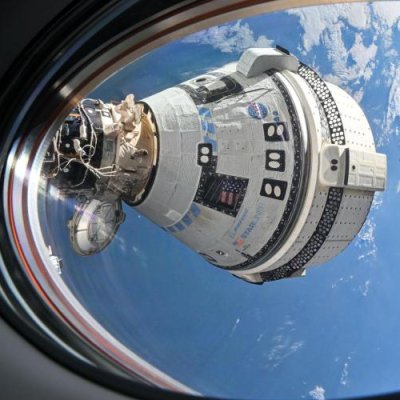
Starliner docked to ISS
Starliner docked to ISS.

According to a long interview given to Eric Berger of Ars Technica, the astronauts flying Boeing’s Starliner capsule on its first manned mission in June 2024 were much more vulnerable than NASA made it appear at the time.

First, the thruster problem when they tried to dock to ISS was more serious than revealed. At several points Butch Wilmore, who was piloting the spacecraft, was unsure if he had enough thrusters to safely dock the capsule to ISS. Worse, if he couldn’t dock he also did not know if had enough thrusters to de-orbit Starliner properly.

In other words, he and his fellow astronaut Sunni Williams might only have a few hours to live.

The situation was saved by mission control engineers, who figured out a way to reset the thrusters and get enough back on line so that the spacecraft could dock autonomously.

Second, once docked it was very clear to the astronauts and NASA management that Starliner was a very unreliable lifeboat.
» Read more

22 comments

ESA isn’t forcing private companies building cargo capsules to hire contractors from all its partners

Capitalism in space: When the European Space Agency (ESA) in May 2024 awarded two contracts to the French startup The Exploration Company and the established Italian contractor Thales-Alenia to develop unmanned capsules for bringing cargo to and from orbit, it also made a major policy change that went unnoticed at the time.

During a press briefing on 23 May [2024], following the Phase 1 awards, ESA Director General Josef Aschbacher explained that the agency would not require participants in the initiative to adhere to its geo-return policy. The policy typically ensures that contracts are distributed among ESA member states in proportion to their financial contributions. “We contract very differently because we will be the anchor customer,” said Aschbacher. “That means we buy a service. We give industry all the freedom to find the best solution technically, but also the best partners, with whomever they want to work with.”

What means is that the two companies, in developing their capsules, have not been required to spread the work out across Europe. Instead, they have been free to do the work entirely in house, or hire just the subcontractors they prefer, from anywhere. As the CEO of The Exploration Company noted, “In plain terms, we choose our suppliers based purely on quality and cost—not because they’re French, Italian, or German. We choose the best supplier for the job.”

In the past, as part of its bureaucratic and political needs, ESA’s “geo-return policy” required every space project to spread the wealth to all of the ESA’s partner nations, in amounts proportional to their financial contributions to the ESA. The result was that every project went overbudget, took too long to complete, and was unrealistically complex. Many projects simply failed because of these issues. Others took decades to get completed, for too much money. And when it came to rockets, it produced the Ariane-6, that is too expensive and cannot compete in today’s market.

This decision last year means that ESA is very slowly adopting the concept of capitalism in space, whereby it acts merely as a customer, buying products that are completely owned and controlled by the seller.

This new policy presently only applies to the development phase of these capsules. Though no decision has been made about the construction phase, involving much more money, ESA publications indicate it will apply there as well.

Though it is taking time, Europe’s space bureaucracy is beginning to accept the idea of freedom and capitalism.

1 comment

Fram2 passengers take their first pictures of Earth’s polar regions

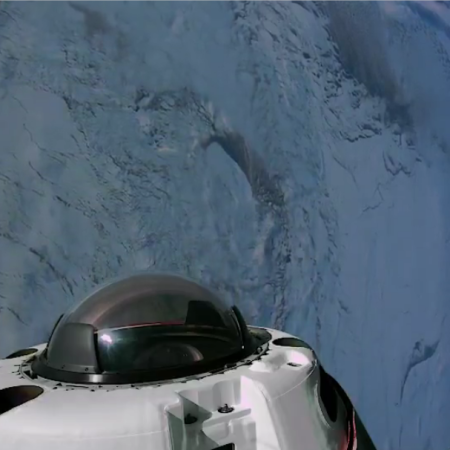
The Arctic as seen from Fram2

SpaceX yesterday released a short video of the first pictures of the Earth’s polar regions taken by its Fram2 passengers on the capsule Resilience.

The picture to the right is a screen capture from that film, looking out the capsule’s large cupola window in its nose. The capsule’s nosecone can be seen at the bottom, having hinged sideways out of the way during orbital operations.

The tweet provided little information about the images. For example, it did not say which pole was imaged. Since the ground and ice below is dark, we are likely looking at the north pole, which at this time of year is mostly in shadow. You can see what looks like the edge of the ice pack, partly hidden by clouds.

The flight is scheduled to last from three to five days, and is presently in its second day. Not much information from the crew in orbit has at this point been released. I suspect they are simply enjoying their experience in private, since they are not obligated to share it with the world.

9 comments
1 134 135 136 137 138 182