
Another example of the weird taffy terrain in Mars’ death valley

More taffy terrain

Cool image time! The picture to the right, rotated, cropped, reduced, and enhanced to post here, was taken on January 30, 2025 by the high resolution camera on Mars Reconnaissance Orbiter (MRO).

The scientists label it dimply as “layers in Helles Planitia.” Other scientists have given this strange landscape a much more interesting label, “taffy terrain.” It is found only in the Hellas Basin, the basement of Mars, having the lowest elevation found anywhere on the red planet. According to a 2014 paper, the scientists posit that this material must be some sort of “a viscous fluid,” naturally flowing downward into “localized depressions.” Because of its weird nature I have posted many cool images of it in the past (see here, here, here, here, and here).

Is taffy terrain still viscous, or has it become solidified? That question I think remains unanswered, though pictures taken of the same spot over time do not yet appear to show changes.
» Read more
0 comments

Sunspot update: NOAA scientists try to hide how wrong they have gotten things

My monthly sunspot update today will have less to do with the Sun’s sunspot activity itself — which continues to show a very very slow decline from a peak in August 2024 — and more to do with more games-playing by NOAA solar scientists to fool the public into believing they know more than they do.

Below is my annotated version of NOAA’s monthly graph showing the amount of sunspot activity on the Earth-facing hemisphere of the Sun. This graph is significantly different from the graph that NOAA’s scientists have issued for the past few years, with all the changes designed to make it seem as if these scientists’ predictions are on the money, when they have been entirely wrong now for two solar cycles in a row.
» Read more

10 comments

Chinese man who used drone illegally over Vandenberg, spying for China, given slap on wrist in sentencing

Yinpiao Zhou, the Chinese man who flew a drone illegally over Vandenberg last fall in order to spy for China, has now been sentenced for his crime.

Yinpiao Zhou was sentenced Monday morning by a U.S. district judge in Los Angeles to four months in prison with a year of supervised released [sic]. He was also ordered to pay a $200 fine and $25 special assessment.

Since Zhou has been held in prison almost four months already, he will likely be released in days for time served.

All the evidence suggests he did this either willingly or unwillingly under orders from China. A second man that was with him while he flew the drone was never identified or arrested, and has likely been allowed to flee the country. Zhou himself tried to flee as well, as he was arrested at the airport as he tried to board a plane back to China. He is a Chinese citizen who is lawfully in the U.S., but having been caught spying it is astonishing that he is being allowed to remain in the country. He should be deported immediately.

5 comments

Twenty years of Hubble data map one long season on Uranus

Uranus over twenty years
Click for original image.

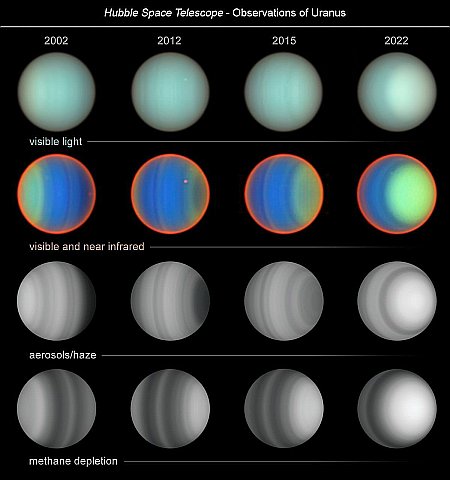
Astronomers using the Hubble Space Telescope multiple times since 2002 have now tracked the changes in its atmosphere during one quarter of its 84 year orbit around the Sun.

The image to the right, reduced and sharpened to post here, shows Hubble’s views across several electromagnetic wavelengths. Uranus’s rotational tilt or inclination is almost 90 degrees, so that it literally rolls on its side as it orbits the Sun. You can see this especially in the bottom two rows. From 2012 to 2022 one pole slowly shifted westward. From the press release:

The Hubble team observed Uranus four times in the 20-year period: in 2002, 2012, 2015, and 2022. They found that, unlike conditions on the gas giants Saturn and Jupiter, methane is not uniformly distributed across Uranus. Instead, it is strongly depleted near the poles. This depletion remained relatively constant over the two decades. However, the aerosol and haze structure changed dramatically, brightening significantly in the northern polar region as the planet approaches its northern summer solstice in 2030.

Since we have not yet observed Uranus over one full year, there are a lot of uncertainties in any conclusions the scientists propose. For one, we don’t know the general atmospheric patterns across all four seasons. For another, any changes seen now might simply be the planet’s weather, random events not directly related to long term climate patterns.

1 comment

SpaceX launches 28 Starlink satellites; China launches test internet satellite

SpaceX yesterday successfully placed 28 Starlink satellites into orbit, its Falcon 9 rocket lifting off from Cape Canaveral in Florida.

Thank you from several readers for letting me know that I missed it. This was the company’s first of two launches yesterday, the second of which was the Fram2 manned mission. I was so focused on that I missed the first.

The first stage completed its seventeenth flight, landing on a drone ship in the Atlantic.

China in turn today launched a satellite to test new technology for providing the internet from orbit, its Long March 2D rocket lifting off from its Jiuquan spaceport in China’s northwest. Little information was released about the satellite, and no information was released about where the rocket’s lower stages — using very toxic hypergolic fuels — crashed inside China.

The leaders in the 2025 launch race:

37 SpaceX
17 China
5 Rocket Lab
4 Russia

SpaceX now leads the rest of the world in successful launches, 37 to 30.

4 comments

SpaceX launches four commercial private citizens on the first manned polar orbital mission

Capitalism in space: SpaceX tonight successfully launched its Resilience capsule carrying four private citizens on commercial manned mission, its Falcon 9 rocket lifting off from Kennedy in Florida.

The first stage completed its sixth mission, landing on a drone ship in the Atlantic. Resilience in turn is on its fourth flight, with the last three all dedicated to commercial flights for private citizens.

The crew is made up of four rookie space-flyers, mission commander Chun Wang (who paid for the flight), vehicle commander Jannicke Mikkelsen, vehicle pilot Rabea Rogge, and mission specialist and medical officer Eric Philips. The plan is for them to stay in orbit from three to five days, circling the Earth in a polar orbit, the first time any humans have flown in space in such an orbit.

As always, the mission, dubbed Fram2 to honor Fridtjof Nansenโ€™s Fram ship that explored the north pole region from 1893 to 1896, touts its many science experiments, but we should not fool ourselves. Its real goal is to provide Wang and his compatriots the thrill of flying in space.

That the flight is attracting relatively little press compared to previous private and NASA missions indicates how routine SpaceX is making its business. It is making space exploration profitable and no longer reliant on government funds. This is a big deal. Too bad most news outlets don’t realize it.

The leaders in the 2025 launch race:

36 SpaceX
16 China
5 Rocket Lab
4 Russia

SpaceX now leads the rest of the world in successful launches, 36 to 28.

16 comments

March 31, 2025 Quick space links

Courtesy of BtB’s stringer Jay. This post is also an open thread. I welcome my readers to post any comments or additional links relating to any space issues, even if unrelated to the links below.

3 comments

Blue Origin completes investigation of the failed landing of New Glenn’s 1st stage

Blue Origin today announced that it has completed its investigation into the failure of New Glenn’s first stage when it attempted to land on a barge in Atlantic during the rocket’s first launch on January 16, 2025.

Our ambitious attempt to land the booster, “So Youโ€™re Telling Me Thereโ€™s a Chance,” was unsuccessful due to our three BE-4 engines not re-igniting properly. Our review confirmed that all debris landed in our designated hazard area with no threat to public safety. The report identified seven corrective actions, focusing on propellant management and engine bleed control improvements, which weโ€™re already addressing. We expect to return to flight in late spring and will attempt to land the booster again.

It is very concerning that the three BE-4 engines that were supposed to relight were unable to do so, especially because this engine was supposedly designed from the start of re-usability.

The next scheduled New Glenn launch in for June, launching NASA’s Escapade Mars orbiters.

6 comments

CEO of rocket engine startup accused of bankrupting company by misuse of funds

Buyer beware: Christopher Craddock, the founder in 2014 of the rocket engine startup RocketStar, has now been accused by his former CEO of bankrupting the company by the misuse of funds for “pricey jaunts to Europe, jewelry for his wife, child support payments, and, according to the companyโ€™s largest investor, ‘airline tickets for international call girls to join him for clandestine weekends in Miami.'”

Onetime stockbroker Christopher Craddock established RocketStar in 2014 after financial regulators barred him from working on Wall Street over a raft of alleged violations. Craddock held the firm out as โ€œan entity that intended to reinvent space exploration,โ€ states a $6 million lawsuit filed by former CEO Michael Mojtahedi and obtained by The Independent.

….according to Mojtahediโ€™s complaint, RocketStar โ€œis nothing more than a Ponzi schemeโ€ฆ [that] has been predicated on Craddockโ€™s ability to con new people each time the company has run out of money.โ€

โ€œCraddock recklessly and lavishly misappropriated for his lifestyle almost every cent RocketStar received from investors, running the company into the ground by August 2024,โ€ the complaint says. โ€œAt that point, Craddockโ€™s โ€˜keeping up with the Jonesesโ€™ lifestyle caught up with him, investor funds dried up completely, and his house of cards collapsed.โ€

Whether Craddock was the crook Mojtahedi say he was remains at this moment unproved. In a sense however this is beside the point. This story illustrates one reality about capitalism that no one should ever forget: Be careful with whom you invest your money. Make sure you know their background. And above all, investigate the company thoroughly before investing in it.

It sure appears that the wealthy people who invested in RocketStar did none of this research. They were the con-man’s perfect mark, innocently handing over cash to someone because what he said sounded good. Rocket science however ain’t easy, and merely sounding good is not enough.

2 comments

Isar Aerospace’s first launch attempt fails seconds after lift-off

Isar's first launch attempt fails

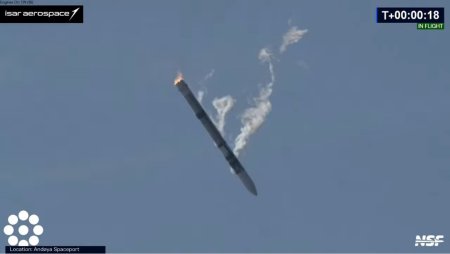
The first launch attempt of the German rocket startup Isar Aerospace’s Spectrum rocket from Norway’s upgraded orbital Andoya spaceport failed early this morning shortly after lift off, when the rocket started to swivel out of control. When its engines then cut off the rocket then fell to the ground and crashed.

The live stream at the link cuts off at that point, with the screen capture to the right the last thing shown. BtB’s stringer Jay however found a different viewpoint that shows the stage falling and crashing to the ground. I have embedded that video below.

As the company admitted repeatedly prior to launch, this was a test flight. They were quite ready to see such a failure, with they main goal gathering data on the rocket and its systems to figure out what needs to be revised and improved. From the video it appears the company above all needs to upgrade its flight termination system. Out of control rockets should not be allowed to crash. When they fail so soon after launch it is better to hit the self-destruct button and destroy them in the air. Isar’s rocket clearly failed in this matter.

For Norway however this launch is a resounding success. Andoya has now become the first spaceport on the continent of Europe to attempt an orbital launch. Though Andoya has been used for suborbital launches for decades, it was only upgraded for commercial orbital launches in the past two years. Unlike the United Kingdom, where two spaceports in Scotland and the Shetland Islands were proposed more than six years ago and have been blocked by government red tape and some local opposition, preventing any launches for years, Norway streamlined the licensing process at Andoya so that launches can proceed with speed.

Expect business to flow from these stymied spaceports to Andoya.
» Read more

21 comments

NASA approves SpaceX’s Starship to bid for some launch contracts

NASA yesterday announced that it has added SpaceX’s Starship/Superheavy rocket to its launch services program, thereby allowing the company to bid that rocket for some launch contracts.

The NLS II contracts are multiple award, indefinite-delivery/indefinite-quantity, with an ordering period through June 2030 and an overall period of performance through December 2032. The contracts include an on-ramp provision that provides an opportunity annually for new launch service providers to add their launch service on an NLS II contract and compete for future missions and allows existing contractors to introduce launch services not currently on their NLS II contracts.

This change is mostly bureaucratic in nature. SpaceX has not won a Starship launch contract from NASA. It has only been given the opportunity to bid that rocket in the future.

What is significant about this announcement is the change it signals in the way NASA’s bureaucracy functions. In the past these service contracts at NASA (and at the Pentagon) were routinely used to limit who could bid. NASA had to approve your company, and if it decided you weren’t good enough, or maybe didn’t like your politics, or possibly you weren’t one of the old-time big space companies the bureaucrats were buddies with, you stood no chance of getting in the game. For example, SpaceX had to sue the military when it would only allow ULA to bid while blocking any and all competitors.

These limits never made any sense. The best thing any customer can do is consider the products of as many businesses as possible, in order to get the best deal.

NASA decision here suggests its bureaucracy and management is loosening things up. Starship/Superheavy is not yet ready to put payloads in orbit, but this decision makes it possible for it to begin doing so, as soon as possible. No need to wait until it is 100% operational. NASA can now consider using it as a cheap way to launch some high risk missions during the testing period.

4 comments
1 135 136 137 138 139 182