Fram2 private manned mission splashes down safely

The Fram2 private commercial manned mission successfully ended today when SpaceX’s Resilience capsule splashed down safely off the coast of California.

The crew spent about four days in space, circling the Earth in the first polar orbit by a human crew.

This was SpaceX’s sixth privately funded manned mission. Three docked with ISS and were paid for by Axiom. Three flew independently, with two paid by Jared Isaacman and one by Chun Weng (which landed today). Plus Axiom has scheduled its next ISS commercial flight for May, 2025, using a new SpaceX capsule (bringing the company’s manned fleet to five spacecraft).

As I noted earlier this week, SpaceX is making space exploration profitable, which in turn makes the government irrelevant. And ain’t that a kick?

7 comments

White dwarf binary discovered only 150 light years away is a major supernova candidate in about 23 billion years

Astronomers have discovered only 150 light years away the most massive white dwarf binary system yet detected, that they believe is a major candidate for producing one type of supernova many billions of years in the future.

White dwarf stars in binary systems are thought to produce Type 1a supernova. The dwarf sucks material from the companion star, which eventually piles up on the surface of the dwarf until the extra mass, more than 1.4 times the mass of the Sun (dubbed the Chandrasekhar mass limit), causes the supernova explosion.

That’s the theory at least. Up to now astronomers have not yet observed this process, prior to the supernova. This newly discovered binary system however is a prime candidate, because its combined mass is already 1.55 the mass of the Sun. According to the researchers’ computer models, when these stars come close to merging the result will be a Type 1a supernova. From the peer reviewed paper:

The interaction of the accretion stream with the surface of the primary white dwarf ignites a helium detonation close to the point of interaction. The helium detonation then wraps around the primary white dwarf and sends a shock wave into its core that converges at a single point. This ignites a second detonation that completely destroys the primary white dwarf. When the shock wave of its explosion hits the secondary white dwarf, the double detonation mechanism repeats itself. The shock wave from the detonation of the primary ignites a helium detonation near the surface of the secondary which drives a shock wave into its core. It is sufficient to ignite the core detonation, destroying the secondary white dwarf as well.

These events won’t occur tomorrow however. The two stars orbit each other every 14 hours, but their high mass is causing gravitational waves to ripple outward from the system, robbing it of energy. The orbits of the stars are thus spiraling inward. In about 23 billion years they will be about to merge, which will be the moment when the above explosive events are predicted to occur.

If at that moment the binary system was still only 150 light years away, the explosion would do great harm to the Earth and likely cause a major extinction. In 23 billion years however the binary will no longer be so close, and could in fact be on the other side of the Milky Way.

5 comments

Engineers use simulated moon dust to make glass

Engineers have successfully manufactured glass using simulated moon dust, and found this “moonglass” works better than Earth glass in solar panels.

To test the idea, the researchers melted a substance designed to simulate Moon dust into moonglass and used it to build a new kind of solar cell. They crafted the cells by pairing moonglass with perovskite—a class of crystals that are cheaper, easier to make, and very efficient in turning sunlight into electricity. For every gram of material sent to space, the new panels produced up to 100 times more energy than traditional solar panels.

…When the team zapped the solar cells with space-grade radiation, the moonglass versions outperformed the Earth-made ones. Standard glass slowly browns in space, blocking sunlight and reducing efficiency. But moonglass has a natural brown tint from impurities in the Moon dust, which stabilizes the glass, prevents it from further darkening, and makes the cells more resistant to radiation.

Though encouraging, they are many unknowns that could become show stoppers. For one, this research was all done in Earth gravity. In the Moon’s 1/6th gravity the results might be very different. For another, all they have done is demonstrate a way to make glass using Moon dust. That is a far cry from building solar panels, as implied by the press release.

Nonetheless, the results demonstrate one more way in which a lunar base can eventually become self-sufficient, the inevitable goal.

5 comments

China: samples from the near and far sides of the Moon are different

Scientists studying the lunar samples brought back from China’s Chang’e-6 mission to the far side of the Moon have determined that the different environments create differences in the surface material.

The study found that the solar wind exposure time of the Chang’e-6 samples was close to the minimum observed in the Apollo 11 samples, lower than that of the other Apollo samples, and slightly shorter than that of the Chang’e-5 samples. However, surprisingly, the npFe⁰ grain sizes in the Chang’e-6 samples were larger. “This might suggest that solar wind radiation in this region leads to more pronounced segregation and aggregation of iron,” she noted. These exciting new results add to the growing evidence that space weathering on the lunar farside may differ from that on the nearside, and, contrary to previous findings from Apollo and Chang’e-5 samples, solar wind radiation plays a more dominant role in the space weathering process on the lunar farside.

There are differences in the solar wind’s influence on different regions of the Moon. During each synodic month, the near side of the Moon enters Earth’s magnetotail, where the protection afforded by Earth’s magnetic field reduces its exposure to the solar wind; in contrast, the farside is continuously exposed to direct solar wind radiation. Moreover, due to orbital dynamics, different locations on the Moon experience varying impact velocities from cometary and asteroidal meteoroids. The relative velocity between the Moon’s surface and impacting meteoroids changes with the lunar phase: during a full moon, when the Moon and meteoroids move in the same orbital direction, the relative velocity increases; the opposite occurs during a new moon.

That there are differences between samples from the Moon’s two hemisphere should not a surprise. Confirming and characterizing those differences however is good.

1 comment

The World’s Most Famous Unknown Band

An evening pause: Performed live 1990. Performers include unknowns Glen Campbell, Jerry Reed, & Steve Wariner (guitar); Roy Clark (mandolin), Ray Stevens (piano), Ricky Skaggs (fiddle), Lee Greenwood (saxophone), Steve Gatlin (bass), Barbara Mandrell (steel guitar), and Irlene Mandrell (drums).

Hat tip Mike Nelson.

2 comments

April 3, 2025 Quick space links

Courtesy of BtB’s stringer Jay. This post is also an open thread. I welcome my readers to post any comments or additional links relating to any space issues, even if unrelated to the links below.

2 comments

Hamas proves its death toll numbers are a lie

I originally though this story would be part of my earlier essay today on the hate that links Hamas with the American left, but it simply didn’t fit. Nonetheless, this new revelation is worth posting, just so as to keep the record straight.

Hamas this week quietly adjusted the death toll numbers that it has touted since the war in Gaza began in October 2023, removing thousands of names of women and children. The new numbers prove what many analysts have noted repeatedly, that the death statistics Hamas has been releasing were fabricated lies designed to take advantage their willing allies in the mainstream leftist propaganda press to garner sympathy for this terrorist organization worldwide.

Hamas quietly removed the names of thousands of Palestinians it had previously alleged were killed during the Israel-Hamas war, Salo Aizenberg, from the US-based non-profit organisation Honest Reporting told The Telegraph on Tuesday after analyzing Hamas’s March 2025 casualty update.

Hamas has previously claimed that 70% of casualties have been women and children, a claim no longer reflected in their recently updated lists, according to the research. Approximately 72% of fatalities between the ages of 13-55 are men – the demographic category aligns with Hamas combatants. “Hamas’s new March 2025 fatality list quietly drops 3,400 fully ‘identified’ deaths listed in its August and October 2024 reports – including 1,080 children. These ‘deaths’ never happened. The numbers were falsified – again,” Aizenberg asserted.

The only genocide going on in Gaza right now is being committed by Hamas. It has to go, or there will never be any chance for peace there.

76 comments

Hamas and American leftists: both driven solely by mindless hate

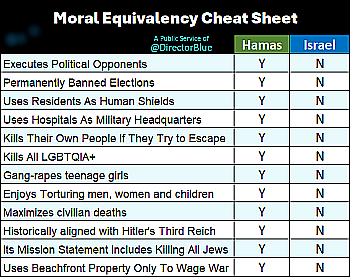
Actions taken this week by both the terrorist group Hamas in Gaza as well as the leftist terrorists in the United States has once again illustrated how little difference there is between these two groups.

Hamas vs Israel
The obvious reasons why killing the leaders
of Hamas and Hezbollah is a good thing.
Courtesy of Doug Ross.

In Gaza, Hamas responded to the public demonstrations against it by ordinary Gazans last week by torturing and killing one of the demonstration leaders.

Hamas operatives kidnapped, tortured and executed a 22-year-old Palestinian man who participated in last week’s wave of protests against the terror group, according to his family. Oday Nasser Al Rabay’s body was left in front of his family’s home over the weekend. On Saturday, many dozens were filmed participating in his funeral procession, shouting, “Hamas out!”

Hamas has reportedly been threatening Palestinians who participate in the protests against the terror group, but this appears to be the first time that anyone has been killed in connection to them.

Hamas, which is strongly supported by many politicians in the Democratic Party, has thus illustrated its unwavering intolerance of any opposition, an intolerance so strong that torture and murder is considered a viable option for maintaining power.

Driving that intolerance however is not simply a lust for power, but a hate that fuels Hamas’s every action. The members of Hamas hate all non-Muslims, especially Jews, and want to kill them all. Anyone that stands in the way of this goal thus earns death as well.

Hate allows for this kind of evil. It has to be fed somehow, and if murder is the food, than so be it.

What does this have to do with the American left? » Read more

9 comments

Terraces within one of Mars’ giant enclosed chasms

Overview map

Terraces within Hebes Chasma

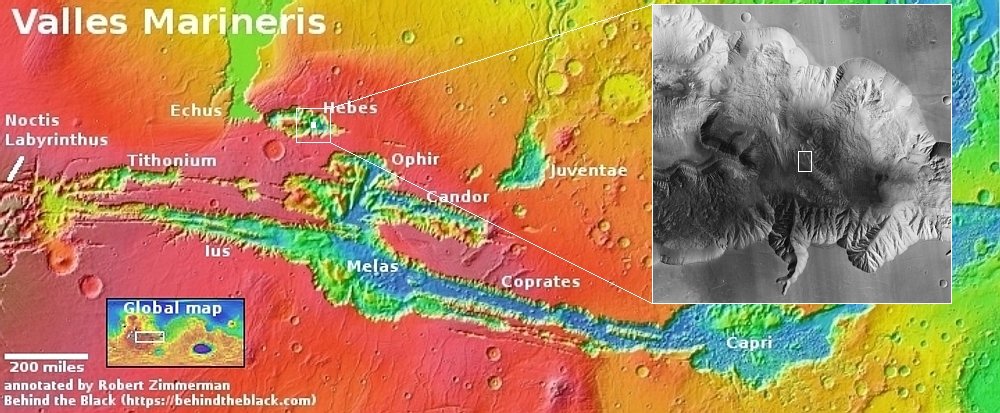
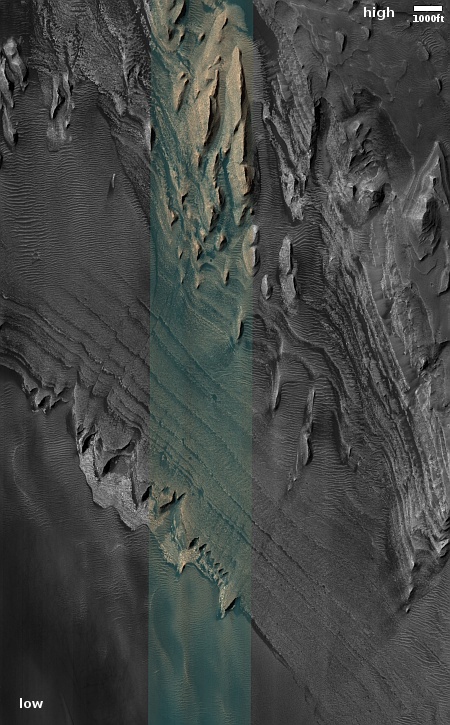
Cool image time! The picture to the right, rotated, cropped, reduced, and sharpened to post here, was taken on January 27, 2025 by the high resolution camera on Mars Reconnaissance Orbiter (MRO). It shows the terraced layers descending down a 7,000-foot-high ridgeline within Hebes Chasma, one of several enclosed chasms that are found to the north of Mars’s largest canyon system, Valles Marineris.

The white dot on the overview map above marks this location, inside Hebes. The rectangle in the inset indicates the area covered by the picture, which only covers the lower 5,000 feet of this ridge’s southern flank.

The ridgeline might be 7,000 feet high and sixteen miles long, but it is dwarfed by the scale of the chasm within which it sits. From the rim to the floor of Hebes is a 23,000 foot drop, comparable to the general heights of the Himalaya Mountains. Furthermore, this ridge is not the highest peak within Hebes. To the west is the much larger mesa dubbed Hebes Mensa, 11,000 feet high and 55 miles long.

The terraces indicate the cyclical and complex geological history of Mars. Each probably represents a major volcanic eruption, laying down a new bed of flood lava. With time, something caused Hebes Chasm to get excavated, exposing this ridge and these layers.

The excavation process itself remains unclear. Some scientists think the entire Valles Marineris canyon was created by catastrophic floods of liquid water. Others posit the possibility of underground ice aquifers that sublimated away, causing the surface to sink, eroded further by wind. Neither theory is proven, though the former is generally favored by scientists.

0 comments

Fantasyland: Turkey to establish its own spaceport

If you believe this I have a bridge I can sell you cheap: According to Turkey’s state-run press, the Turkish Space Agency is now researching locations for its own spaceport, either in Turkey or in some other nearby nation such as Somalia.

According to information provided by relevant government agencies, efforts are ongoing to select a suitable location for the facility. Discussions are underway with countries near the equator, including Somalia, to maximize launch efficiency.

…Once operational, the spaceport will support independent satellite launches, marking a major step in Türkiye’s ability to access space without relying on foreign platforms.

Recently Turkey launched its first home-built smallsat on a SpaceX Falcon 9 rocket. It seems its space agency now believes it can quickly whip up its own rocket and launch it from a quickly built spaceport, likely in another country.

This announcement is nothing but government blather published to puff up these government officials so that they can garner more funding and build bigger more palatial offices.

1 comment

Iran accelerates plans for new coastal spaceport

Iran's spaceports

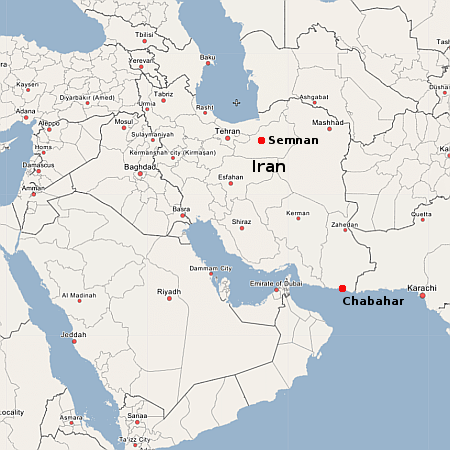
According to Iran’s state-run press, the government is about to begin the next construction phase for its proposed new coastal spaceport near the city of Chabahar.

The head of the Iranian Space Agency has announced that the second phase of the Chabahar spaceport for semi-heavy liquid-fueled launchers is to be inaugurated in the current Persian calendar year. Hassan Salarieh said on Tuesday that the first phase of the Chabahar spaceport is for solid fuel launchers and is expected to be inaugurated this year (which started March 21), adding that adequate studies were conducted regarding the second phase of the site in previous years and the new phase for semi-heavy liquid fuel launchers is to be opened during the year.

The details are very vaguely words. Will launches of solid-fueled rockets begin this year, or construction? Earlier reports had promised the first launch from Chabahar would occur in March 2025. That clearly has not occurred.

This spaceport will supplement Iran’s older Semnan launch facility in the country’s interior, from which all previous Iranian launches have occurred.

4 comments
1 133 134 135 136 137 182