Isar launch several times scrubbed due to high winds, rescheduled for tomorrow

Proposed spaceports surrounding Norwegian Sea

The German rocket startup Isar Aerospace, forced to scrub the first launch of its Spectrum rocket from Norway’s Andoya spaceport several times this week due to high winds, is now targeting a launch tomorrow, March 27, 2025, at 7:30 am (Eastern).

Munich-based Isar Aerospace postponed the debut launch of its Spectrum rocket, citing unfavorable winds at Norway’s Andøya Spaceport. On Tuesday, Isar said it will now target Thursday at 7:30 a.m. EDT for the highly anticipated test flight, which could pave the way for a more robust European presence in the commercial space industry.

The mission will not have a payload—rather, it will serve as the first integrated test of all rocket systems. And no matter what happens, Isar said it will view the test as a success.

…Standing about 92 feet tall with a diameter of about 6 feet, Spectrum is designed to carry payloads of up to 2,200 pounds to low Earth orbit. The two-stage vehicle burns 40 tons of liquid oxygen and propane across its nine first-stage Aquila engines and single second-stage engine. Unlike Falcon 9, though, the vehicle is not reusable, which is what allowed SpaceX to lower launch costs and take command of the market.

Isar’s goal is to eventually produce up to 40 Spectrum vehicles annually at its facility near Munich. Per Metzler, it builds nearly all components in house and is already producing two more rockets. The company is operating with about $435 million in funding from private investors as well as the NATO Innovation Fund and German government.

If successful, Isar will win the race to become the first new private rocket company from Europe to get to orbit. The launch will also inaugurate orbital operations from Andoya, giving Norway the first commercial spaceport in Europe, beating out both of the UK’s proposed spaceports that had begun work much earlier.
3 comments

Survey of protoplanetary disks finds their size varies significantly

Proto-planetary disks of all sizes
Click for original image.

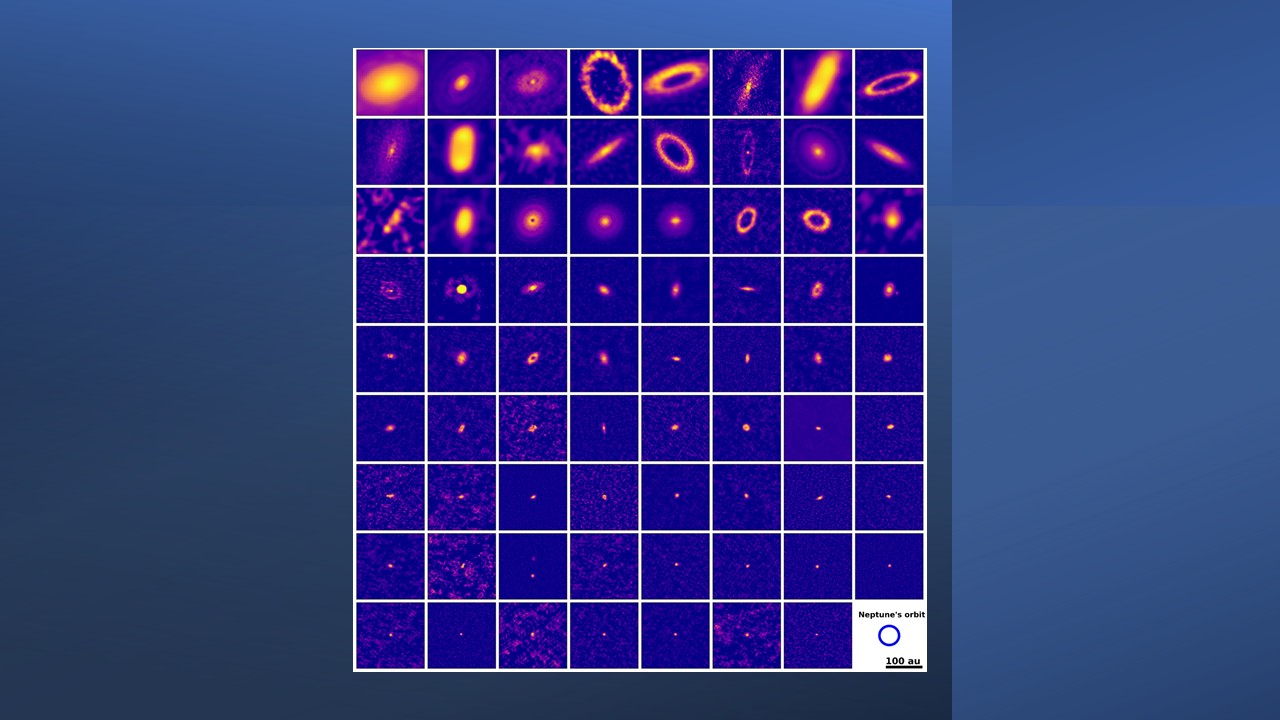
A survey of the protoplanetary disks in a star-forming region about 400 light years from Earth has found that the size of the disks can vary considerably, with many much smaller than our own solar system.

Using ALMA [Atacama Large Millimeter/submillimeter Array in Chile], the researchers imaged all known protoplanetary discs around young stars in Lupus, a star forming region located about 400 light years from Earth in the southern constellation Lupus. The survey reveals that two-thirds of the 73 discs are small, with an average radius of six astronomical units, this is about the orbit of Jupiter. The smallest disc found was only 0.6 astronomical units in radius, smaller than the orbit of Earth.

…The small discs were primarily found around low-mass stars, with a mass between 10 and 50 percent of the mass of our Sun. This is the most common type of star found in the universe.

You can read the research paper here [pdf]. The image to the right, figure 1 from the paper, shows 71 of those disks, with two-thirds clearly much smaller than our solar system.

Because exoplanet surveys have found many small exoplanets around low-mass stars, this new data suggests that planets can also form from these small accretion disks, and that planet formation is also ubiquitous throughout the universe.

1 comment

Rocket Lab launches eight satellites for constellation to monitor wildfires

Rocket Lab today successfully launched eight satellites for German company OroraTech and its commercial constellation for monitoring wildfires, its Electron rocket lifting off from one of its two launchpads in New Zealand.

The leaders in the 2025 launch race:

34 SpaceX
14 China
5 Rocket Lab
4 Russia

SpaceX still leads the rest of the world in successfully launches, 34 to 26.

This is not the last launch expected today. Both China and SpaceX plan launches, with the Chinese launch scheduled to have occurred already. More information to follow as it becomes available.

0 comments

March 25, 2025 Quick space links

Courtesy of BtB’s stringer Jay. This post is also an open thread. I welcome my readers to post any comments or additional links relating to any space issues, even if unrelated to the links below.

4 comments

NASA confirms DOGE contract cancellations totaling about $420 million

According to Space News, NASA officials have now confirmed a DOGE post that described contract cancellations totaling about $420 million.

In a statement to SpaceNews late March 24, NASA press secretary Bethany Stevens confirmed a post by the Department of Government Efficiency (DOGE) that NASA had terminated about $420 million in “unneeded” contracts. “NASA is committed to optimizing its workforce and resources in alignment with the Department of Government Efficiency’s initiatives. As part of this effort, NASA has identified and phased out $420 million in contracts that were determined to be redundant or misaligned with our core mission priorities,” Stevens said in the statement.

…NASA did not answer questions about specific contracts selected for termination or details about how it determined those contracts were redundant or misaligned. The DOGE post, published just before midnight March 21, said only that it included three contracts worth $15 million each to consultancies for “Change Management Support Services.”

Though it is not yet clear what specific contracts were cancelled, the statements from both NASA and DOGE, as well as the research by Space News‘s own reporter, suggest strongly these contracts had nothing to do with space or aviation engineering, but were related to management and DEI related projects, all of which have nothing to do with NASA’s “core mission priorities.”

As always, the Space News genuflects to the swamp, implying these cuts are the precursor to the utter destruction of NASA’s science research. In truth, NASA — like all government agencies in the 21st century — is bloated and wasteful. There is plenty of room for cuts, without doing any harm to the work the agency does. If anything, by getting rid of the waste the agency will be more efficient, able to do science and engineering research more effectively.

1 comment

Martian stucco

Martian stucco
Click for original image.

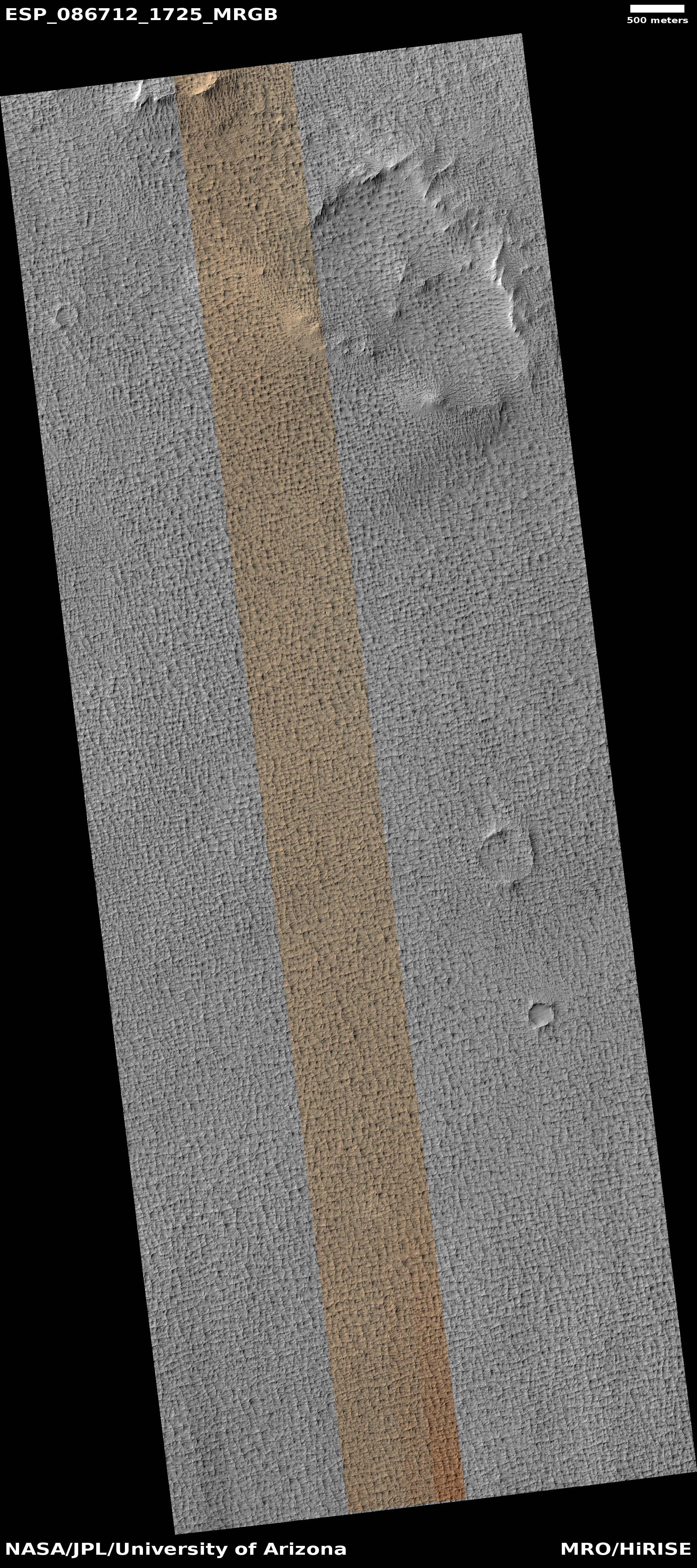
Cool image time! The picture to the right, cropped, reduced, and sharpened to post here, was taken on January 24, 2025 by the high resolution camera on Mars Reconnaissance Orbiter (MRO). Labeled simply as a “terrain sample,” it was likely taken not as part of any specific research request but to fill a gap in the schedule in order to maintain the camera’s proper temperature.

In this case the camera team got something quite intriguing. The entire terrain is reminiscent of stucco found on the outside walls of southwest homes. What makes even more intriguing is that the stucco appears to be material that has covered the terrain, based on the two craters that appear half-buried by it. Moreover, this picture only captures a small portion of this landscape, which extends like this over an area approximately 40 miles squared.

What caused this strange terrain? As always, the overview map below provides a clue, though no firm answers.
» Read more

0 comments

Scientists believe they have found evidence of largest carbon molecules yet in Curiosity drill sample

The uncertainty of science: Scientists analyzing material drilled out by the Mars rover Curiosity back in 2013 now believe the sample included the largest carbon molecules yet found on Mars.

The detection of these long and large carbon molecules was based not on actual Martian data, taken at a site dubbed Cumberland on the floor of Gale Crater, but on follow-up lab work on Earth.

The recent organic compounds discovery was a side effect of an unrelated experiment to probe Cumberland for signs of amino acids, which are the building blocks of proteins. After heating the sample twice in [the Curiosity] SAM’s oven and then measuring the mass of the molecules released, the team saw no evidence of amino acids. But they noticed that the sample released small amounts of decane, undecane, and dodecane [thought to be fragments of fatty acids].

Because these compounds could have broken off from larger molecules during heating, scientists worked backward to figure out what structures they may have come from. They hypothesized these molecules were remnants of the fatty acids undecanoic acid, dodecanoic acid, and tridecanoic acid, respectively.

The scientists tested their prediction in the lab, mixing undecanoic acid into a Mars-like clay and conducting a SAM-like experiment. After being heated, the undecanoic acid released decane, as predicted. The researchers then referenced experiments already published by other scientists to show that the undecane could have broken off from dodecanoic acid and dodecane from tridecanoic acid.

Based on this Earth lab work, the scientists now suggest that Mars could also have these much longer carbon molecules that are associated with biological processes.

Very intriguing, but we must exercise caution. Curiosity did not detect such molecules, only evidence that they might exist on Mars. And even if they do exist on Mars, this is not evidence that Mars has or once had biological life. While such large molecules on Earth are usually associated with biological processes, they do not have to be, as the scientists readily admit in their abstract. Furthermore, in the alien environment of Mars there could be many non-biological processes we don’t even yet understand that could explain their existence.

0 comments

Firefly awards Blue Origin subsidiary contract to build rover for third Blue Ghost mission

Blue Ghost 3 landing site

Firefly yesterday announced that it has awarded the Blue Origin subsidiary Honeybee Robotics a contract to build a rover for its third Blue Ghost mission to the Moon.

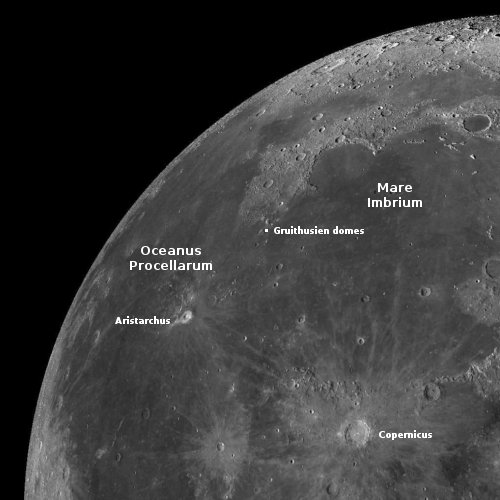
Firefly Aerospace and Honeybee Robotics, a Blue Origin company, today announced Honeybee was contracted by Firefly to provide the lunar rover for the company’s recently awarded NASA task order to explore the Gruithuisen Domes on the Moon’s near side in 2028. Once deployed on the Moon by Firefly’s Blue Ghost lander, Honeybee’s rover will carry NASA instruments to investigate the unique composition of the Gruithuisen Domes.

The funding for this rover actually comes from NASA, awarded first to Firefly which has in turn given a subcontract to Honeybee.

Before this 2028 mission however Firefly will launch its second Blue Ghost mission to the Moon, targeting a 2026 launch date. That second mission will not only land on the far side of the Moon, it will also deploy two lunar orbiters, one for European and the second Firefly’s own orbital tug for these spacecraft that will also service as a communications satellite after deployment.

3 comments

ESA announces competitive program to encourage new European rocket startups

The European Space Agency (ESA) yesterday announced a new competitive award program, dubbed the European Launcher Challenge, designed to give contracts to new European rocket startups to help them develop their own rockets.

Proposals are due no later than May 5, 2025. The program will award up to $183 million to each company, depending on its application. The program has two components, one for rockets that will serve government contracts and will launch beginning in 2026, and the second for rockets that are upgraded by 2028. In both cases a company must complete a demonstration launch by 2027 to qualify for any award. More details here.

Essentially, ESA is structuring this program to provide free subsidies to those companies it decides it likes, with anywhere from two to three getting awards. In January six rocket startups — HyImpulse, Latitude, MaiaSpace, Orbex, Rocket Factory Augsburg and The Exploration Company — submitted a joint letter to ESA endorsing the program and outlining how they think the program should be structured.

Interestingly, the two rocket startups did not sign that letter, Isar Aerospace from Germany and PLD from Spain. Of all these companies, these two are actually closest to launch, with Isar about to attempt its first launch and PLD having already completed a suborbital test flight and building its launch sites in French Guiana and Duqm, Oman.

Officials at PLD are quoted here as apparently opposed to this ESA award program.

“We need to let the market select a winner,” Raúl Verdú, co-founder and chief business development officer of the company, said at the January conference. “Today, to be very honest, it is super-hard to select who will be the winner.”

It will be interesting to see this government program play out. Right now it appears designed to play favorites, a typical European approach. There is a good chance however that it will not do this, and will instead succeed in jumpstarting an independent, competitive European rocket industry. The program’s main structure remains sound, truly capitalistic, whereby the government owns nothing and simply acts as a customer, buying rockets from competing companies on the open market.

0 comments

March 24, 2025 Quick space links

Courtesy of BtB’s stringer Jay. This post is also an open thread. I welcome my readers to post any comments or additional links relating to any space issues, even if unrelated to the links below.

2 comments
1 138 139 140 141 142 182