Webb finds more elements not possible so soon after the Big Bang

A galaxy that shouldn't be there
Click for original image.

The uncertainty of science: Using the Webb Space Telescope, astronomers have now detected emissions of hydrogen from a galaxy that exists only 330 million years after the Big Bang that simply shouldn’t be possible, based on present cosmological theory.

The false-color infrared image of that galaxy is to the right, cropped to post here. At that distance, 13.5 billion light years away, all Webb can really see is this blurry spot. From the press release:

In the resulting spectrum, the redshift was confirmed to be 13.0. This equates to a galaxy seen just 330 million years after the big bang, a small fraction of the universe’s present age of 13.8 billion years old. But an unexpected feature stood out as well: one specific, distinctly bright wavelength of light, known as Lyman-alpha emission, radiated by hydrogen atoms. This emission was far stronger than astronomers thought possible at this early stage in the universe’s development.

“The early universe was bathed in a thick fog of neutral hydrogen,” explained Roberto Maiolino, a team member from the University of Cambridge and University College London. “Most of this haze was lifted in a process called reionization, which was completed about one billion years after the big bang. GS-z13-1 is seen when the universe was only 330 million years old, yet it shows a surprisingly clear, telltale signature of Lyman-alpha emission that can only be seen once the surrounding fog has fully lifted. This result was totally unexpected by theories of early galaxy formation and has caught astronomers by surprise.”

In more blunt terms, the theory that the haze would clear only one billion years after the Big Bang appears very wrong. This result is also similar to the story earlier this week about the detection of oxygen in a similarly early galaxy, oxygen that could not possibly be there only a few hundred million years after the Big Bang. Not enough time had passed for the number of star generations needed to produce it.

You can read the peer-reviewed paper here. While the Big Bang theory is hardly dead, the data from Webb continues to suggest it either needs a major rethinking, or there is something fundamentally wrong with it.

13 comments

UK government continues to dither about fixing its serious red tape issues relating to space

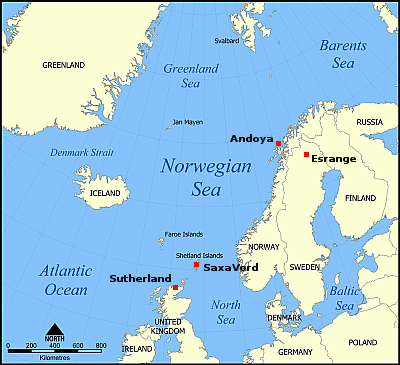
Proposed spaceports surrounding Norwegian Sea

Three different news articles from three different British news sources in the past 24 hours strongly suggest that the factions within the government of the United Kingdom are still unfocused about fixing the serious regulatory red tape that not only bankrupted the rocket startup Virgin Orbit but has delayed for years the first launches from either of its two proposed spaceports in Scotland. The headlines might sound positive, but the details are far less encouraging:

The first article describes the comments of industry officials at a House of Lords committee hearing, where they pleaded with the government to help foster a British launch capability. Sounds good, eh? The problem is that such hearings have been held now repeatedly for the last several years, and Britain’s parliament has done nothing to reform its very cumbersome, complex, and byzantine launch licensing process. Getting approvals still takes months if not years.

It appears that this particular hearing is no different. While it provided government officials the chance to express sympathy for industry in front of news cameras, there is no indication parliament will do anything to fix anything.

The second article describes comments by the Labor government’s technology secretary Peter Kyle before the House of Commons. » Read more

10 comments

NASA: Cygnus capsule damaged in transit to launchpad is too damaged to launch

According to this Ars Technica article today, the Cygnus cargo capsule that was reported to be damaged several weeks ago while being transported in a shipping container to its launchpad has now been found too damaged for launch, according to NASA.

On Wednesday, after a query from Ars Technica, the space agency acknowledged that the Cygnus spacecraft designated for NG-22 is too damaged to fly, at least in the nearterm. “Following initial evaluation, there also is damage to the cargo module,” the agency said in a statement. “The International Space Station Program will continue working with Northrop Grumman to assess whether the Cygnus cargo module is able to safely fly to the space station on a future flight.” That future flight, NG-23, will launch no earlier than this fall.

As a result, NASA is modifying the cargo on its next cargo flight to the space station, the 32nd SpaceX Cargo Dragon mission, due to launch in April. The agency says it will “add more consumable supplies and food to help ensure sufficient reserves of supplies aboard the station” to the Dragon vehicle.

It will be at least half a year before the next Cygnus will be ready for launch.

As the article notes (and immediately occurred to me also), this incident creates an opportunity to help Boeing and Starliner. Last year there were rumors that NASA might pay Boeing to fly Starliner as an unmanned cargo flight to ISS. This would allow the company to test its fixes to the capsule without having to pay for another test flight. These rumors however have faded since Trump took power, suggesting the new administration did not want to pay that extra money.

The loss however of this Cygnus cargo mission not only frees up NASA cash that could be transferred to a Starliner cargo mission, it frees up a slot in the cargo schedule. It actually makes a lot of sense to give Boeing the job.

Unfortunately, unless someone higher up in the Trump administration (possibly Trump himself) makes the decision, we should not expect any action on this idea until NASA’s new administrator is confirmed by the Senate and takes office. And that event remains in limbo at this point.

In the meantime, NASA has no redundancy for getting cargo to ISS, and must rely entirely on SpaceX and its Dragon cargo capsules. A third option, Sierra Nevada’s Tenacity Dream Chaser reusable cargo mini-shuttle, is still not ready to launch. It was supposed to do its first test flight to ISS a year ago, but could not because ground testing had to be done first, and for reasons that are very unclear, it appears that testing has not yet been completed.

8 comments

Two more launches today

Since this morning’s launch by Rocket Lab, there have been two more launches. First, SpaceX placed another 27 Starlink satellites into orbit, its Falcon 9 rocket lifting off from Vandenberg in California.

The first stage completed its 24th flight, landing on a drone ship in the Pacific. This is presently SpaceX’s second most used booster, exceeded only by one that has flown 26 times.

Next China launched a communications satellite for use by its space station and other government space missions, its Long March 3B rocket lifting off from Xichang spaceport in southwest China. No word on where the rocket’s core stage and four side boosters, all using very toxic hypergolic fuel crashed inside China.

The leaders in the 2025 launch race:

35 SpaceX
15 China
5 Rocket Lab
4 Russia

SpaceX still leads the rest of the world in successfully launches, 35 to 27.

0 comments

Space Force finally certifies ULA’s new Vulcan rocket for commercial military launches

After significant delays in developing ULA’s new Vulcan rocket, and then further delays after the rocket’s second test launch (which experienced technical issues), the Space Force today finally announced that it has certified the rocket, thus allowing ULA to proceed with several military launches that have been stalled for months. From ULA’s press release:

In September 2016, ULA entered into an agreement with the U.S. Air Force and outlined the plan to certify Vulcan according to the Air Force’s New Entrant Certification Guide. Over the last few years, the collective ULA and Space Force team have completed 52 certification criteria, including more than 180 discrete tasks, two certification flight demonstrations, 60 payload interface requirement verifications, 18 subsystem design and test reviews, and 114 hardware and software audits.

What was not revealed was the criteria the Space Force used to finally put aside as critical the loss of a nozzle on one of Vulcan’s two side booster’s during the second test launch. While the rocket successfully got its payload into the proper orbit, for a booster to lose a nozzle is not trivial. ULA has recently said it had found the cause and has fixed it, but few details have been revealed. Nor has this new announcement revealed any further details about the fix.

Regardless, this certification is very good news for ULA. Expect it to move as quickly as it can (which will seem slow in comparison to SpaceX) to launch a number of delayed military launches.

6 comments

Restoring a historic racing yacht after buying it for a dollar

An evening pause: The yacht, the Tally Ho, had won an important race in 1927 in Great Britain. The goal is to get this work done so it can compete in 2027 in a similar race in Britain that it won one hundred years previously.

Though after watching the video, it seems this is more like a complete rebuild from scratch rather than a restoration.

Hat tip Cotour.

10 comments

March 26, 2025 Quick space links

Courtesy of BtB’s stringer Jay. This post is also an open thread. I welcome my readers to post any comments or additional links relating to any space issues, even if unrelated to the links below.

5 comments

A major very public protest against Hamas by Gazans

Protest against Hamas, in Gaza

In what might signal a major turning point in Israel’s war against Hamas, many hundreds of Gazans earlier this week marched through the ruins protesting against Hamas quite publicly and apparently with no fear.

Hundreds of Gazans marched through the northern town of Beit Lahiya carrying white flags and chanting anti-Hamas slogans, according to videos posted from the scene, which showed participants calling for peace, press coverage, and the release of hostages.

In a rare public uprising against Hamas rule in Gaza, demonstrators took to the streets outside the Indonesian Hospital in northern Gaza. Footage shared on social media on Tuesday captured a crowd of protesters demanding an end to what they called “tyrant rule,” with chants of “Out, out, out! Hamas out!” and “We want to live!” echoing through the streets.

The images to the right are a screen capture from this video. The tweet claims thousands participated in this protest, with chants of “Down with Hamas, we’ve had enough, Hamas!”

Hamas has controlled Gaza for almost two decades. In that time any hint of protest against it has been routinely met quickly with brutal and violent retaliation. It now appears however that its power within Gaza has been severely damaged by Israel’s aggressive war, killing one leader after another with amazing efficiency.

Recently for example I have noticed in watching videos posted by Hamas supposedly showing Gazans cheering its effort, that if you look closely at the people in the crowd, many do not appear to be enthusiastic or supportive. Instead, these so-called Hamas supporters often have appeared sullen, joining the chants reluctantly almost out of fear.

These new protests against Hamas I think give us a better sense of the situation. Even though there is ample evidence that until recently Gazans of all stripes supported Hamas and were willing to eagerly aid it in its terrorist acts of murder, rape, and torture, it appears that Hamas’s failures in the war are finally taking their toll on its popularity.

These protests are a great opportunity for Israel, if it moves fast. If it can find and identify these protesters, especially their leaders, and protect them, it will further isolate Hamas and make its destruction more likely. It will also sow the seeds of a new leadership in Gaza that might actually be willing to live in peace with Israel.

47 comments

As Space Force switches to capitalism model for its satellites, it will also not name the companies it hires

Capitalism in space: The main reason President Trump got the Space Force established in his first term was because the Air Force resisted rethinking its space military operations. It insisted on building large government-built satellites that took years to complete and always went overbudget and behind schedule.

The creation of the Space Force gave new people the ability to push for a major change, switching to the capitalism model whereby the government designed and built nothing but instead acted as a customer buying what it needed from the private sector. In addition, it allowed a major shift from those big satellites — easy targets for destruction — to the large private constellations of many small satellites, cheap to build and launch and difficult for other militaries to take out.

The Space Force — in order to protect the satellite companies it hires to build these satellites — has now announced that it will no longer publish the names of those companies.

The U.S. Space Force plans to keep the names of commercial companies participating in its new space reserve program under wraps, aiming to protect them from potential adversary threats as commercial satellites play a growing role in military operations.

Col. Richard Kniseley, director of the Space Force’s Commercial Space Office, said companies signing agreements under the Commercial Augmentation Space Reserve (CASR) program can disclose their participation but are not required to. “That potentially puts a target on their back,” Kniseley told SpaceNews, underscoring the risk to private-sector firms providing space-based services during wartime.

Under this program, the Space Force has already signed contracts with four satellite companies, but the names remain undisclosed.

Though there is some logic to this decision, it carries great risk of corruption and misbehavior. Almost every time government bureaucrats and private companies are allowed to work in secret we routinely see kickbacks, bribery, and contract payoffs. And don’t expect congressional oversight to prevent such things, since there is now ample evidence from DOGE that our federal lawmakers have been quite willing to take their own payoffs to allow such corruption to prosper.

The switch to capitalism by the Pentagon is unquestionably a good thing. It will get more done for less. Letting it act in secrecy is a mistake however. Better to live with the risk of attack than allow our government and the companies it issues big money contracts to do things behind closed doors.

6 comments

Parker completes 23rd close fly-by of Sun, matching record set by its previous fly-by

The Parker Solar Probe on March 22, 2025 successfully completed its 23rd close fly-by of Sun, matching the distant and speed records set by its previous fly-by in December 2024.

NASA’s Parker Solar Probe completed its 23rd close approach to the Sun on March 22, equaling its own distance record by coming within about 3.8 million miles (6.1 million kilometers) of the solar surface. The close approach (known as perihelion) occurred at 22:42 UTC — or 6:42 p.m. EDT — with Parker Solar Probe moving 430,000 miles per hour (692,000 kilometers per hour) around the Sun, again matching its own record.

Actual science data won’t be downloaded from the spacecraft for several weeks, but it has sent back a signal that it is in good shape and operating as expected.

1 comment

Webb images in the infrared the aurora of Neptune

The aurora of Neptune
Click for original image.

Astronomers using the Webb Space Telescope have captured the first infrared images of the aurora of Neptune, confirming that the gas giant produces this phenomenon.

The picture to the right combines infrared data from Webb and optical imagery from the Hubble Space Telescope. The white splotches near the bottom of the globe are clouds seen by Hubble. The additional white areas in the center and near the top are clouds detected by Webb, while the greenish regions to the right are aurora activity detected by Webb.

The auroral activity seen on Neptune is also noticeably different from what we are accustomed to seeing here on Earth, or even Jupiter or Saturn. Instead of being confined to the planet’s northern and southern poles, Neptune’s auroras are located at the planet’s geographic mid-latitudes — think where South America is located on Earth.

This is due to the strange nature of Neptune’s magnetic field, originally discovered by Voyager 2 in 1989, which is tilted by 47 degrees from the planet’s rotation axis. Since auroral activity is based where the magnetic fields converge into the planet’s atmosphere, Neptune’s auroras are far from its rotational poles.

The data also found that the temperature of Neptune’s upper atmosphere has cooled significantly since it was first measured by Voyager 2 in 1989, dropping by several hundred degrees.

12 comments
1 137 138 139 140 141 182