SpaceX launches reconnaissance satellite for National Reconnaissance Office

SpaceX today successfully placed a classified reconnaissance payload into orbit for National Reconnaissance Office, its Falcon 9 rocket lifting off from Cape Canaveral in Florida.

The first stage completed its second flight, landing back at Cape Canaveral.

The leaders in the 2025 launch race:

34 SpaceX
14 China
4 Russia
4 Rocket Lab

SpaceX now leads the rest of the world in successfully launches, 34 to 25.

0 comments

New Webb infrared image reveals galaxy hidden behind outflow from baby star

Webb infrared image of baby star outflow
Click for original image.

Cool image time! The false-color infrared image to the right, cropped, reduced, and sharpened to post here, was taken by the Webb Space Telescope of the outflow from a baby star, dubbed Herbig-Haro 49/50, located about 625 light years away.

The picture was taken to get a better understanding of the flow itself. Earlier infrared images at much lower resolution by the Spitzer Space Telescope had left many features in this outflow unclear. For example, at the head of the outflow the Spitzer infrared image was unable to clearly identify the background spiral galaxy located there. In those earlier images it could have instead been a part of the outflow itself.

The galaxy that appears by happenstance at the tip of HH 49/50 is a much more distant, face-on spiral galaxy. It has a prominent central bulge represented in blue that shows the location of older stars. The bulge also shows hints of “side lobes” suggesting that this could be a barred-spiral galaxy. Reddish clumps within the spiral arms show the locations of warm dust and groups of forming stars. The galaxy even displays evacuated bubbles in these dusty regions

The actual source from which this flow comes remains unconfirmed, though astronomers think the source is one particular protostar about 1.5 light years away.

3 comments

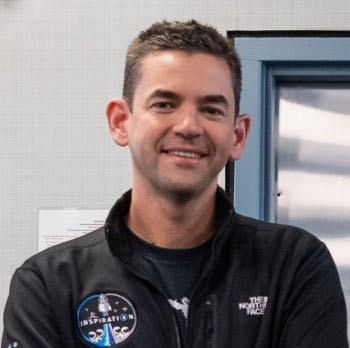
Rolling Stone provides more details about Jared Isaacman and his nomination as NASA administrator

Jared Isaacman
Jared Isaacman

This article from Rolling Stone published yesterday provides a wealth of new information about Jared Isaacman, Trump’s still unconfirmed pick to become NASA’s next administrator.

Two key details: First, the article quotes Isaacman saying he opposes NASA’s policy of signing up two companies, SpaceX and Blue Origin, to build manned lunar landers.

I will try to help, but this is why I get frustrated at two lunar lander contracts, when will be lucky to get to the [Moon] a few times in the next decade. People falsely assume its because I want SpaceX to win it all, but budgets are not unlimited & unfortunate casualties happen.

In other words, he opposes using NASA to develop an aerospace industry with multiple companies capable of doing things NASA needs done. He also appears to dismiss the value of redundancy that two landers provides.

Second, the article provides links to the financial [pdf] and ethics [pdf] disclosures that he submitted to the government after being named as nominee. In the financial statement he indicates he paid SpaceX more than $50 million for providing the transportation for his multi-mission Dragon/Starship Polaris Dawn manned program. In the ethics statement he asserts he would end that contract if confirmed as NASA administrator, with SpaceX refunding any monies for services not yet rendered. The program itself would be suspended until Isaacman completes his term as administrator.

The Rolling Stone article, though detailed and fair-minded, appears to strongly endorse Isaacman, and thus joins a growing public campaign from many insider Washington players — a large number of whom have been passionately hostile to Donald Trump — to get Isaacman approved. At the moment however his nomination appears stalled because the Trump administration has not yet submitted to the Senate the paperwork needed to allow that body to schedule hearings.

The strange campaign by many of Trump’s opponents to endorse Isaacman continues to suggest to me that the Trump administration has had second thoughts about its NASA nominee. The swamp now wants him, and this is raising hackles inside the administration, which thus explains the slow-walking of his paperwork.

25 comments

South Korean rocket startup Innospace details successful tests of its portable launchpad

Engineering test prototype during tests
Click for original image.

The South Korean rocket startup Innospace has now provided some additional details about its testing of the portable launchpad and strongback that it will use on its first planned rocket launch in July 2025.

The Launch Pad-Vehicle Interface Integrated System Test comprehensively verifies the operational readiness of the launch vehicle and launch pad, covering processes from vehicle assembly and pad integration to vertical erection, propellant supply system checks, and final operational validation. During the test, INNOSPACE confirmed the mechanical and electrical interfaces between the launch pad and vehicle, the transporter erector launcher system, the detachment of the Umbilical, the fuel and oxidizer supply system, and the separation of the launch vehicle hold-down mechanism, ensuring technical reliability and operational stability.

The launch pad that successfully completed the test, is scheduled for maritime transportation to the Alcântara Space Center in Brazil on April 2. Upon arrival in May, it will undergo installation and final verification in the local environment to complete preparations for launch operations. In addition, the launch vehicle used in this test was the HANBIT-Nano Qualification Model (QM), which shares the same specifications—21.8 meters in height and 1.4 meters in diameter—as the Flight Model (FM) scheduled for launch in July.

The company will still need to do these same tests in Brazil at its Alcântara spaceport using the actual rocket, dubbed Hanbit-Nano, before the launch can occur. Thus. meeting that July target date is likely difficult if not impossible. At the same time it does appear the company has a chance of launching before the end of this year.

0 comments

Perseverance spots a rock made of many tiny spherules

Rock made of spherules found by Perseverance
Click for wide shot. The original of the inset
can be found here.

In their exploration of the outer flanks of the rim of Jezero Crater, the science team operating the Perseverance rover have discovered an unusual rock different than everything around it, appearing to be made of many very tiny spherules.

The picture to the right illustrates this. The wider picture was taken by Perseverance’s left high resolution camera, with the inset a close-up mosaic of three images taken by the rover’s micro-imager, designed to get very very high resolution pictures of small objects. From the press release:

The rock, named “St. Pauls Bay” by the team, appeared to be comprised of hundreds of millimeter-sized, dark gray spheres. Some of these occurred as more elongate, elliptical shapes, while others possessed angular edges, perhaps representing broken spherule fragments. Some spheres even possessed tiny pinholes! What quirk of geology could produce these strange shapes?

This isn’t the first time strange spheres have been spotted on Mars. In 2004, the Mars Exploration Rover Opportunity spotted so-called, “Martian Blueberries” at Meridiani Planum, and since then, the Curiosity rover has observed spherules in the rocks of Yellowknife Bay at Gale crater. Just a few months ago, Perseverance itself also spied popcorn-like textures in sedimentary rocks exposed in the Jezero crater inlet channel, Neretva Vallis. In each of these cases, the spherules were interpreted as concretions, features that formed by interaction with groundwater circulating through pore spaces in the rock.

Not all spherules form this way, however. They also form on Earth by rapid cooling of molten rock droplets formed in a volcanic eruption, for instance, or by the condensation of rock vaporized by a meteorite impact.

At the moment the science team has no idea which of these theories explains the spherules. That the rock is located on the crater rim, where ejecta from the impact will be found, strongly suggests the impact was the cause, not groundwater flow.

7 comments

NASA drops its DEI emphasis on race and sex in describing who will fly on first Artemis lunar landing

Not surprisingly, considering Trump’s executive orders demanding all government agencies discontinue their racial and sex quotas based on the bigoted Diversity, Equity, and Inclusion (DEI) policies, NASA has now deleted any mention of launching the first “woman and person of color” on its first Artemis lunar landing mission.

The Artemis landing page of Nasa’s website previously included the words: “Nasa will land the first woman, first person of color, and first international partner astronaut on the Moon using innovative technologies to explore more of the lunar surface than ever before.” The version of the page live on the website on Friday, however, appears with the phrase removed.

During the Biden administration every single press release about this first Artemis lunar landing touted these racial and sexual qualifications, as if it was the only thing that mattered in choosing the right astronauts for the job. It was not only illegal discrimination against men and whites, it was insulting to minorities and women.

This change in language does not mean that NASA will now purposely exclude “women or people of color” from that mission. Instead, it ends the emphasis on race and sex. The astronauts NASA chooses for the flight will now be picked based on more important considerations, such as experience and talent. Picking someone because of their race or gender is like picking someone because of the color of their eyes or hair. It is stupid and misguided. Trump has now ended that stupidity.

Or at least he is forcing NASA’s management make its bigotry less obvious. We should not be surprised if that management still intends to make race and sex a major criteria. They will simply no longer blast that decision with a bullhorn.

8 comments

March 21, 2025 Quick space links

Courtesy of BtB’s stringer Jay. This post is also an open thread. I welcome my readers to post any comments or additional links relating to any space issues, even if unrelated to the links below.

  • European Space Agency (ESA) releases a report outlining its overall strategy through 2040
    Contains lots of typical bureaucratic blather. It actually means little, as the real strategies are presently being established by the individual European nations independent of this central bureaucracy. Rather than depend on ESA, the member nations are one-by-one encouraging private enterprise, not government projects. ESA is likely going to become a backwater in the next decade, and unnecessary after that.
16 comments

The insane left keeps shooting itself in the foot!

Tesla vandal identified and arrested
Click for video.

The recent string of vandalism of Tesla vehicles as well as swatting attacks on well known conservatives by leftist crazies might be scary, horrifying, and disgusting, but if you take a step back from these emotions for a second to look dispassionately at the situation, you will realize these attacks are only the dying screams of a bankrupt political movement that has no proposals, no ideas, and no goals except the obtaining of power — now through the use of violence because its political support has dropped to such record lows.

First, the attacks are beyond senseless. In the case of the vandalism of Teslas, the attacks are actually doing harm to those who in the past were most likely to have supported the Democratic Party’s leftist political agenda. Conservatives in general have not been buying electric vehicles, because they have no need to virtue signal leftist climate goals. So, by damaging Teslas owned by innocent bystanders, just because the car was built by a company founded by Elon Musk, the vandals are not only not winning converts to their cause, they are making enemies of people who were once on their side.
» Read more

14 comments

New research finds cosmic rays hitting the atmosphere cause of the ignition of lightning

Two lightning flashes graphed
Click for original image.

New research has now found that the shower of energy produced when a cosmic ray hits the atmosphere could be a major cause for the ignition of lightning in thunderheads.

You can read the paper here. The two graphs to the right are taken from figure 3 of the paper, and show two different lightning events. The colors represent time, going from green (earliest) to blue to yellow and red (latest). The white dot marks the spot where the lightning flash started. From the article above:

We believe that that most lightning flashes in thunderstorms are ignited by cosmic ray showers,” says the study’s lead author Xuan-Min Shao, a senior scientist at the Los Alamos National Laboratory in New Mexico.

…One of the important things about cosmic ray showers is that they contain antimatter–positrons as well as ordinary electrons. The Los Alamos 3D lightning maps contained strong evidence for positrons. Electrons and positrons are bent in opposite directions by Earth’s magnetic field, so they leave opposite imprints on the lightning’s polarization, which BIMAP-3D also measured.

…Positrons clinched the case for cosmic rays. “The fact that a cosmic ray shower provides an ionized path in the cloud that otherwise lacks free electrons strongly favor the inference that most lightning flashes are ignited by cosmic rays,” the authors wrote.

It remains unclear if cosmic rays cause all lightning flashes or just some. Either way, it is a remarkable thing to consider: Cosmic rays are created in distant interstellar and even intergalactic events. The rays take millions, maybe billions of years to reach Earth. And when they do, they produce lightning in thunderstorms!

Hat tip reader Steve Golson.

7 comments

Oxygen found in the most distant known galaxy, too soon after the Big Bang

The uncertainty of science: Astronomers studying the most distant galaxy so far discovered, 13.4 billion light years away and existing only 300 million years after the Big Bang, have now detected the existence of oxygen, an element that simply should not have had the time to develop in such a short time span.

The new oxygen detection with ALMA, a telescope array in Chile’s Atacama Desert, suggests the galaxy is much more chemically mature than expected. “It is like finding an adolescent where you would only expect babies,” says Sander Schouws, a PhD candidate at Leiden Observatory, the Netherlands, and first author of the Dutch-led study, now accepted for publication in The Astrophysical Journal. “The results show the galaxy has formed very rapidly and is also maturing rapidly, adding to a growing body of evidence that the formation of galaxies happens much faster than was expected.”

Galaxies usually start their lives full of young stars, which are made mostly of light elements like hydrogen and helium. As stars evolve, they create heavier elements like oxygen, which get dispersed through their host galaxy after they die. Researchers had thought that, at 300 million years old, the Universe was still too young to have galaxies ripe with heavy elements. However, the two ALMA studies indicate JADES-GS-z14-0 has about 10 times more heavy elements than expected.

The spectroscopy that confirmed the oxygen also allowed the scientists to confirm the galaxy’s distance, which also confirmed the fact that there is something seriously wrong with the present theories of cosmologists about the formation of the universe. Present theory requires at least several generations of star birth followed by star death, with each forming heavier and heavier atoms. Such a process is expected to take far more than 300 million years.

Either that theory is very wrong, or the theory of the Big Bang has problems. The facts don’t fit the theories, and when that happens, it is the theories that must be abandoned.

9 comments
1 139 140 141 142 143 182