SpaceX launches 23 more Starlink satellites, including 13 with phone-to-satellite capabilities

SpaceX today successfully launched another 23 Starlink satellites, its Falcon 9 rocket lifting off from Cape Canaveral in Florida.

The first stage completed its nineteenth flight, landing on a drone ship in the Atlantic.

The leaders in the 2025 launch race:

32 SpaceX
13 China
4 Russia
4 Rocket Lab

SpaceX now leads the rest of the world in successfully launches, 32 to 24.

0 comments

More surprises from the Wolf-Rayet star numbered 104 and known for its pinwheel structure

Keck infrared data of WR104

Among astronomers who study such things, Wolf-Rayet 104 is one of the most well known OB massive stars in their catalog, with the infrared picture to the right illustrating why. The star is actually a binary of massive stars, orbiting each other every eight months. Both produce strong winds, and the collision of those winds results in a glorious pinwheel structure that glows in the infrared.

Such stars are also believed to be major candidates to go supernova and in doing so produce a powerful gamma ray burst (GRB) that would shoot out from the star’s poles. As the orientation of this pinwheel suggests we are looking down into the pole of the system, this star system was actually considered a potentially minor threat to Earth. Located about 8,400 light years away, this is far enough away to mitigate the power of the GRB, but not eliminate entirely its ability to damage the Earth’s atmosphere.

New research now suggests however that despite the orientation of the pinwheel, face-on, the plane of the binary star system is actually tilted 30 to 40 degrees to our line of sight. The press release asks the new questions these results raise:

While a relief for those worried about a nearby GRB pointed right at us, this represents a real curveball. How can the dust spiral and the orbit be tilted so much to each other? Are there more physics that needs to be considered when modelling the formation of the dust plume?

You can read the paper here. It is a quite refreshing read, not just because of its relatively plain language lacking jargon, but because of its willingness to list at great length the uncertainties of the data.

1 comment

Isar confirms March 20, 2025 for first launch

Proposed spaceports surrounding Norwegian Sea

The German rocket startup Isar Aerospace has now confirmed that it will attempt the first orbital test launch of its Spectrum rocket on March 20, 2025, lifting off from Norway’s Andoya spaceport.

Isar announced March 17 that the Norwegian Civil Aviation Authority (CAA) issued a launch operator license to the company for its Spectrum rocket, launching from Andøya Spaceport in northern Norway. The launch, called “Going Full Spectrum” by the company, is a test flight of Spectrum with no customer payloads on board. “Our goal is to test each and every component and system of the launch vehicle,” Alexandre Dalloneau, vice president of mission and launch operations at Isar Aerospace, said in a statement about the upcoming launch.

Isar Aerospace did not announce a specific time for the launch, noting the timing would depend on weather as well as range and vehicle readiness.

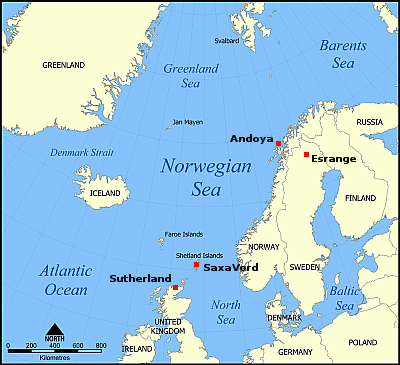
This launch is also going to be the first vertical orbital rocket launch from the European continent, and will put Andoya ahead of the three other spaceports being developed in the United Kingdom and Sweden. For the two UK spaceports this launch will be especially embarrassing, as both started years before Andoya but have been endlessly hampered by red tape, government interference, and local lawsuits. Norway meanwhile has moved with alacrity in approving Andoya’s permits and Isar’s launch licenses.

As for Isar, this launch puts it in the lead over the half dozen or so new European rocket startups as the first to attempt a launch. None of the others are close to that first launch attempt, though the German startup Rocket Factory Augsburg came close last year. During its last static fire test of the first stage prior to launch the rocket was destroyed in a fire.

0 comments

Curiosity’s newest view from the heights

Mars in its glorious barrenness
Click for original image.

Overview map
Click for interactive map.

Cool image time! The panorama above, cropped slightly to post here, was taken today by the right navigation camera on the Mars rover Curiosity. It looks north from the rover’s present location on the flank of Mount Sharp, with the rim of Gale Crater in the far distance about 20 to 30 miles away. Curiosity now sits about 3,000 feet above the floor of the crater.

The blue dot on the overview map to the right marks the rover’s position at this time. The yellow lines indicate the approximate view of the panorama. As with all of the images from both Curiosity and Perseverance, the main impression is a barren and lifeless landscape of incredible stark beauty.

It is now very evident that the Curiosity science team has made the decision to abandon their original route to the west. Instead, they have decided to strike south up into this canyon because it provides them the easiest and fastest route to the boxwork geology to the southwest. It also has them climbing into new geological layers rather than descending into layers that the rover has already seen.

3 comments

SpaceX’s manned Freedom capsule has undocked with ISS with its crew of four

SpaceX’s manned Freedom capsule tonight undocked with ISS, carrying with it the two astronauts that launched with it in September as well as the two astronauts that launched on Boeing’s Starliner capsule in June.

At 1:05 a.m. EDT Tuesday, NASA astronauts Nick Hague, Suni Williams, and Butch Wilmore, along with Roscosmos cosmonaut Aleksandr Gorbunov undocked from the space-facing port of International Space Station’s Harmony module aboard the SpaceX Dragon spacecraft.

Splashdown is scheduled for 5:57 pm (Eastern) March 18, 2025 off the coast of Florida. I have embedded the NASA live stream below.

Normally the transfer of control of the station from the old crew to the new one takes about a week. In this case NASA cut that transfer time to only three days because of the political desire to get the Starliner astronauts home more quickly. The irony is that NASA decided to leave them up there for almost seven months more than planned in order to disturb its normal ISS launch and crew schedule as little as possible. This effort now to shorten their spaceflight by a few measly days seems quite trivial in comparison.
» Read more

6 comments

Rocket Lab launches the last of five missions for French satellite company

Rocket Lab today successfully completed the last of a five missions contract for the French satellite company Kinéis, its Electron rocket lifting off from one of its two launch pads in New Zealand.

This was Rocket Lab’s second launch in only two days.

The leaders in the 2025 launch race:

31 SpaceX
13 China
4 Russia
4 Rocket Lab

SpaceX still leads the rest of the world in successfully launches, 31 to 24.

0 comments

March 17, 2025 Quick space links

Courtesy of BtB’s stringer Jay. This post is also an open thread. I welcome my readers to post any comments or additional links relating to any space issues, even if unrelated to the links below.

8 comments

The next time someone tells you Mars lacks water, show them this picture

Lots of near surface ice on Mars
Click for original image.

In the past decade orbital images from Mars have shown unequivocally that the Red Planet is not the dry desert imagined by sci-fi writers for many decades prior to the space age. Nor is it the dry desert that planetary scientists had first concluded based on the first few decades of planetary missions there.

No, what the orbiters Mars Reconnaissance Orbiter (MRO) and Mars Express have clearly shown is that, except for the planet’s equatorial regions below 30 degrees latitude, the Martian surface is almost entirely covered by water ice, though it is almost always buried by a thin layer of protective dust and debris. Getting to that ice will be somewhat trivial, however, as it is almost always near the surface.

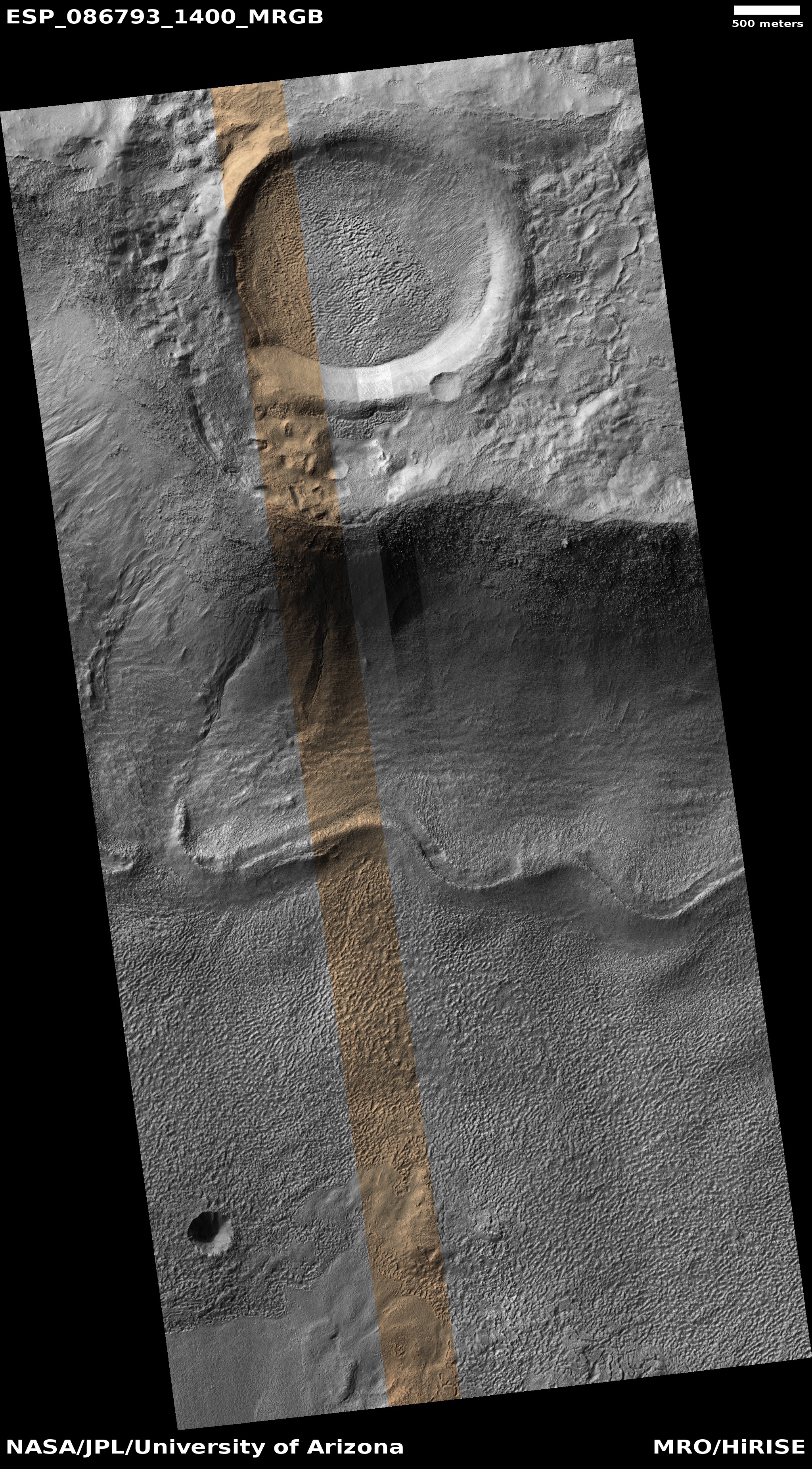
The picture to the right, rotated, cropped, reduced, and sharpened to post here, is a perfect example. It was taken on January 31, 2025 by the high resolution camera on MRO. At the top it shows part of a small glacial-filled crater surrounded by blobby ground clearly impregnated with ice. That crater in turn sits on the rim of a much larger very-eroded ancient 53-mile-wide crater whose floor, also filled with glacial debris, can be seen at the bottom of this picture. The wavy ridge line at the base of the rim appears to be a moraine formed by the ebb and flow of the glacial ice that fills this larger crater.

None of these glacial features is particularly unique on Mars. I have been documenting their presence now at Behind the Black for more than six years. Yet, I find still that most news organizations — including many in the space community — remain utterly unaware of these revelations. Any new NASA or university press release that mentions the near-surface ice that covers about two-thirds of the planet’s surface results in news stories claiming “Water has been found on Mars!”, as if this is a shocking new fact from a place where little water is found.

It is very shameful that so many reporters and news organizations are so far out of touch with the actual state of the research on Mars.
» Read more


11 comments

Webb captures infrared images of five exoplanets orbiting two different stars

Four gas giants in infrared
Click for original image.

Using the Webb Space Telescope, astronomers have taken two different direct false-color infrared images of exoplanets orbiting the stars HR 8799 (130 light years away) and 51 Eridani (97 light years away.

The image of the four gas giants orbiting HR 8799 is to the right, cropped, reduced, and slightly enhanced to post here. From the caption:

The closest planet to the star, HR 8799 e, orbits 1.5 billion miles from its star, which in our solar system would be located between the orbit of Saturn and Neptune. The furthest, HR 8799 b, orbits around 6.3 billion miles from the star, more than twice Neptune’s orbital distance. Colors are applied to filters from Webb’s NIRCam (Near-Infrared Camera), revealing their intrinsic differences. A star symbol marks the location of the host star HR 8799, whose light has been blocked by the coronagraph. In this image, the color blue is assigned to 4.1 micron light, green to 4.3 micron light, and red to the 4.6 micron light.

The Webb false color infrared picture taken of one of the exoplanets orbiting the star 51 Eridani is also at the link, showing “a cool, young exoplanet that orbits 890 million miles from its star, similar to Saturn’s orbit in our solar system.”

The data from the HR 8799 image suggests these gas giants have a lot of carbon dioxide gas, and thus might be growing by pulling in material from the star’s accretion disk.

0 comments

Avio to begin testing its own Grasshopper prototype later this year

According to recent changes to its proposed plans, it appears that the Italian rocket company Avio hopes to begin tests of its own Grasshopper prototype vertical takeoff-and-landing stage later this year, with the hope of incorporating a reusable first stage in its upgraded Vega-Next rocket.

In the latest rendering shared in Avio’s 2024 full-year financial results presentation, control surfaces resembling those on a Falcon 9 booster are visible, seemingly confirming that the stage will be used to explore reusability.

In addition to the new rendering, Avio’s 2024 full-year financial results presentation included an update on the progress of the IFD1 mission. According to the company, integration of the demonstrator is ongoing, with an initial “firing test” expected in the third quarter of 2025. This test will likely be the final major milestone before the demonstrator is launched.

The company is targeting a 2032 first orbital launch of Vega-Next. Right now Avio owns the Vega-C rocket, and is the only private rocket company in Europe launching its own rocket. The only other operational European rocket, the larger Ariane-6, is operated by the European Space Agency. Another half-dozen-plus new private rockets are under development by other European rocket startups, but non have so far launched.

0 comments

Norway awards the German rocket startup Isar Aerospace a two-satellite contract

Proposed spaceports surrounding Norwegian Sea

In what appears to be a concerted effort by Norway to cement the establishment of its Andoya spaceport on its northwest coast, last week it awarded a two-satellite launch contract to the German rocket startup Isar Aerospace, launching from that spaceport.

The launch is scheduled until 2028 and will take place from Andøya Spaceport, Europe’s first operational spaceport on the mainland. The agreement between the Norwegian Space Agency and Isar Aerospace involves launching two Norwegian satellites as part of the AOS program, a national maritime surveillance system.

Isar is now gearing up for the very first orbital test launch of its Spectrum rocket, which will also be the very first from Andoya, and the very first from the four proposed spaceports in Europe. Regulatory filings from Norway suggest it will occur during a ten-day launch window beginning on March 20, 2025, but Isar has not yet confirmed this.

Unlike the two UK spaceports, which have been delayed years due to government red tape, Norway’s government has apparently worked hard to cut red tape and help Isar get off the ground quickly. It also appears that Norway’s government is acting to stymie Sweden’s Esrange spaceport, releasing a report last week that suggested it will not give permission for launches over its territory from Esrange.

0 comments
1 141 142 143 144 145 182