
Billy F Gibbons, ZZ Ward, & Orianthi – Sharp Dressed Man
An evening pause: Performed live 2017.
Hat tip Judd Clark.
An evening pause: Performed live 2017.
Hat tip Judd Clark.
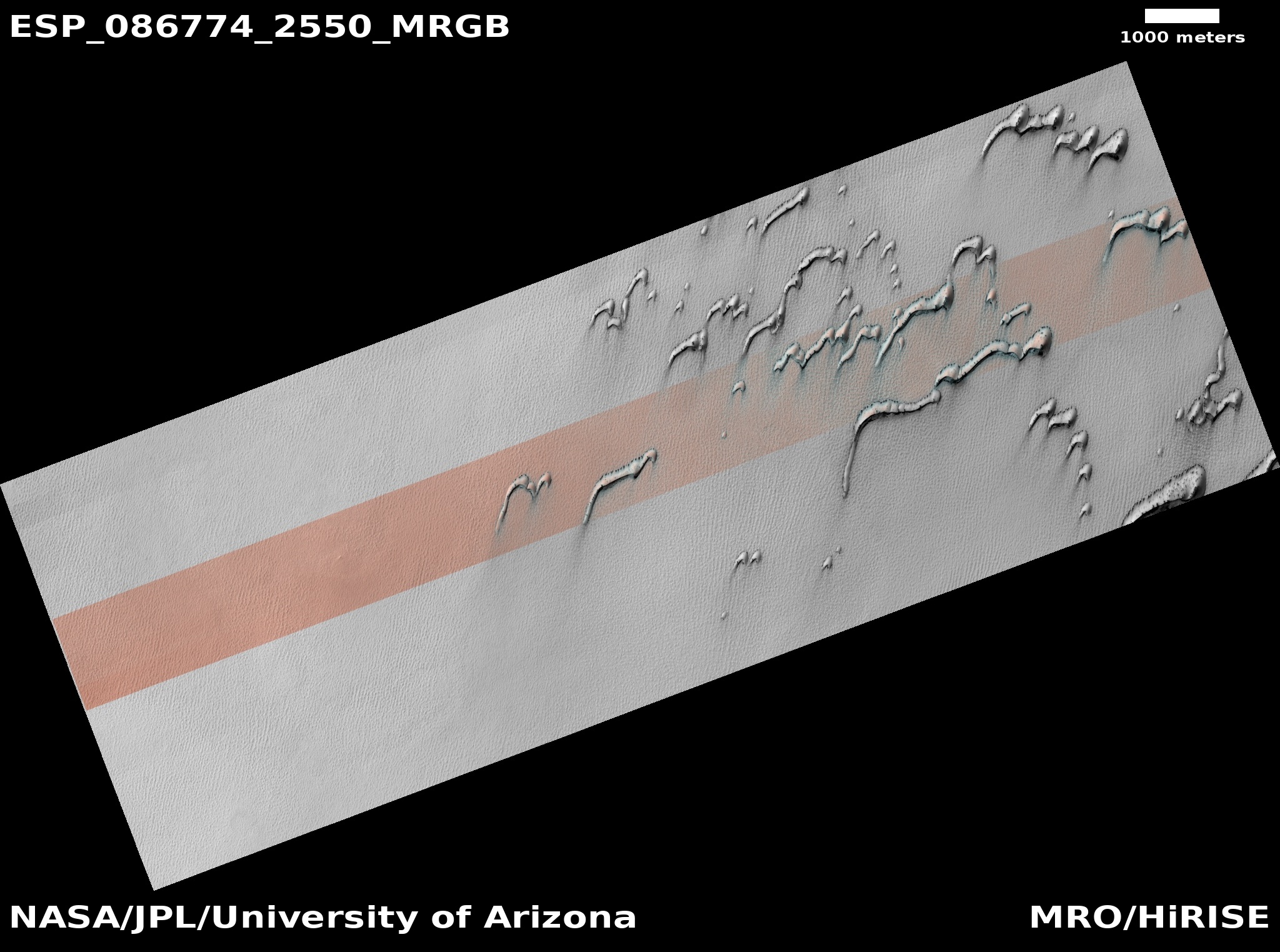
Click for original image.
Cool image time! The picture to the right cropped, reduced, and sharpened to post here, was taken on January 29, 2025 by the high resolution camera on Mars Reconnaissance Orbiter (MRO). I have also rotated it so north is up. Labeled simply as a “terrain sample,” it was likely taken not as part of any specific research request but to fill a gap in the schedule in order to maintain the camera’s proper temperature.
In this case the timing allowed the camera team to capture this breath-taking picture of these graceful arching dunes sitting in what is likely the near-surface ice sheet that covers much of the red planet’s high latitudes. That sheet is not pure ice, but a complex mixture of ice, dirt, dust, and sand, covered during the winter by a thin mantle of dry ice.
The isolated dunes appear to be ridges sticking up from that flat terrain, but this impression is probably incorrect, based on the location.
» Read more
Readers!
My annual February birthday fund-raising drive for Behind the Black is now over. Thank you to everyone who donated or subscribed. While not a record-setter, the donations were more than sufficient and slightly above average.
As I have said many times before, I can’t express what it means to me to get such support, especially as no one is required to pay anything to read my work. Thank you all again!
The Chinese man, Yinpiao Zhou, who was arrested in November when he flew a spy drone illegally over Vandenberg Space Force Base for almost an hour, has now been convicted of a misdemeanor.
A 39-year-old man from Contra Costa County and Chinese citizen, Yinpiao Zhou, pled guilty to a misdemeanor charge in U.S. District Court in Los Angeles Monday morning for flying a drone over Vandenberg Space Force Base, according to the U.S. Attorney’s Office.
Zhou was arrested in December on charges of failing to register an aircraft that was not providing transportation and violation of national defense airspace, based on federal court documents. Following an indictment by a federal grand jury on the two misdemeanor charges, Zhou, under a plea agreement, admitted guilt to one charge—violation of national defense airspace. … The plea agreement stipulates Zhou may face up to one year imprisonment, one year supervised release, and a $100,000 fine.
All the evidence suggests this guy was doing spying for China. For one, he was arrested at the airport as he tried to board a plane back to flee back to China. Second, when confronted by security he lied about his actions, trying to hide the drone. Third, he had an accomplice who security people foolishly allowed to get away, who is still unidentified and still at large (assuming he is even still in the country).
Based on these facts, at a minimum Zhou should be immediately deported after he completes his one year sentence. In the past he would not have gotten off so lightly. He would have been tried as a spy, and hanged.
In a sign that suggests OneWeb is losing the competition to begin satellite internet access to India, SpaceX this week has signed two Starlink deals with India’s two largest telecom operators.
Jio Platforms, the subsidiary of India’s conglomerate Reliance Industries and the country’s largest telecom operator, Wednesday announced a partnership with Elon Musk’s SpaceX to offer Starlink’s satellite broadband internet services to its customers in India. Under the agreement, which is subject to regulatory approvals, Jio and SpaceX will explore using Starlink to extend the telco’s offerings, while Jio will sell Starlink equipment through its retail outlets and online storefronts, the telco said in a press statement.
…Earlier Wednesday, Airtel, India’s second-biggest telco, announced a similar partnership with SpaceX to offer Starlink through its channels. The Airtel partnership is also subject to SpaceX’s regulatory approvals in the country, which are in process with IN-SPACe and the Department of Telecommunications.
SpaceX had previously tried to bring Starlink to India by selling subscriptions directly to customers but was forced to pull back when the government denied it regulatory approval. These two deals suggest that the government wanted SpaceX to partner with Indian companies, keeping some of its profits in-country.
These deals also suggest that OneWeb is failing to provide good service to the Indian market, even though it is half owned by a major Indian investor and got regulatory approval several years ago. The design of OneWeb’s system requires the construction of ground stations to link its satellite constellation with the ground operations, and it appears this added step is causing delays that is forcing the telecom industry to look elsewhere. For example, the same thing has happened in the Falkland Islands, which signed first with OneWeb (which is also half owned by the UK government) but has now approved Starlink because OneWeb wasn’t able to provide its service on time.
Using a ground-based telescope, astronomers have now identified 128 new moons circling Saturn, bringing its moon count to 274, more than the total moons around all the other planets in the solar system combined.
Edward Ashton at Academia Sinica in Taipei, Taiwan, and his colleagues found the new moons with the Canada-France-Hawaii Telescope, revealing dozens that have previously evaded astronomers. They took hours of images of Saturn, adjusted them for the planet’s movement through the sky and stacked them on top of each other to reveal objects that would otherwise be too dim to see.
All the new moons are between 2 and 4 kilometres in diameter and are likely to have been formed hundreds of millions or even billions of years ago in collisions between larger moons, says Ashton.
That Saturn has so many moons should surprise no one. Saturn actually has possibly millions, maybe even billions, of moons, if you count every particle in its rings. In fact, the gas giant poses a problem for astronomers in defining what a moon actually is. How small must an object be before you stop calling it a moon?
Two launches to report: First, China yesterday successfully completed its first Long March 8 launch from its new launchpad at its coastal Wenchang spaceport, placing 18 satellites for SpaceSail internet constellation, the fifth group so far launched.
China’s state run press noted that the launchpad is designed to allow the Long March 8 rocket to launch every seven days, a pace needed to place these giant Chinese satellite constellations into orbit.
Next, in the early morning hours today SpaceX successfully launched two different NASA science missions, its Falcon 9 rocket lifting off from Vandenberg in California.
The prime payload was SPHEREx, a space telescope designed to make an all-sky survey. The secondary payload was PUNCH, four satellites forming a constellation to study the Sun.
The rocket’s first stage completed its third flight, landing back at Vandenberg.
The leaders in the 2025 launch race:
27 SpaceX
11 China
3 Russia
2 Rocket Lab
As happened last year, SpaceX handily leads the rest of the world, including American companies, in total launches, 27 to 20. This lead will be extended tonight should the company’s next manned Dragon launch to ISS go off as planned.
An evening pause: Performed live 2007.
Hat tip Diane Zimmerman.
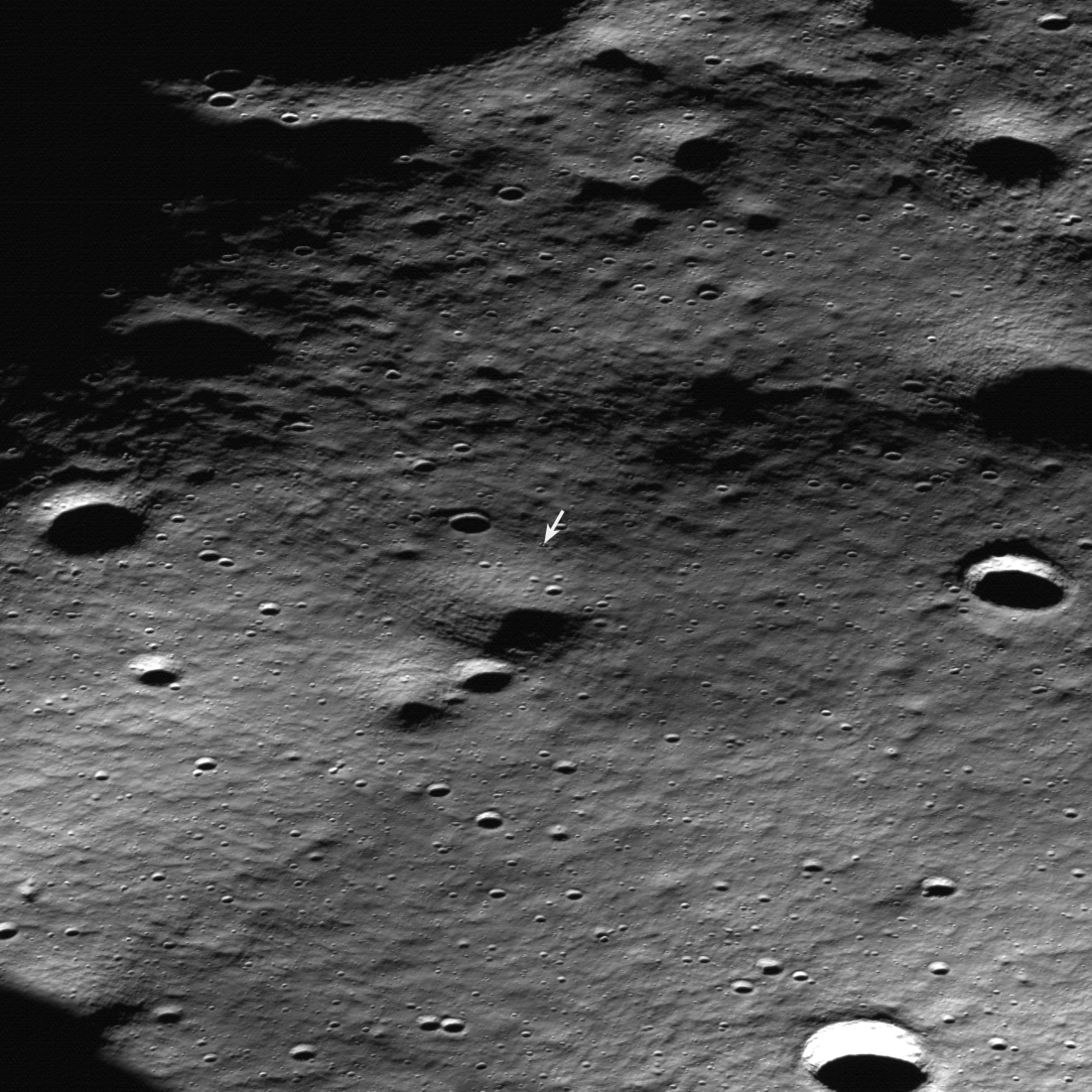
Click for original master image.
Using Lunar Reconnaissance Orbiter (LRO), scientists have now located and photographed Intuitive Machines lunar lander Athena where it sits on its side on the Moon.
The picture to the right, reduced to post here, shows that location with the small arrow. This is definitely on Mons Mouton, the intended landing zone about 100 miles from the Moon’s south pole. However at the best magnification provided by the LRO science team, the rover is not visible. Reader James Fincannon was puzzled by this and downloaded the highest resolution version of this image and sent it to me. I have added it to the picture as the inset. Athena is the little white dot in the center of a small 65-foot-wide crater. Note that its shadow falls in the opposite direction of all the shadows in the craters, as the lander projects upward from the surface while the craters descend downward.
One can’t help questioning the quality of the lander’s landing software, if it ended up picking the center of this small crater to touch down, especially considering there appear to be large relatively clear flat areas all around.
The rocket startup Relativity yesterday uploaded a 42-minute long video on Youtube describing in great detail the status of its Terran-R rocket, providing a great deal of information about its design, construction, and goals, including the significant changes the company has made from its much smaller Terran-1 rocket.
I have embedded that video below.
Several take-aways: First, the video devotes a long segment explaining why the company has abandoned its long expressed goal of making a rocket entirely 3D printed. It found with Terran-1 that 3D printing the rocket’s body and fairing was not cost effective. It took too long and was too expensive. Using aluminum is faster and cheaper, especially as Relativity is no longer doing this in-house. Instead, it appears they are partnering long term with specific outside vendors for the rocket shells, tanks, and domes, as well as the fairings.
Second, the company is aiming to make the rocket’s first stage reusable from the start, making the first landing attempts on the first launch. They also recognize that success will take time and many attempts, similar to SpaceX’s experience a decade ago.
Third, they are pushing to go into major production of the rocket by 2026, so that when they launch the first time they will have more rockets ready to quickly follow up with more launches. This schedule is extremely fast, as they only started rocket development in the spring of 2023.
Finally and most important, the video provides no dates for that first launch. Previous releases from the company had suggested a 2026 first launch, and officials in the video implied that they might be ready by 2026, but no one said so directly. My guess is that 2026 is no longer realistic (not that it ever was), and they are beginning to prepare the public for a later launch date.
One other new development at Relativity not mentioned in the video. The company has named former Google CEO Eric Schmidt as its new CEO, with the company’s founder, Tim Ellis, stepping down as CEO to transition to the company’s board of directors. This change could be related to rumors last year that the company was having problems.
» Read more
Based on data from several ground-based telescopes, astronomers now believe that Barnard’s Star, the nearest single star to our Sun at a distance of about six light years away, has a solar system of at least four sub-Earth-sized planets.
After rigorously calibrating and analyzing data taken during 112 nights over a period of three years, the team found solid evidence for three exoplanets around Barnard’s Star, two of which were previously classified as candidates. The team also combined data from MAROON-X with data from a 2024 study done with the ESPRESSO instrument at the European Southern Observatory’s Very Large Telescope in Chile to confirm the existence of a fourth planet, elevating it as well from candidate to bona fide exoplanet.
You can read the paper here. The scientists estimate the minimum masses of these exoplanets to range from 19% to 34% that of the Earth, with their maximum mass not exceeding 57% of the Earth. All are believed to be rocky planets orbiting just inside the star’s habitable zone.
Astronomers have been trying to detect exoplanets around Barnard’s Star for more a century. Several previous “discoveries” were later retracted. This result however appears somewhat firm though of course there are a lot of uncertainties in the result.
Apparently due to his failures in min-February dealing with debris dropped on Poland from a de-orbiting Falcon 9 upper station, the government has fired the head of its space agency.
The President of the Polish Space Agency, Grzegorz Wrochna, has been dismissed following a botched response to the uncontrolled re-entry of a Falcon 9 second stage that scattered debris across multiple locations in Poland.
It appears Wrochna’s office had sent its reports on the debris to the wrong email address, so that the people higher up in the command chain were not informed properly about what was happening. This failure was then compounded in early March when the space agency’s computer systems were hacked, forcing it to shut down its access to the internet.
You might ask why Poland even has a space agency, and if you do you are asking the right question. The nation does not have “a space program,” which would require an agency. Instead it has a handful of new rocket startups, mostly focused on suborbital flights. All these need is the right legal framework to succeed, not a bureaucracy telling them what to do.