
Popa Chubby – Rollin’ and tumblin’
An evening pause: Performed live c2015.
Hat tip Judd Clark.
An evening pause: Performed live c2015.
Hat tip Judd Clark.

Click for original image of 3I/Atlas.
Astronomers using the Gemini North Telescope in Hawaii have obtained the first good image of the interstellar object 3I/Atlas, as it plunges within the orbit of Jupiter on its way through the solar system.
That picture is to the right, cropped to post here and overlaid on top of a map showing the interstellar object’s calculated path through the solar system.
The picture clearly shows this is a comet, with central nucleus surrounded by a cloud of dust and gas. The data also suggests its nucleus has a diameter of about twelve miles. That it resembles a comet also suggests it is a dirty snowball, made up of ice and rocky material mixed together.
Because it will never get closer to the Sun then just inside the orbit of Mars, it is not likely it will ever get bright enough for naked eye observations. At the same time, it is large enough and will be close enough to make possible some excellent observations as it zips by and leaves the solar system sometime in the fall. The previous two identified interstellar objects, Oumuamua and Comet 21/Borisov, were either too small or too far away as they flew past to get this kind of good data.
Courtesy of BtB’s stringer Jay. This post is also an open thread. I welcome my readers to post any comments or additional links relating to any space issues, even if unrelated to the links below.

Music historian Timothy Jackson
Fight! Fight! Fight! After the public University of North Texas (UNT) blacklisted and dismissed professor Timothy Jackson in 2020 from his job as editor of the music history journal he founded for daring to express some academic conclusions the faculty and students didn’t like, he sued.
After a five year battle, Jackson and the university have now settled out of court, with the terms of the settlement [pdf] largely a big win for Jackson.
First the background: In 2019 woke music theorist Philip Ewell of Hunter College in New York gave a presentation to the Society of Music Theory where he claimed 20th century music theorist Heinrich Schenker was a “virulent racist” whose “racist views infected his music theoretical arguments.”
Jackson, who had devoted his career studying Schenker and had co-founded at the university the Journal of Schenkerian Studies focused expressly on Schenker’s works, knew this was patently untrue. For example, Schenker was also a Jew who was a victim of German anti-Semitism and lost many relatives in the Holocaust, facts that Ewell somehow did not think important to mention. To counter Ewell’s historical slanders, Jackson decided to dedicate the next issue of the journal to this issue, presenting essays from both sides. He even asked Ewell to write an essay.
Ewell did not respond. In Jackson’s own essay he outlined in detail the historical facts — as he knew them as an expert on this subject — that put the lie to Ewell’s claims. As Jackson noted, “Ewell peddled a ‘conspiracy theory’ that is ‘part and parcel of the much broader current of Black anti-semitism.'”
Instead of celebrating this perfect example of free speech, the university immediately moved to punish Jackson.
» Read more
According to a detailed New Zealand news report today, the failed MethaneSat climate satellite — funded and operated by the Environmental Defense Fund — apparently had significant problems during its short fifteen month life-span, going into safe mode many times, before failing completely last month.
An earlier report from this same news outlet described more fully the issues — which began in September 2024 only about six months after launch.
The mission’s chief scientist has now said more intense solar activity because of a peak in the sun’s magnetic cycle has been causing MethaneSAT to go into safe mode. The satellite has to be carefully restarted every time.
There has also been a problem with one of the satellite’s three thrusters, which maintain its altitude and steer the spacecraft. MethaneSAT says it can operate fully on two thrusters.
It appears there is a lot of unhappiness in New Zealand for spending $32 million on this project that was designed, built, and operated by an environmental activist organization with little space experience.
What is clear now is that the spacecraft likely got relatively little data during its fifteen month life span.

Click for source.
Using the Webb Space Telescope, astronomers have discovered the collision of two spiral galaxies that appears to have caused a supermassive black hole to collapse in its wake.
The Webb false-color infrared image to the right shows the two galaxies as the red dots, both surrounded by a ring, with the supermassive black hole the bluish spot in between but offset somewhat to the left. Follow-up radio observations suggested that this bluish spot was a supermassive black hole, having a mass of a million suns and sucking up matter from the giant gas cloud that surrounds it.
The team proposes that the black hole formed there via the direct collapse of a gas cloud – a process that may explain some of the incredibly massive black holes Webb has found in the early universe.
This hypothesis however has enormous uncertainties, and requires a lot more observations to confirm. The black hole could simply exist unrelated to the galaxy collision, having come there from elsewhere. Or it could be from a third galaxy in this group that these initial observations have not yet detected.
The image however is quite cool.

Like pigs at the trough
The House appropriations committee’s draft budget for NASA has followed the Senate appropriations committee in canceling all of Trump’s proposed NASA budget cuts, though it has shifted that funding significantly from science to manned space operations.
The House Appropriations Committee released the draft text of their version of the FY2026 Commerce-Justice-Science bill that funds NASA today. Like their Senate counterpart, the House committee would essentially keep NASA at its current funding level instead of imposing the severe 24.3 percent budget cut proposed by the Trump Administration. The CJS bill also includes almost $2 million for a White House National Space Council even though the Trump Administration has yet to establish one.
Unlike the Senate, which mostly kept the budget the same across all NASA departments, this House draft budget would reduce science and aeronautics spending from about $8.2 billion to $6.8 billion. Trump had requested only $4.5 billion for these departments.
In turn, the House would increase Trump’s request for NASA’s manned operations from $10.8 billion to $11.9 billion. Note that Trump’s proposed budget had already called for an increase here, so the House is clearly shifting funding to manned space in an enthusiastic manner.
At the same time, the House continues funding for the SLS and Orion programs Trump wishes to cancel. Both of these projects are over budget and behind schedule. Neither is very useful in the long run for exploring the solar system. If the House truly wanted to save money, it could easily fund all the cuts in science by cutting the billions spent yearly on these pork projects, and still lower NASA’s budget in total.
Based on the draft budget’s language [pdf], it is unclear whether the House has also funded the Lunar Gateway space station, as the Senate has, another useless pork project that Trump wishes to cancel.
I should note that the appropriations committee’s overall draft budget [pdf] does reduce the federal budget by about 2.8 percent. This is a marked change from past budgets, which often claimed (a lie) to cut spending but really only reduced the rate of budget growth. It appears the House is finally making some effort to shrink the size of the budget, though that effort is quite wimpy.
Axiom’s fourth commercial manned mission to ISS successfully splashed down off the coast of California early this morning, returning its astronaut commander, employed by Axiom, and three government passengers from India, Poland, and Hungary after spending two weeks at the space station and eighteen days total in space.
For all three nations this was their second manned flight, and the first in more than four decades. All three had previously flown astronauts on Soviet era Soyuz missions, with Poland and Hungary’s astronauts visiting the Salyut 6 station in 1978 and 1980 respectively, and India’s astronaut visiting the Salyut 7 station in 1984.
The mission also marked the inaugural flight of SpaceX’s new Grace reusable manned Dragon capsule, the fifth such spacecraft in its fleet. SpaceX’s fleet is now larger that NASA’s space shuttle fleet ever was.
If you watch the live stream at the link, it is once again important to note that everyone you see on the screen, except for these three government astronauts, are employees of SpaceX or Axiom. There is no government involvement at all in the splash down procedure. It is entirely commercial and private affair.
In other words, who needs NASA for spaceflight? It clearly is not required.
China today successfully launched a new Tianzhou cargo ship to its Tiangong-3 space station, its Long March 7 rocket lifting off from its coastal Wenchang spaceport.
The freighter subsequently docked with the station about three hours later.
The leaders in the 2025 launch race:
86 SpaceX
37 China
10 Rocket Lab
8 Russia
SpaceX still leads the rest of the world in successful launches, 86 to 64.
An evening pause: Performed live 1971, before he rejected all of western civilization and became a Muslim.
Hat tip Ferris Akel.
Courtesy of BtB’s stringer Jay. This post is also an open thread. I welcome my readers to post any comments or additional links relating to any space issues, even if unrelated to the links below.

George Reeves as the heroic Superman as envisioned
in the 1950s television show, emulated later by Richard
Donner in his 1978 movie. Click for show’s opening credits.
Not surprisingly, the newest Hollywood attempt to tell the story of Superman appears by all accounts to be on the verge of another movie disaster, for all the usual reasons. Though the first weekend receipts were acceptable, a closer look suggests they also have feet of clay. When compared with the 2013 attempt to reboot the 1978 classic Richard Donner film, the numbers do not look that good.
Now, look at the number of tickets sold:
Estimated tickets sold opening weekend:
MAN OF STEEL (14.3M)
SUPERMAN (10.7M)Sometimes a win isn’t quite a win.
The article also notes that the movie is having problems attracting foreign audiences.
The reviews meanwhile have been horrible. Take for example this review:
I’ve seen a lot of superhero movies, and this one — given the level of investment involved, the promotional push, the iconic nature of the character and the importance to the future of DC and Warner Bros. — is by far the worst. I would have left the theater if I hadn’t gone with a friend. There are minor Marvel entries with more to their credit than this. It doesn’t even manage to be fun.
Why should this new movie about the first true American super-hero standing for “truth, justice, and the American way” be having problems at box office? Isn’t the story exactly the kind of thing audiences love and normally consume with eager anticipation?
The problem is that this modern Superman movie is not about “truth, justice, and the American way.” Instead, the film’s director and producer, James Gunn, decided it should instead be about “truth, justice, and the human way,” a statement that is not only meaningless and carrying far less substance, it is a slap in the face of the very noble American ideals of this very American legend.
» Read more
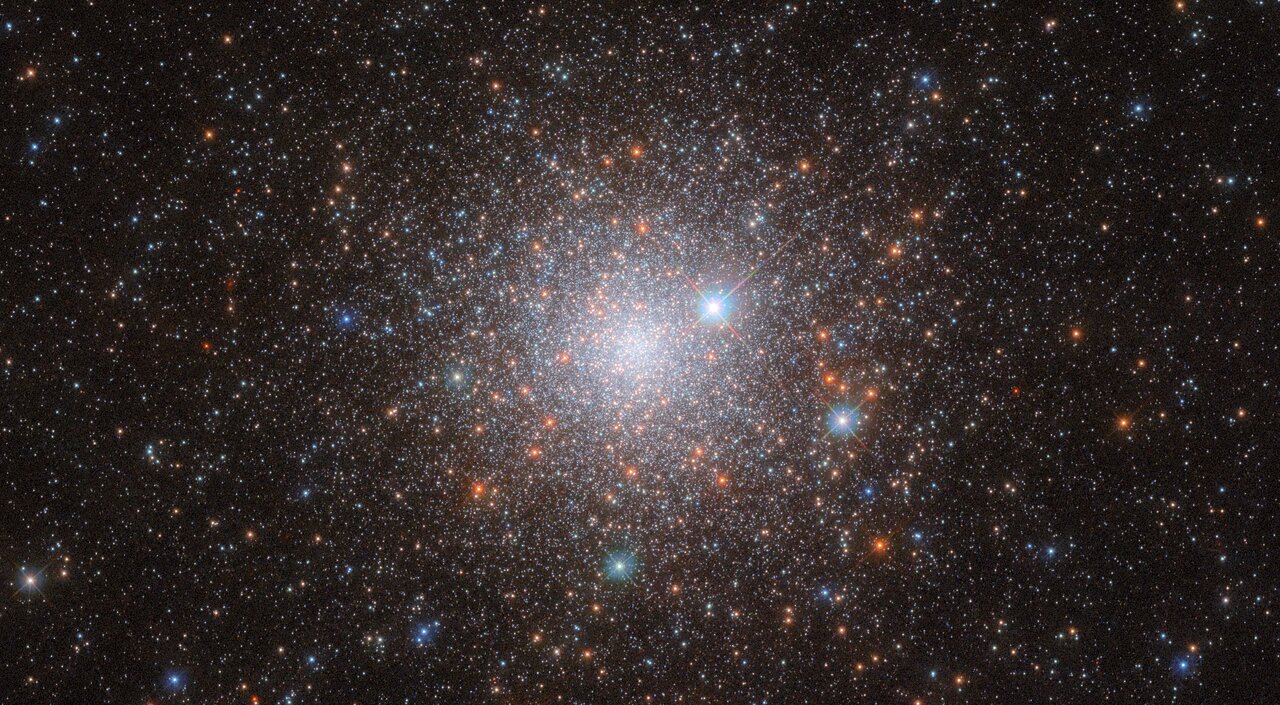
Click for original image.
Cool image time! The picture to the right, cropped, reduced, and sharpened to post here, was taken by the Hubble Space Telescope as part of a research project to study globular clusters in galaxies other than the Milky Way.
The data for this image comes from an observing programme comparing old globular clusters in nearby dwarf galaxies — the LMC [Large Magellanic Cloud], the Small Magellanic Cloud and the Fornax dwarf spheroidal galaxy — to the globular clusters in the Milky Way galaxy. Our galaxy contains over 150 of these old, spherical collections of tightly-bound stars, which have been studied in depth — especially with Hubble Space Telescope images like this one, which show them in previously-unattainable detail. Being very stable and long-lived, they act as galactic time capsules, preserving stars from the earliest stages of a galaxy’s formation.
Astronomers once thought that the stars in a globular cluster all formed together at about the same time, but study of the old globular clusters in our galaxy has uncovered multiple populations of stars with different ages. In order to use globular clusters as historical markers, we must understand how they form and where these stars of varying ages come from. This observing programme examined old globular clusters like NGC 1786 [pictured] in these external galaxies to see if they, too, contain multiple populations of stars. This research can tell us more not only about how the LMC was originally formed, but the Milky Way Galaxy, too.
This cluster, discovered in 1835 by John Herschel, is about 160,000 light years away.
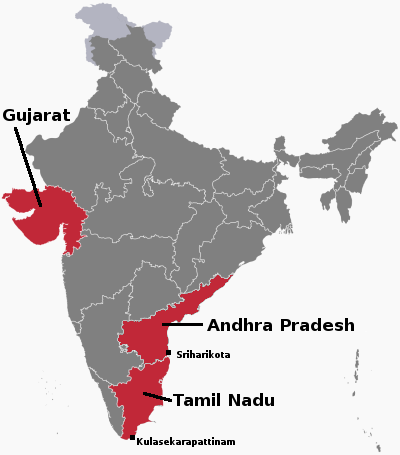
A third state in India, Andhra Pradesh, has now released its own space policy, designed to create what it calls “manufacturing clusters”, centered around India’s main spaceport at Sriharikota.
The A.P. Space Policy (4.0) 2025-30 is valid for five years from the date of issue (July 13, 2025), or till a new policy is announced. A technical committee will be constituted under the Commissioner of Industries to vet and process applications for land allotment in the Space Cities proposed to be developed along the Hyderabad-Bengaluru Industrial Corridor in Sri Sathya Sai district and in Tirupati (Routhasuramala).
The government will form an SPV, ‘AP Space City Corporation’, which will drive all initiatives related to the development of the above Space Cities, and serve as the central agency to coordinate infrastructure development, raise start-up funds, attract investments, facilitate industry partnerships, build partnerships to attract global demand, and liaise with all GoI [Government of India] entities for tapping the domestic demand.
The previous two state space policies in Tamil Nadu and Gujarat, announced in April, had similar goals aimed at promoting the establishment of private aerospace companies within their regions.
Whether Andhra Pradesh’s policy will work carries uncertainties. Its advantage is that it is linked to India’s primary spaceport. Its disadvantage lies in the complex bureaucracy the state is creating in conjunction with these “Space Cities.” Such bureaucracies are rarely helpful for new businesses.
The LIGO gravitational wave detector, spread across several continents, successfully detected the largest black hole merger yet on November 23, 2023.
The two black holes that merged were approximately 100 and 140 times the mass of the Sun. In addition to their high masses they are also rapidly spinning, making this a uniquely challenging signal to interpret and suggesting the possibility of a complex formation history. “This is the most massive black hole binary we’ve observed through gravitational waves, and it presents a real challenge to our understanding of black hole formation,” says Professor Mark Hannam, from Cardiff University and a member of the LIGO Scientific Collaboration. “Black holes this massive are forbidden through standard stellar evolution models. One possibility is that the two black holes in this binary formed through earlier mergers of smaller black holes.”
To date, approximately 300 black-hole mergers have been observed through gravitational waves, including candidates identified in the ongoing O4 run. Until now the most massive confirmed black-hole binary was the source of GW190521, with a much smaller total mass of “only” 140 times that of the sun.
As noted by the press release as well as this news article, present theories of stellar evolution say that these black holes could not have come from single stars, which are predicted to never be this massive. It is posited that each black hole might have formed from earlier mergers, but there is also a lot of uncertainty in the data. To quote the release again: “Extracting accurate information from the signal required the use of theoretical models that account for the complex dynamics of highly spinning black holes.”
That this detection was almost two years ago and only announced now makes me wonder if the timing of the announcement has more to do with lobbying and less to do with science. Trump’s proposed budget eliminates the U.S. funding portion for this project, and it is standard operating procedure for such projects to suddenly announce big discoveries timed to correspond to when Congress is considering the budget.

The Middle East, showing the location of
Oman’s proposed spaceport at Duqm.
A suborbital test launch from Oman’s Duqm spaceport was scrubbed yesterday due to” a technical issue” with the rocket.
DUQM: Etlaq Spaceport’s highly anticipated experimental rocket launch mission “Duqm-2” was aborted due to a technical issue on Sunday, July 13, 2025. Consequently, the launch has been postponed until “a replacement solution is developed,” it stated.
This was the second attempt launch scrubbed at Duqm, officially labeled the Etlaq Spaceport. The first, an attempt by a Middle East startup to do a vertical take-off and landing of a prototype small rocket, was scrubbed in April due to weather and technical issues. No new launch date has been scheduled.
The spaceport had announced in April a schedule of five launches before the end of the year. Two have now been scrubbed. All appear to have major financing from the Oman government. I suspect all have been pushed too hard and too fast by the government for PR reasons, which explains the two scrubs and the lack of a new launch schedule.
After spending 18 days in space, 14 on ISS, the Dragon capsule early this morning undocked from ISS with a splashdown scheduled for early tomorrow.
The mission was financed by the space station company Axiom, and was commanded by former NASA astronaut Peggy Whitson, now employed by Axiom as a professional astronaut. The three paying passengers were all government astronauts from India, Poland, and Hungary.
The capsule, dubbed Grace, is the newest addition to SpaceX’s fleet of five manned reusable capsules, flying on its first mission.
Splashdown is scheduled for the wee hours of July 15th tomorrow off the coast of California. The live stream can be found here.
SpaceX tonight successfully launched a geosynchronous satellite for unnamed customer, its Falcon 9 rocket lifting off from Cape Canaveral in Florida.
The first stage completed its thirteenth flight, landing on a drone ship in the Atlantic. The fairings completed their fourteenth and eighteenth flights respectively. No information about the satellite was released, including ending the live stream right after the first stage landed while providing no information about the satellite’s orbit after stage separation.
The leaders in the 2025 launch race:
86 SpaceX
36 China
10 Rocket Lab
8 Russia
SpaceX now leads the rest of the world in successful launches, 86 to 63.
Though U.S. district judge Stanley Blumenfeld ruled in May that SpaceX’s lawsuit against California Coastal Commission for targeting the company because the commissioners did not like Elon Musk’s political views can proceed, in early July he also narrowed the lawsuit significantly.
Blumenfeld granted a motion to dismiss violations of the First Amendment and due process against the commission and individual members based on lack of standing, sovereign immunity and failure to state a claim, but allowed allegations of “biased attempts to regulate SpaceX’s activity” and unlawfully demanding a CDP to proceed.
“In sum, SpaceX has plausibly alleged a ripe, nonspeculative case or controversy over whether it must obtain a CDP to continue its Falcon 9 launches,” Blumenfeld said in his order. “The credible threat that defendants will bring an enforcement action and subject SpaceX to daily fines for not having a CDP — which defendants pointedly do not disavow — is sufficient to establish an actual injury under Article III [of the U.S. Constitution].”
It appears the judge acted to protect the commissioners themselves from direct liability, using the made-up concept from the 20th century that government employees are somehow wholly immune from any responsibility for their actions.
Nonetheless, SpaceX has a great case, and is very likely to win in court, a victory that could very well cause the coastal commission and the state of California serious monetary pain.
The first suborbital launch of the Taiwan rocket startup Tispace failed today shortly after lift-off from a new commercial spaceport on the northern island of Hokkaido in Japan.
The rocket took off from Hokkaido Space Port at 11:40 a.m. local time, but it was soon seen drifting, with smoke escaping. Footage of the launch was shown by NHK News on its website.
Nobody was reported injured in the incident, and the rocket was not carrying any payload. The first launch of a foreign-made rocket from Hokkaido served to test its engine’s capabilities, the report said.
The rocket startup was formed in 2016 and originally wanted to launch from Taiwan. After legal issues blocked that launch site it then attempted to arrange a launch from Australia. It appears similar red tape issues forced it to switch to Japan.