Court throws out environmental lawsuit against SpaceX, FAA, and Starship/Superheavy

The federal district court judge for the District of Columbia yesterday dismissed entirely the environmental lawsuit that had been filed against SpaceX and the FAA by anti-Musk activists following the first orbital test launch of Starship/Superheavy.

More details here. The lawsuit itself [pdf] was filed in 2023, claiming that the FAA’s environmental assessment of SpaceX’s activities at Boca Chica would do no harm to the environment were wrong.

SpaceX activities authorized in the FONSI/ROD [the environmental reassessment issued last year] have and will adversely affect the surrounding wildlife habitat and communities. In addition to harm from construction activities and increased vehicle traffic, rocket launches result in intense heat, noise, and light pollution. Furthermore, the rocket launches and testing result in explosions which spread debris across surrounding habitat and cause brush/forest fires — including one that recently burned 68 acres of adjacent National Wildlife Refuge. The FAA calls these explosions “anomalies,” but in fact they occur frequently, with at least 8 over the past 5 years. FAA acknowledged that many more such “anomalies” are expected over the next 5 years. The U.S. Fish and Wildlife Service has found that prior SpaceX rocket explosions harmed protected wildlife and designated habitat in violation of the Endangered Species Act (ESA).

At the time I noted this:

In other words, rockets and launch sites should never be placed inside wildlife refuges, because such activity is detrimental to wildlife.

A more false statement cannot be made. Under this conclusion the launch facilities at Cape Canaveral, which have been operating in the middle of a wildlife refuge now for more than six decades, should be shut down immediately. All the wildlife there must certainly be dead!

We have almost three-quarters of a century of empirical data in both Florida and California that spaceports are clearly beneficial to wildlife, because they actually create the refuge by reserving large areas where development cannot occur. This court decision merely confirms reality, something it appears increasingly the left doesn’t have much grasp of.

6 comments

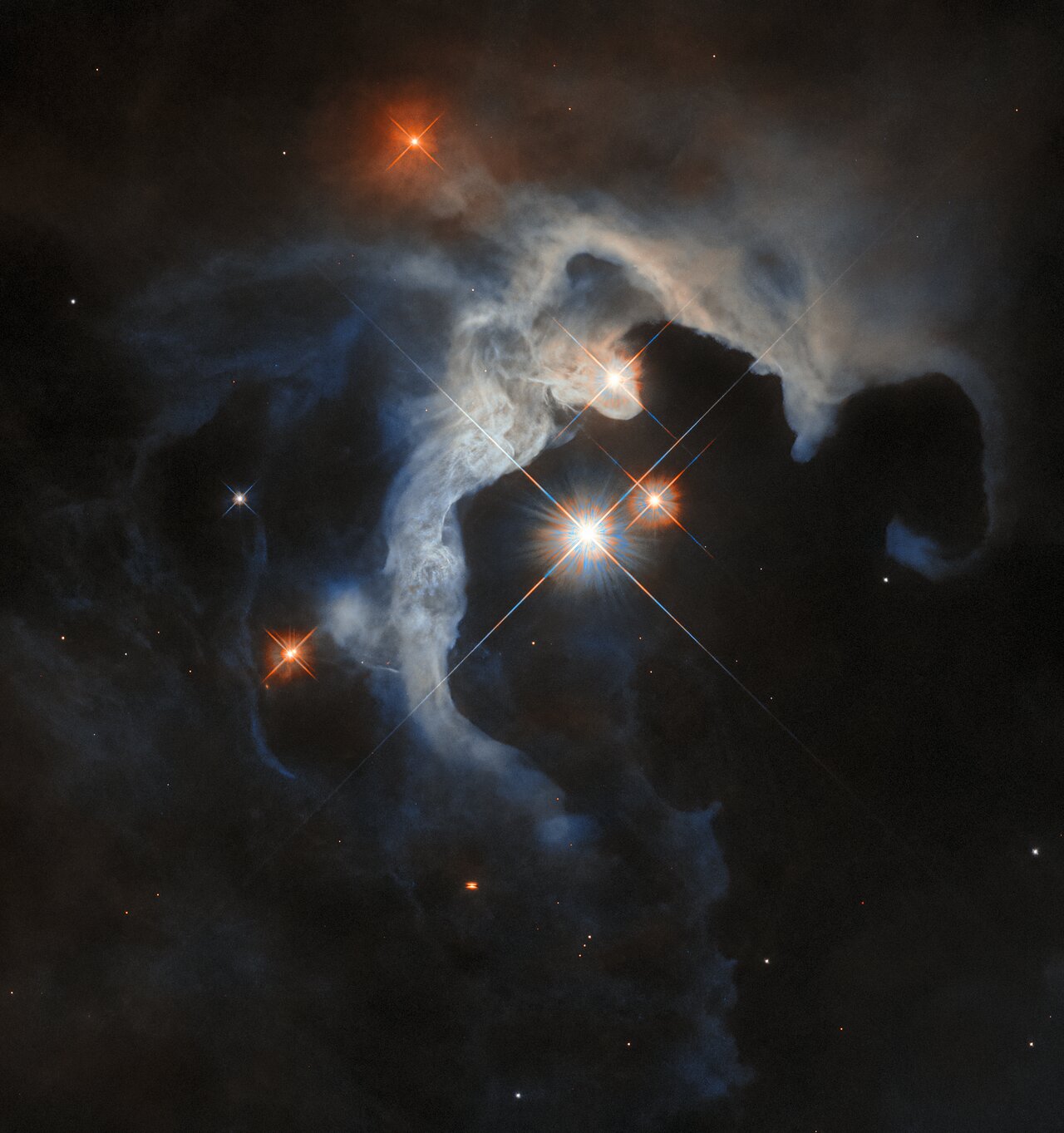
The central star-forming cauldron of M82, the most well known star-forming galaxy

The central star-forming region of M82
Click for original. For original of inset go here.

Cool image time! The picture to the right, cropped, reduced, and annotated to post here, was released today by the Hubble Science team. It shows the central star-forming core of the galaxy M82, only about 12 million light years away and long known as a “peculiar” galaxy by earlier research from the 20th century. For this reason I used the 1963 optical image taken by the 200-inch Hale Telescope at Palomar in California as the inset, showing the entire galaxy. At the time the data only suggested some major energetic events were occurring in the galaxy’s core, as indicated by what looked like filaments shooting out from that core at right angles to the plane of the galaxy.

Data since then, from Hubble and Webb and other space telescopes, have revealed that this galaxy, which some have nicknamed the “Cigar Galaxy”, is forming stars at a prolific rate.

Forming stars 10 times faster than the Milky Way, the Cigar Galaxy is what astronomers call a starburst galaxy. The intense starburst period that grips this galaxy has given rise to super star clusters in the galaxy’s heart. Each of these super star clusters contains hundreds of thousands of stars and is more luminous than a typical star cluster.

The red indicates the dust that permeates the galaxy. The blue comes from the radiation emitted from the clusters near the center, illuminating and ionizing that dust.

0 comments

Bubbling lava frozen in a Martian crater

Bubbling lava frozen in a Martian crater
Click for original image.

Cool image time! The picture to the right, cropped, reduced, and sharpened to post here, was taken on June 23, 2025 by the high resolution camera on Mars Reconnaissance Orbiter (MRO). This one-mile-wide unnamed crater was a featured image last week by the science team. As noted in the caption, written by Chris Okubo of the U.S. Geological Survey:

This area was covered by a large flood of lava, which we see as the generally flat areas surrounding the crater. As the lava flowed across, some of it flowed into this crater through a low spot along the crater rim.

Once in the crater, the lava heated ground water or ground ice in the floor, causing the water to boil and turn into steam. This steam then exploded through the overlying lava and created small, ring-shaped formations. These are called ”rootless cones,” and they record the presence of ground water or ground ice in the crater floor at the time of the lava eruptions.

In other words, when this crater was flooded with hot lava, it was filled with ice or water. That fact is significant because of the crater’s location, as shown in the overview map below.
» Read more

2 comments

Russia further centralizes and consolidates its shrinking space sector

Roscosmos: a paper tiger

Russia’s state-run TASS press agency today announced that the operations of much of its space sector has now been moved to a newly completed centralized facility on the west side of Moscow.

Over 30 enterprises of Russia’s rocket and space industry, based in Moscow, will move their production sites to the newly created National Space Center, Roscosmos chief Dmitry Bakanov said. “We now have a single platform, where 35 enterprises will be concentrated in one area,” Bakanov said in the National Space Center, visited by Russian President Vladimir Putin on Saturday.

The National Space Center opened in Moscow on Saturday. A complex of building with the total area of 276,000 square meters, is located in the West of Moscow. It’s a joint project of the Moscow Government and Roscosmos.

Sounds neat, eh? In fact, this illustrates how Russia’s space sector is declining. First, Putin in the 2000s centralized the entire industry into a single corporation, Roscosmos, run by the government. That Soviet-style top-down structure eliminated competition and acted to block new companies from forming.

Second, when Russia invaded the Ukraine in 2022 Roscosmos lost billions in revenue when its international customer base cancelled all their contracts and boycotted the country.

Consolidating all these “companies”, which are simply divisions of Roscosmos, into this one facility might save money, but it prevents independent action and competition. It also indicates Russia’s lack of cash.

Most importantly, this move presages the eventually shutdown of many of Russia’s space operations when ISS is retired. Russia has said it is building a new station, but its ability to launch anything new has been abysmal in the 21st century. Routinely it announces new projects which never fly. There is no reason to expect its proposed space station to be anything different.

4 comments

Progress docks safely with Zvezda module at ISS

ISS as of today
ISS as of today. Click for original.

In what is increasingly a worrisome procedure, Russia’s just launched Progress freighter successfully docked with the aft port of the Zvezda module at ISS this past weekend, bringing with it more than 5,000 pounds of supplies and research equipment.

The image to the right, annotated additionally by me, shows the present configuration of spacecraft at ISS. The concerns center on the stress fractures that have been found in the Zvezda hull, fractures that have caused the air leak on ISS and are believed attributable to the many dockings to the module since its launch in the late ’90s, as well as the module’s age. It was first built in the late ’80s, making it almost four decades old.

For recent dockings, NASA now closes the hatch between the Russian and American halves of the stations, just in case Zvezda experiences a catastrophic failure. The Russians seem less concerned, but nonetheless they also take extra care during dockings. It is my understanding their astronauts prepare their Soyuz capsule as a lifeboat and immediately escape during these operations.

11 comments

Starlink down for about an hour last night

According to several major news sources, Starlink was down for about an hour last night globally, impacting several tens of thousands in the U.S. alone.

More than 37,000 US users were reporting issues with the internet service Monday at 12:30 a.m. ET, according to the website Downdetector.com. By 1:30 a.m., that number had fallen into the hundreds. The internet service owned by Musk’s SpaceX stopped working on “the entire frontline in Ukraine” around 7:30 a.m. Kyiv time (12.30 a.m. ET), said Maj. Robert “Magyar” Brovdi, the commander of Ukraine’s unmanned systems force, on Telegram. As of 8:00 a.m., service was gradually being restored, he said.

I link to CNN, but numerous other outlets thought this story significant enough to give it front page coverage. That this is considered news, however, illustrates perfectly how well Starlink functions normally. A brief outage lasting less than an hour makes the cover of every news outlet in the world, because normally Starlink works without problems for its more than six million subscribers.

SpaceX has not as yet provided any information about the cause of the outage. I suspect we are seeing the result of a hacker attack, possibly by Russia, but that is pure speculation. Even if not, it is in SpaceX’s interest to outline in detail what happened. This has been its policy in the past, but in the previous outage in July the company was not forthcoming. That lack of transparency has not served the company well.

0 comments

Space station startup Vast endorses NASA’s new strategy that no longer requires a continuous human presence in space

The American space stations under construction
The American space stations under development

Officials from the space station startup Vast revealed at a conference last week that they endorse NASA’s new strategy that, not only no longer requires the commercial stations to immediately establish a continuous human presence in space, will also award multiple development contracts to the commercial stations.

Speaking Sept. 11 at the Global Aerospace Summit, Max Haot [chief executive of Vast] endorsed NASA’s new strategy, announced more than a month ago, that calls for multiple Space Act Agreements to support development leading to a four-person, 30-day demonstration mission. “We think it’s really the right direction,” he said, noting it accelerates the award timeline. NASA said in a draft solicitation this month it expects to award multiple funded agreements by April 2026, months sooner than under earlier plans.

The original plan had been to choose at most two, but likely only one of the four consortiums/companies that are developing station proposals. The winner would have gotten a big contract that would have also required it to push hard for continuous full time occupation, from day one.

The new plan will instead award smaller development contracts to as many as three of the four station projects, aimed at getting them off the ground and operating, even if astronauts only fly in them intermittently. Eventually the hope is that their capabilities will expand quickly to permanent occupation, especially if they start earning revenue from the private sector, outside NASA. In fact, the smaller government contracts will force them to seek investment and profits elsewhere.

The four commercial stations under development, ranked by me based on their present level of progress:
» Read more

0 comments

SpaceX launches Northrop Grumman’s Cygnus freighter to ISS

SpaceX today successfully launched Northrop Grumman’s Cygnus freighter with more than five tons of cargo, its Falcon 9 rocket lifting off from Cape Canaveral in Florida.

The first stage completed its fourth flight, landing back at Cape Canaveral. The two fairing halves completed their 3rd and 6th flights respectively. Cygnus is expected to be berthed to ISS using the robot arm on September 24, 2025. This is also the first flight of the stretched version of Cygnus, capable of carrying more cargo.

The leaders in the 2025 launch race:

118 SpaceX
53 China
13 Russia
12 Rocket Lab

SpaceX now leads the rest of the world in successful launches, 118 to 92. China also had its own launch scheduled for this evening, but no information about it has yet been released.

2 comments

Two launches in the past day

The beat goes on. Since yesterday afternoon there have been two more global rocket launches, by Russia and SpaceX.

First, Russia launched the sixth GPS-type satellite as part of its next generation Glonass constellation, its Soyuz-2 rocket lifting off from its Plesetsk spaceport in northeast Russia. The rocket’s lower stage fell several different drop zones in Russia. No word if they landed near any habitable areas.

Next, SpaceX this morning launched another 24 Starlink satellites into orbit, its Falcon 9 rocket lifting off from Vandenberg in California. The first stage completed its 28th flight, landing on a drone ship in the Pacific.

The leaders in the 2025 launch race:

117 SpaceX
53 China
13 Russia
12 Rocket Lab

SpaceX now leads the rest of the world in successful launches, 117 to 92.

As for the rankings for the most reuse by a rocket, this is the present leader board:

39 Discovery space shuttle
33 Atlantis space shuttle
30 Falcon 9 booster B1067
28 Columbia space shuttle
28 Falcon 9 booster B1071
27 Falcon 9 booster B1069
27 Falcon 9 booster B1063

Sources here and here.

8 comments
1 54 55 56 57 58 182