
Daniel Roy – 10 Levels of Sleight of Hand
An evening pause: For the long weekend, some tricks you can use in your next poker night.
Hat tip Cotour, who adds, “Never play cards with strangers.”
An evening pause: For the long weekend, some tricks you can use in your next poker night.
Hat tip Cotour, who adds, “Never play cards with strangers.”
Courtesy of BtB’s stringer Jay. This post is also an open thread. I welcome my readers to post any comments or additional links relating to any space issues, even if unrelated to the links below.

Trump in charge
They apparently forgot who the American people elected and who is thus the boss! The 170 EPA employees who publicly signed a letter this week announcing their opposition to Trump’s policies at EPA have now all been put on leave, with the expectation that they will eventually lose their jobs as well.
Staffers at the Environmental Protection Agency who signed a letter of dissent against President Donald Trump have been placed on leave, reports The Hill. “The Environmental Protection Agency has a zero-tolerance policy for career bureaucrats unlawfully undermining, sabotaging, and undercutting the administration’s agenda as voted for by the great people of this country last November,” EPA spokeswoman Brigit Hirsch said in a written statement.
The letter, posted on June 30, 2025, made it very clear in its opening paragraph that these employees were willing to defy orders and sabotage the Trump administration.
» Read more
Russia today (July 4th in Kazakhstan) successfully launched a new Progress freighter to ISS, its Soyuz-2 rocket lifting off from the Baikonur spaceport in Kazakhstan.
The freighter will dock to ISS in two days, bringing with it almost three tons of cargo and more than a half done of hardware and equipment. Expect NASA to order its astronauts to shut the hatch between the American and Russian sections of ISS due its fear that a docking to the Zvezda module could cause a catastrophic failure because of the stress fractures in that module’s hull. That docking will however not be directly to Zvezda, but to the Poisk module that is itself docked to Zvezda.
The lower stages and strap-on boosters crashed inside Kazakhstan in the normal drop zones that Russia has used for decades.
The leaders in the 2025 launch race:
84 SpaceX
36 China
10 Rocket Lab
8 Russia
SpaceX still leads the rest of the world in successful launches, 84 to 63.
Russia’s launch pace this year is its lowest pace in decades. At this rate Russia might only get about 15-17 launches off in 2025, a count more comparable to what it did in the very early 1960s. This decline can be directly linked to the Russian invasion of the Ukraine. That invasion caused Russia to lose billions in contracts in the international launch market. And it continues to prevent Russia from winning any new international contracts as well. Except for its government launches (which are limited due to government cash shortages), the only other missions Russia flies are those to ISS, and those number about four per year.

I once again feel compelled to rant against the shallow ignorance of too many people in both the journalism field as well as academia about the most recent data we now have of Mars. Two articles today once again show this ignorance, assuming blandly that Mars is a dry planet with little water on it anywhere, when orbital data over the past decade has unequivocally shown that — except for its equatorial regions — the planet is covered with a LOT of near-surface ice.
The headlines make this ignorance quite clear:
In both cases, the articles assume that the data obtained from rovers and landers in the dry Martian tropics applies to the entire planet. It does not. This evidence of a dry planet carries a bias that comes from the decision by the planetary community as well as NASA to send every rover to that dry equatorial region. Only one lander, Phoenix, has ever been successfully dropped far from the Martian equator, and it was purposely sent to a very high latitude, where it proved there was ice present just below the surface.
Orbital data in the past decade from both Mars Reconnaissance Orbiter and Mars Express has clearly shown that there is a lot of near surface ice on Mars, as shown by the map above. In the mid-latitudes the terrain is dominated by glaciers, as this is the region where the vast ice sheets in the high latitudes begin to fade away.
Only the equatorial region, indicated by the white lines on the map, is dry and barren. And yet, even here, orbital data has detected evidence that suggests underground ice still exists.
It seems to me that journalists and academic PR departments should know these facts, and include them in any reports about the dry nature of Mars’ equatorial regions.
A Luxembourg-based startup aimed at building orbiting recoverable capsules for cargo as well as in-space manufacturing has won a $14.7 million grant from the European Innovation Council as part of its European Innovation Council Accelerator program to encourage development in Europe’s private commercial space sector.
The company, Space Cargo Unlimited, will use the money to develop what it calls its “BentoBox in-orbit testing and manufacturing platform.” It is also partnering with well-established European company Thales-Alenia, with the BentoBox development based on previous work done for the European Space Agency’s (ESA) Space Rider demonstrator project.
The overall nature of this grant and work illustrates Europe’s aggressive shift in the past two years from the government model, where ESA designed and owned everything, to the capitalism model, where the government is merely the customer, buying what it needs from the private sector. The government-built Space Rider, which was intended to be a re-usable space plane similar to the X-37B, has never flown. Now, its technology is being repurposed by private European companies for their own spacecraft with the intention of making profits. And this Bentobox project is a prime example.
The inaugural flight of the BentoBox platform as a standalone system using the ATMOS inflatable heatshield is expected in the fourth quarter of 2025. As of a late 2024 update, Space Cargo Unlimited had already secured bookings for 80% of the inaugural flight, and 50% and 40% of the second and third flights, respectively.
Note too that Space Cargo is a European competitor with Varda in the U.S. It appears Europe wants some of this business for itself.
China today successfully launched a technology test satellite, its Long March 4C rocket lifting off from its Xichang spaceport in southwest China.
As is usual for China’s state-run press, little information about the satellite was released. The most information any article provided was this:
The satellite, designed and built by the Innovation Academy for Microsatellites under the Chinese Academy of Sciences in Shanghai, will measure and survey space environmental elements and test new technologies.
Nor did that state-run press provide any information about where the rocket’s lower stages, using very toxic hypergolic fuels, crashed inside China.
The leaders in the 2025 launch race:
84 SpaceX
36 China
10 Rocket Lab
7 Russia
SpaceX still leads the rest of the world in successful launches, 84 to 62.

SpaceX employees cheering the first chopstick capture of
Superheavy, October 13, 2025. Click for video.
Two new articles today outline two different new lawsuits against SpaceX by former employees, with both claiming harassment and discrimination as reasons for their firing.
In the first case, the former employee, L’Tavious Rice, claims that he “was fired for being late to work while caring for his young daughter as she recuperated from a heart transplant, while his white colleagues were given a pass for their own “consistent tardiness and absences.” The lawsuit also claims the SpaceX human resources department was retaliating against him because he testified about another employee’s misbehavior in another unrelated case.
In the second case, the former employee, Jenna Shumway, claims she was passed over for promotion, and the man who got the job “waged a campaign of harassment against her, which included stripping her of her responsibilities over a period of months and ultimately leading to her termination in October 2024.” She also claims this “harassment extended to other female employees, too.”
I have no idea whether these claims are true or not. I tend to be skeptical, because of the overall make-up of SpaceX’s entire work-force. The image to the right, a screen capture from the company’s broadcast during the fifth flight of Starship/Superheavy on October 13, 2024 and taken mere seconds after the first successful capture of Superheavy. illustrates this. The SpaceX work-force is young, and typical of engineering, more male than female. At the same time it has many long time female employees, including the company’s president and chief operating officer, Gwynne Shotwell.
We must not also dismiss the possibility of political motives in these lawsuits. In the past three years the left has made it clear it is out to get Elon Musk, and that campaign has included vandalism, regulatory sabotage, and numerous other environment lawsuits by leftist activist groups whose funding is political.
At the same time, it is very possible that these two former employees have legitimate beefs. We shall have to see how both cases play out in the courts.
An evening pause: Performed live 2017.
Hat tip Diane Zimmerman.
Courtesy of BtB’s stringer Jay, as well as reader Gary for the last link. This post is also an open thread. I welcome my readers to post any comments or additional links relating to any space issues, even if unrelated to the links below.
My two hour appearance yesterday on the Space Show with David Livingston is now available as a podcast. You can find here.
A number of members of the Space Show’s advisory board joined the Zoom feed to raise questions and add their perspective, which made it for me at least a truly fascinating two hours. Lots of discussion about Starship, about Artemis, and about the desperate need for Americans to stop emoting and begin to discuss these issues calmly and rationally. This mature nature of the discussion made this show is very much worthwhile listening to.

The uncertainty of science: A science paper released yesterday suggests that the ozone hole over Antarctica that scientists have been tracking for almost a half century is caused mostly by the solar cycle and the accompanying fluctuations in cosmic rays hitting the upper atmosphere, not the release of chlorofluorocarbons (CFCs) that used to be used in aerosol spray cans.
The graph to the right, from figure 2 of the paper, illustrates the data. The red line is the ozone hole fluctuations predicted by the paper’s model, labeled “CRE Theory”, based on the increase of cosmic ray radiation during solar minimum. The blue, black, and green lines indicate the actual fluctuations of ozone and temperature in the lower stratosphere where the ozone layer exists. As you can see, the model and actual fluctuations match quite closely. From the paper’s abstract:
» Read more
As I have done since I started this website fifteen years ago, I post at the start of every month an update of the Sun’s ongoing sunspot activity, using the update that NOAA posts each month to its own graph of sunspot activity but annotated by me with extra information to illustrate the larger scientific context.
Below is that graph, showing that in June sunspot activity rebounded upward somewhat from the shocking drop in activity that occurred in May.

Astronomers think they have identified another interstellar object that is now entering the solar system.
The dim space rock is currently at about magnitude 18.8. Our new visitor, A11pl3Z, will get its closest to the sun – at about 2 astronomical units (AU), or twice as far as Earth is from the sun – in October. As it reaches perihelion – its closest point to the sun – it should be moving at about 68 km/s relative to the sun, or at about 152,000 miles per hour.
The object’s calculated path through the solar system, shown by the blue line in the graphic to the right, as well as the object’s high speed, are why the astronomers think it is interstellar in origin. Both facts suggest it is coming from beyond the Oort cloud.
This is the third such object discovered, after Oumuamua (whose nature remains somewhat unknown), followed by Comet 21/Borisov.
UPDATE: The object has now been renamed 3I/Atlas. The “3I” indicates it is the third interstellar object discovered, and “Atlas” refers to the discovering telescope survey.

Click for original picture.
Using the ground-based Very Large Telescope (VLT) in Chile, astronomers have discovered evidence suggesting a star apparently exploded twice went it went supernova several hundred years ago.
They detected this possibility by looking at the remnant of that blast, shown to the right. It shows a double halo, indicated by the blue and orange colors. The blue however is seen in both shells. As noted by the VLT’s press notice:
Calcium is shown in blue, and it is arranged in two concentric shells. These two layers indicate that the now-dead star exploded with a double-detonation.
This type of supernova, dubbed type 1a, occurs when a white dwarf sucks matter from its closely orbiting stellar companion. That material piles up on the surface of the star until it reaches critical mass and explodes, causing the supernova.
The two shells, suggesting a double detonation, fits a theory proposed for this process. From the paper’s abstract:
Our analysis reveals that the outer calcium shell originates from the helium detonation at the base of the outer envelope, while the inner shell is associated with the carbon–oxygen core detonation. This morphological distribution of intermediate-mass elements agrees qualitatively with the predicted signature of the double detonation of a sub-Chandrasekhar-mass white dwarf from a hydrodynamical explosion simulation.
In other words, the outer shell resulted from the explosion caused by the helium ripped from the companion star, with the resulting shockwave detonating the second explosion inside the white dwarf’s core.
That’s the theory at least. This data supports it, but it certainly doesn’t prove it.
Fifteen months into a five year mission it appears the methane climate satellite MethaneSat has apparently failed prematurely.
From the press release by the environmental activist organization Environmental Defense Fund that operated the satellite:
On Friday, June 20, the MethaneSAT mission operations lost contact with MethaneSAT. After pursuing all options to restore communications, we learned this morning that the satellite has lost power, and that it is likely not recoverable.
The satellite was unusual in that it was developed and built by this activist organization, not a government or academic institution. Its failure is especially unfortunate at this time, because this non-governmental approach to science research is exactly what the science community needs to pursue faced as it is with major cuts in federal funding.
Embedded below the fold in two parts.
To listen to all of John Batchelor’s podcasts, go here.
» Read more
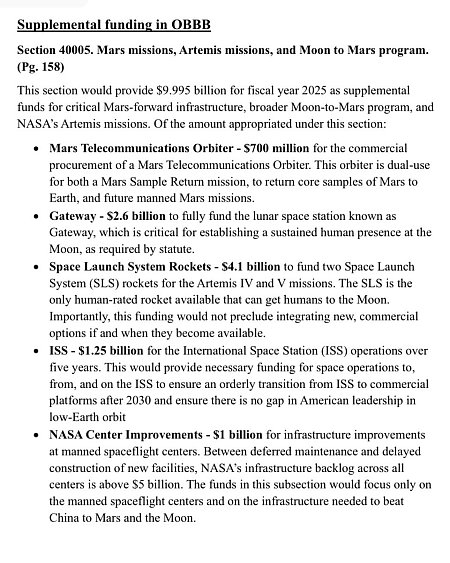
According to a tweet yesterday by Representative Marjorie Taylor Greene (R-Georgia), the reconciliation budget bill that was passed by the Senate included the budget additions that Senator Ted Cruz (R-Texas) had proposed to save SLS, Orion, and Lunar Gateway.
The graphic to the right lists these budget numbers. It is not clear whether the launch taxes on payloads that Cruz proposed were also included, though likely not based on the rules under which the reconciliation bill was passed.
This additional money for these projects contradicts directly the NASA 2026 budget proposal put forth by Trump that aimed to cancel Lunar Gateway and end SLS and Orion after only two more flights. Their existence in this passed Senate bill suggests that Congress is cool with the idea of spending this money and continuing these projects, even though they do nothing but waste taxpayer money and get us no where in space.
It also appears from the language in the graphic that the Senate is eager to also spend more money on NASA’s Mars sample return project, even though NASA itself still has no idea how to accomplish the task.
SpaceX yesterday successfully completed two launches from Florida. First, it placed a European Union weather and climate research satellite, Sentinel-4, its Falcon 9 rocket lifting off from the Kennedy Space Center. The first stage completed its ninth flight, landing on a drone ship in the Atlantic.
Next, it continued its unrelenting pace of launching Starlink satellites, its Falcon 9 rocket lifting off with 27 from Cape Canaveral. The first stage completed its 29th flight, landing on a drone ship in the Atlantic.
That flight makes this particular first stage the third most traveled launch vehicle, with only the space shuttles Discover (39 flights) and Atlantis (33 flights) ahead of it.
The leaders in the 2025 launch race:
84 SpaceX
35 China
10 Rocket Lab
7 Russia
SpaceX now leads the rest of the world in successful launches, 84 to 61.
An evening pause: Performed live on the television show The Midnight Special in 1973.
Hat tip wampyre.