
Journey – Who’s Crying Now
<An evening pause: Performed live 1982.
Hat tip Rex Ridenoure.
<An evening pause: Performed live 1982.
Hat tip Rex Ridenoure.
Elon Musk today announced that he has merged the company xAI (which includes X) with SpaceX, because in his mind the needs of the two companies interlace perfectly.
The requirement to launch thousands of satellites to orbit became a forcing function for the Falcon program, driving recursive improvements to reach the unprecedented flight rates necessary to make space-based internet a reality. This year, Starship will begin delivering the much more powerful V3 Starlink satellites to orbit, with each launch adding more than 20 times the capacity to the constellation as the current Falcon launches of the V2 Starlink satellites. Starship will also launch the next generation of direct-to-mobile satellites, which will deliver full cellular coverage everywhere on Earth.
While the need to launch these satellites will act as a similar forcing function to drive Starship improvements and launch rates, the sheer number of satellites that will be needed for space-based data centers will push Starship to even greater heights. With launches every hour carrying 200 tons per flight, Starship will deliver millions of tons to orbit and beyond per year, enabling an exciting future where humanity is out exploring amongst the stars.
The basic math is that launching a million tons per year of satellites generating 100 kW of compute power per ton would add 100 gigawatts of AI compute capacity annually, with no ongoing operational or maintenance needs. Ultimately, there is a path to launching 1 TW/year from Earth.
My estimate is that within 2 to 3 years, the lowest cost way to generate AI compute will be in space. This cost-efficiency alone will enable innovative companies to forge ahead in training their AI models and processing data at unprecedented speeds and scales, accelerating breakthroughs in our understanding of physics and invention of technologies to benefit humanity.
Many sources online are speculating that this new merged company will make the company’s initial public offering (IPO) now rumored for this summer even more sky high. I remain puzzled however why Musk would want to do it, and this merger today illustrates why. He controls both SpaceX and xAI completely, as both are privately owned. He didn’t need to convince government regulators of anything. Once the company is public, with publicly traded stock, that will change. He will no longer have such freedom of action.
Courtesy of BtB’s stringer Jay. This post is also an open thread. I welcome my readers to post any comments or additional links relating to any space issues, even if unrelated to the links below.
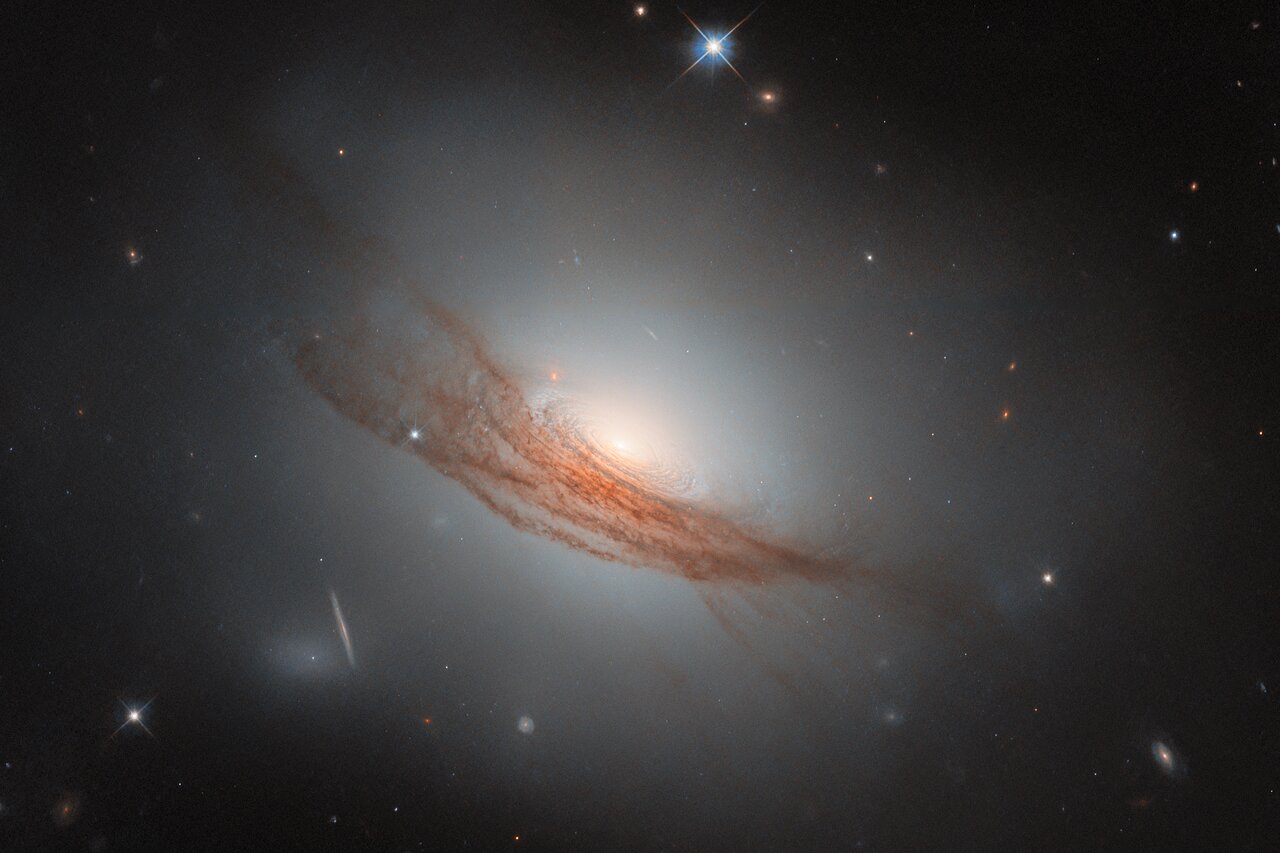
Click for original image.
Cool image time! The picture to the right, cropped, reduced, and enhanced to post here, was taken by the Hubble Space Telescope as part of follow-up observations of a now faded supernovae that occurred there two years earlier.
This was on purpose: the aim of the observations was to witness the aftereffects of the supernova and examine its surroundings, which can only be done once the intense light of the explosion is gone.
The galaxy itself, NGC 7722, is 187 million light years away, and is unusual in itself.
A “lenticular”, meaning “lens-shaped”, galaxy is a type that sits in between the more familiar spiral galaxies and elliptical galaxies. It is also less common than these — partly because when a galaxy has an ambiguous appearance, it can be hard to determine if it is actually a spiral, actually an elliptical galaxy, or something in between. Many of the known lenticular galaxies sport features of both spiral and elliptical galaxies. In this case, NGC 7722 lacks the defined arms of a spiral galaxy, while it has an extended, glowing halo and a bright bulge in the center similar to an elliptical galaxy. Unlike elliptical galaxies, it has a visible disc — concentric rings swirl around its bright nucleus. Its most prominent feature, however, is undoubtedly the long lanes of dark red dust coiling around the outer disc and halo.
The streak in the lower left is a very distant background galaxy, seen on edge.

Hidden in Amazon’s submission last week to the FCC, requesting more time to launch its Leo internet constellation, was this tidbit:
Less than two years after the Commission granted its authorization, Amazon Leo announced the largest commercial launch procurements in history to deploy its initial constellation. It has since added to this launch capacity, and today has contracted for 102 launches across four providers: 18 launches on Arianespace’s Ariane 6, 24 launches on Blue Origin’s New Glenn, 38 launches on ULA’s Vulcan Centaur, 9 launches on ULA’s Atlas V, and 13 launches on SpaceX’s Falcon 9. [emphasis mine]
The highlighted phrases indicate the significant changes. In my initial post last week I was focused solely on whether the FCC would grant Amazon the time extension to get its constellation in orbit. At the moment it has only 180 satellites operating in orbit, and to meet its license requirement it must have 1,616 launched by July.
Thus, I didn’t look closely at these launch contract numbers. While the number of launches for Arianespace (18) and ULA (47) appears to match Amazon’s contract numbers from its original 2022 announcement, Blue Origin’s total has dropped by three launches, 27 to 24.
SpaceX in turn has gained another ten launches, on top of its original already completed 2023 three-launch contract. (In 2023, faced with a stockholder lawsuit for ignoring SpaceX’s Falcon 9, the only operational rocket among all of these at the time and by far the cheapest, Amazon’s management quickly signed SpaceX to that three-launch contract.)
The submission last week tells us that sometime recently Amazon signed SpaceX to a new contract for ten more launches. The numbers also suggest that the company took three launches away from Blue Origin’s New Glenn. Apparently, Amazon is not happy with Blue Origin’s launch pace, and signed SpaceX to help get more satellites in orbit. Without question, SpaceX will get these ten additional launches off faster than ULA, Arianespace, or Blue Origin combined. In fact, I bet it gets all ten done before the middle of this year, assuming Amazon can deliver it the satellites.
SpaceX this morning successfully placed another 25 Starlink satellites into orbit, its Falcon 9 rocket lifting off from Vandenberg in California.
The 1st stage (B1071) completed its 31st flight, landing on a drone ship in the Pacific. Though this number set no records, it moved that booster closer to catching the records for the most reused launch vehicle, presently held by the shuttle Discovery:
39 Discovery space shuttle
33 Atlantis space shuttle
32 Falcon 9 booster B1067
31 Falcon 9 booster B1071
30 Falcon 9 booster B1063
29 Falcon 9 booster B1069
28 Columbia space shuttle
The 2026 launch race:
14 SpaceX
6 China
2 Rocket Lab
This list is likely inaccurate, as Russia had a Soyuz-2 launch of a classified payload planned just prior to SpaceX’s launch, but as yet there been no confirmation of its success. SpaceX also has another launch schedule for this evening. I will include both when I update then.
The uncertainty of science! It is time for another sunspot update. It is also time to note that once again the Sun appears to be confounding the predictions of NOAA’s solar science panel. Below is NOAA’s monthly graph of the sunspot activity on the Earth-facing hemisphere, updated by NOAA to include the activity in January but annotated with extra information by me to illustrate the larger scientific context.
Since April 2025 that science panel has been predicting that the solar maximum has passed and the Sun was beginning the ramp down to solar minimum, now expected to occur around 2031-32. And in the ten months since, sunspot activity has appeared to more or less track that prediction, as indicated by the purple/magenta curve line on the graph below.
It now appears that this prediction might very well have been premature.
» Read more
SpaceX yesterday submitted a proposal to Federal Communications Commission to build new satellite constellation made up of one million satellites designed as an orbiting data center.
In one 8-page document, SpaceX describes its proposed Orbital Data Center system. “To deliver the compute capacity required for large scale AI inference and data center applications serving billions of users globally, SpaceX aims to deploy a system of up to one million satellites to operate within narrow orbital shells spanning up to 50 km each (leaving sufficient room to deconflict against other systems with comparable ambitions),” the company says.
The same satellites would harness the sun’s energy, orbiting at “between 500 km and 2,000 km altitude and 30 degrees and sun-synchronous orbit inclinations,” the company adds. The orbiting data centers would also use “optical links,” or lasers, to connect with Starlink, using the existing satellite internet system to route traffic to users below.
“Orbital data centers are the most efficient way to meet the accelerating demand for AI computing power,” the filing adds in bold, pointing to the growing energy costs of AI data centers on Earth. The company is also betting it can launch the space-based data centers at a rapid clip using SpaceX’s more powerful Starship vehicle, which is also crucial to upgrading Starlink with next-generation satellites.
The FCC is likely not going to okay this submission, as written. It is clearly very preliminary, but appears to be consistent with SpaceX’s way of doing business. It sees an opportunity, and jumps in with full force. While others are working up their plans, SpaceX submits its first license proposal outlining the plan in very broad terms, thus getting there first.
And SpaceX is very well positioned to launch this constellation as promised. It has the rockets, and has proven itself capable of running a satellite constellation of vast size.
NASA yesterday announced that it awarded the space station startup Axiom the next slot for a tourist mission to ISS.
NASA and Axiom Space have signed an order for the fifth private astronaut mission to the International Space Station, targeted to launch no earlier than January 2027 from the agency’s Kennedy Space Center in Florida.
…Axiom Mission 5 is expected to spend up to 14 days aboard the space station. A specific launch date will depend on overall spacecraft traffic at the orbital outpost and other planning considerations.
Both Axiom and the space station startup Vast had been bidding for the fifth and sixth tourist slots. That Axiom had already done this four times previously was probably NASA’s reasons for choosing it. The agency has not yet decided on who will get the sixth slot, targeting a mission likely in 2028. My bet is that it will give to Vast, because by then Vast’s own demo station Haven-1 will have launched and been visited, thus giving that company some of the experience Axiom already has.

Proposed spaceports in Malaysia
Officials from Glavcosmos, the commercial division of Russia’s Roscosmos space agency, have been holding meetings with officials from the Malaysian province of Sabah about building a spaceport there.
Glavkosmos said technical studies identify Sabah as the most suitable location in Southeast Asia for orbital launches, including low-earth and sun-synchronous orbits, due to its strategic geography and safe rocket stage drop zones. The proposed spaceport could create more than 2,000 high-income jobs and boost local supporting industries.
One year ago, in January 2025, the Sabah government announced it was holding similar discussions with the Ukraine. It seems either those talks fell through, or Russia decided to move in and block the Ukraine from making a deal.
A second Malaysian state, Pahang, is also planning a spaceport, working instead with China.
In all cases, it does appear for some reason Malaysia is not very interested in working with western nations.
Blue Origin yesterday announced it is “pausing” the suborbital tourist flights of its New Shepard spacecraft for no less than two years.
Blue Origin today announced it will pause its New Shepard flights and shift resources to further accelerate development of the company’s human lunar capabilities. The decision reflects Blue Origin’s commitment to the nation’s goal of returning to the Moon and establishing a permanent, sustained lunar presence.
Those “lunar capabilites” not only include its lunar landers, both manned and unmanned, but its New Glenn rocket, which it wants to sell to NASA to use for these missions. Both need more attention. In addition, it could be the company’s CEO, David Limp, wants to allocate more resources to the company’s Orbital Reef space station proposal, which has been sitting dead in the water for the past year-plus. All these projects have been very slow to get out of the starting gate, partly because of the very leisurely culture that Blue Origin’s previous CEO installed, and partly because the company has put out too many projects it is not focusing well on finishing.
There is also likely a third reason: New Shepard was not making a profit. While the company has been flying it quite regularly in recent months, it does not appear it could ever recover its costs. Moreover, I suspect the demand for these short suborbital tourist flights has diminished with advent of orbital tourism and the soon-to-arrive multiple commercial space stations.
Amazon yesterday submitted a request to the Federal Communications Commission to extend the July deadline on its license for its Leo internet satellite constellation, which presently requires it to have 1,616 satellites in orbit by that date.
At present Amazon has 181 satellites in orbit, all launched in the last ten months. At that pace there is no chance the company can meet its FCC requirement. From its FCC submission:
While Amazon Leo will meet the deadline for full deployment of its constellation established by its license and the Commission’s rules, launch delays will cause it to fall short of the interim milestone requirement to deploy half of its originally authorized constellation by July 30, 2026. The Commission’s rules provide for extension of such milestones where, as here, delay arises from unforeseeable circumstances beyond an operator’s control or overriding public interest considerations favor an extension.
Because it meets both criteria, Amazon Leo respectfully requests a 24-month extension of its 50% milestone to July 30, 2028, or alternatively, a waiver of this interim requirement.
In its submission Amazon claims the delay is entirely the fault of the rocket companies it was relying on to launch the satellites, but that is a bogus claim. It initially choose to depend almost entirely on three new rockets (Blue Origin’s New Glenn, ULA’s Vulcan, and Arianespace’s Ariane-6), all of which had not launched and were still under development. To expect these to launch on time was absurd.
Furthermore, its ULA contract also called for launches using company’s already operational Atlas-5 rocket, which Amazon claims were delayed because of “unexpected anomalies and delays caused by issues with its vehicle fairings and solid rocket boosters.” I don’t buy it, and suspect the real cause was that Amazon was unable to produce the satellites on time.
Faced with these delays and a stockholder lawsuit, Amazon subsequently signed SpaceX to do three launches, which that company did quickly, in less than four months. If Amazon had truly wanted to get its Leo satellites in orbit on time, it would have given SpaceX more launches and gotten it done.
Nonetheless, it is likely the FCC will agree to Amazon’s extension request. The company has now shown it is committed to the process and intends to get its constellation in orbit. It is not sitting on its license doing nothing. I would not be surprised however if the FCC imposes some new requirements in an effort to force Amazon to launch more satellites more quickly.
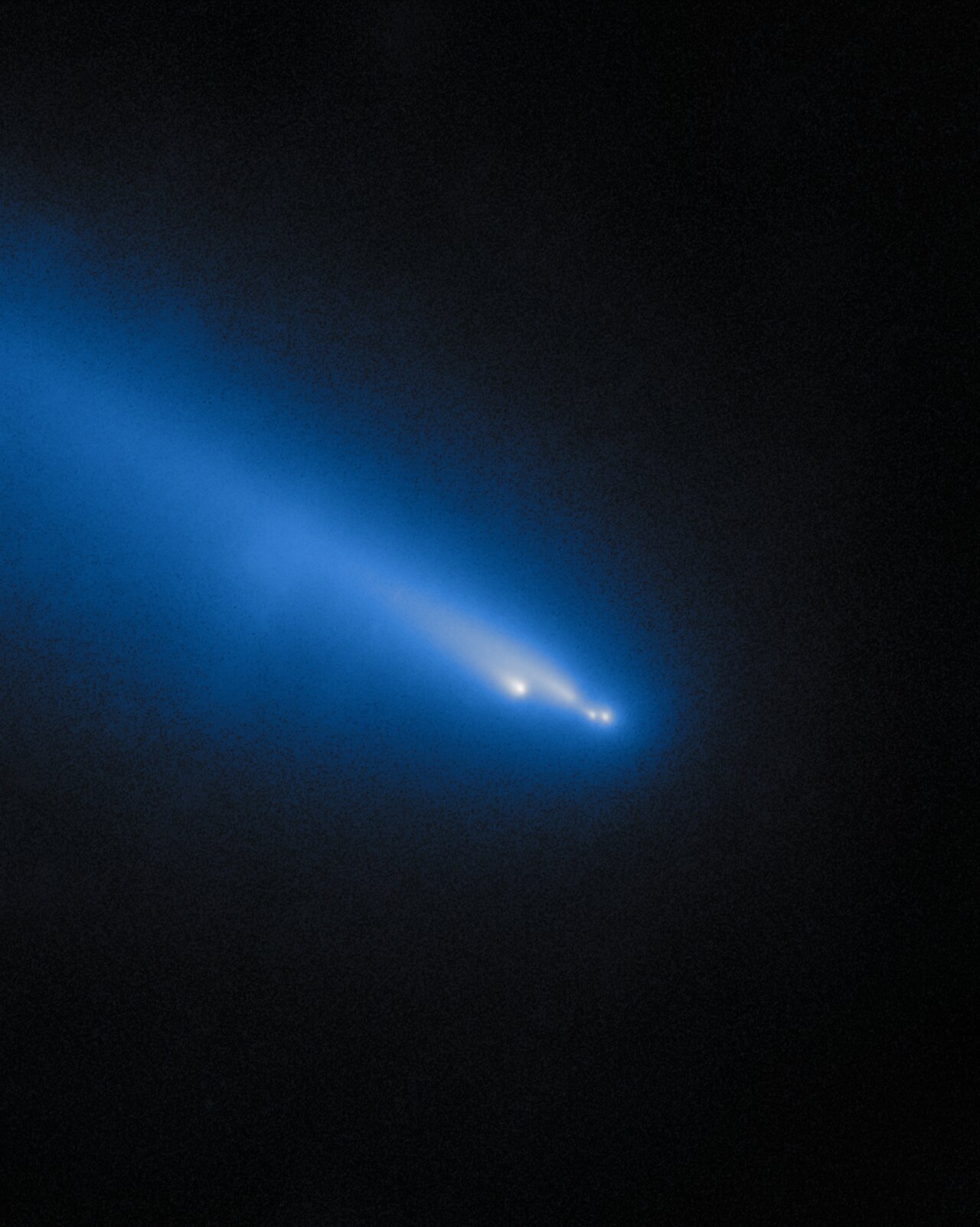
CORRECTION: The image to the right is not that of interstellar Comet 3I/Atlas, as I reported earlier today. I misread the Gemini Telescope release. This is comet K1/Atlas, another comet from our own solar system that made its close approach to the Sun in October, when it broke up.
The the latest image from the Gemini North Telescope in Hawaii shows at least four sections slowly drifting apart.
The picture to the right, cropped to post here, was taken on December 6, 2025. Gemini’s previous image, taken in November 11th, shows about the same number of objects, but clustered much more closely together.
It appears that as the comet made its closest approach, the stress was too great. This is not surprising, as it happens to many comets that get too close to the Sun.
Sorry for the error and hat tip to reader Tom Laskowski for letting me know. I need to look at the names of comets named after the ATLAS telescope, as they are very similar and most are NOT interstellar comet 3I/Atlas.
China today successfully placed an Algerian “remote sensing” satellite into orbit, its Long March 2C rocket lifting off from its Jiuquan spaceport in northwest China.
No word on where the rocket’s lower stages, using very toxic hypergolic fuels, crashed inside China. China’s state-run press also said little about the satellite, other than claiming it would be used for “land planning and disaster prevention and mitigation.” This however doesn’t match what “remote sensing” satellites usually do, which is military surveillance.
The 2026 launch race:
13 SpaceX
6 China
2 Rocket Lab
Embedded below the fold.
To listen to all of John Batchelor’s podcasts, go here.
» Read more
An evening pause: According to this website, this documentary was “made by General Electric between 1928 and 1929 to commemorate the completion of this monumental [8-mile-long] tunnel which took 1800 workers and three years to construct.”
Three years! Today that’s how long it would take just to get the environmental assessment written and approved.
Hat tip Blair Ivey.
Courtesy of BtB’s stringer Jay. This post is also an open thread. I welcome my readers to post any comments or additional links relating to any space issues, even if unrelated to the links below.
According to a bunch of unconfirmed stories today from different news outlets, Elon Musk is considering merging SpaceX with xAI and Tesla as part of the initial public offering (IPO) of SpaceX that the company is contemplating for sometime this summer.
Reuters reports that Musk wants to merge xAI — his very valuable AI company that has already merged with the company that used to be called Twitter — into SpaceX, his very valuable rocket company. And Bloomberg reports that SpaceX is also considering a merger with Tesla, citing people familiar with the matter.
The SpaceX-xAI tie-up could help Musk build data centers in space. “The combination would bring Musk’s rockets, Starlink satellites, the X social media platform and Grok AI chatbot under one roof,” the Reuters report says. Then again, Reuters also says it doesn’t know several key details about the theoretical deal, including “its primary rationale.”
None of this is confirmed, but Musk has not denied it either. If so, this IPO would be the largest ever in the history of the stock markets, by many magnitudes. As noted at the link, xAI is raising gigantic amounts of capital. SpaceX in turn is expected to do even better in its IPO, as a single entity. Tesla is in far less demand, but this merger could be a way to reshape that company to give it a better future. It has already said it is beginning the transition from electronic cars to robots and other autonomous machines.
Whether such a merger will help SpaceX or Musk in his goal of building a Mars colony remains decidedly uncertain. A publicly traded stock company does not have the freedom of action that SpaceX now has as privately owned company.
A Russian defunct military geosynchronous satellite that was launched in 2014 and spent a decade spying on other geosynchronous satellites only to be moved to a graveyard orbit in 2025 when its fuel ran out apparently broke apart earlier today.
The Swiss company S2A systems, which specializes in tracking orbital objects, captured the moment the spacecraft began disintegrating. I have embedded that footage below, though it really is far less exciting than it sounds.
The debris poses a very small risk to other geosynchronous satellites, which orbit at about 22,000 miles elevation where there is too little atmosphere to decay orbits. The graveyard orbit is several hundred miles higher.
» Read more
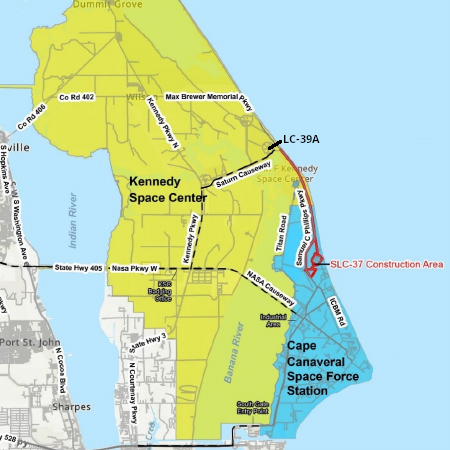
Proposed Starship/Superheavy launchsites at
Kennedy (LC-39A) and Cape Canaveral (SLC-37)
While NASA has already determined that Starship/Superheavy launches from the Kennedy Space Center in Florida will have no significant impact on the environment, the FAA has not yet completed its own environmental impact statement.
Last week it released a preliminary summary [pdf] of its impact statement, revealing that it has reduced its final options to either approving SpaceX’s request to do as many as 44 launches per year, or to reject any changes — the “no action alternative” — which would block all Starship/Superheavy launches at Kennedy.
The overall tone of this summary suggests strongly that the FAA is almost certainly going to approve SpaceX’s request, allowing as many as 44 launches per year from launchpad LC-39A, as shown on the map to the right. As it notes in describing the “no action alternative”:
SpaceX would not launch Starship-Super Heavy from LC-39A. NASA would not develop, implement, or approve agreements with SpaceX associated with Starship-Super Heavy operations at LC-39A. The No Action Alternative would not meet the purpose and need. [emphasis mine]
In other words, rejecting SpaceX’s request would not fulfill the FAA’s obligation to serve the public. It would also not fulfill the FAA’s obligation to serve a fellow government agency, NASA, which has already approved this SpaceX request in a 2019 environmental assessment.
It appears a final decision by the FAA is imminent. A nice summary of this FAA document can be found here, which notes that if approved, it will give SpaceX license approval to launch Starship/Superheavy as much as 146 times per year, from its launchpads at Boca Chica, Kennedy, and Cape Canaveral. Note too that this FAA assessment is independent of the Air Force’s environment assessment, which has already approved 76 launches per year at the SLC-37 launchpad.