
Emmylou Harris – Tulsa Queen
An evening pause: Performed live 1979.
Hat tip Judd Clark.
An evening pause: Performed live 1979.
Hat tip Judd Clark.
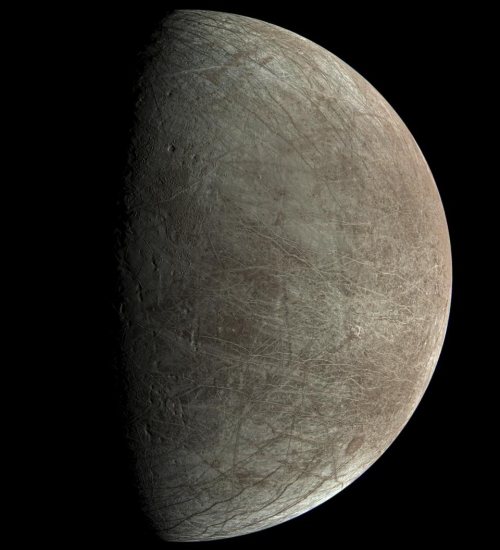
Europa in true color, taken by Juno during that
September 2022 fly-by. Click for full image.
Using data produced by Juno during a 2022 close-fly of Jupiter’s moon Europa, scientists have made a new estimate of the thickness of Europa’s icy crust, approximately 18 miles thick with a 6-mile margin of error.
In other words, their estimate could be as small as 12 miles thick, or as large as 24 miles thick.
You can read their paper here. From their abstract:
For the idealized case of pure water ice, the data are consistent with the existence of a thermally conductive ice shell with a thickness of 29 ± 10 km [18 ± 6 miles] and with the presence of cracks, pores or other scatterers extending to depths of hundreds of metres below the surface with a characteristic size smaller than a few centimetres in radius. An ice-shell salinity of 15 mg kg−1, as indicated by models based on terrestrial marine ice, would reduce our estimate of the thickness of the ice shell by about 5 km, substantially less than our 10 km uncertainty. The low volume fraction, small size and shallow depth of the scatterers indicate that the fracture interfaces observed at Europa’s surface are alone unlikely to be capable of carrying nutrients between the surface and the ocean. [emphasi mine]
The highlighted sentence is the important one. If this new estimate is right, than the unidentified reddish material that appears to leak out of the long ridgelike cracks on Europa’s surface, clearly visible in the picture to the right, are not coming from any underground ocean. The distances are too large.
Other estimates have suggested that ice crust could be as thin as 2 miles, but like this research the uncertainties are very large.
Meanwhile, the Juno mission is still alive, though essentially winding down operations. The mission was expected to officially end at the end of September 2025, when its budget ran out, but the just passed budget included enough money to keep it going, albeit at a relatively low level. According to the orbiter’s webpage, it will continue to orbit Jupiter, its orbit degrading naturally until it falls into Jupiter to burn up. As it does so data will continue to be collected, though at a much lower rate.
Courtesy of BtB’s stringer Jay. This post is also an open thread. I welcome my readers to post any comments or additional links relating to any space issues, even if unrelated to the links below.

Click for original image.
Cool image time! The picture to the right, rotated, cropped, reduced, and sharpened to post here, was taken on November 30, 2025 by the high resolution camera on Mars Reconnaissance Orbiter (MRO).
The science team labels this simply as “Features,” the vagueness of which I can understand after digging in to get a better idea of the location and geography.
The location, as shown by the white dot on the overview map below, is inside the Medusa Fossae Formation, the largest volcanic ash field on Mars that is thought to be the source of much of the red planet’s dust. That ash field is large and very deep, and was put down more than a billion years ago when the giant volcanoes of Mars were active and erupting. Thus it is well layered, and many images of that ash field show that layering exposed by the eons of Martian wind scouring its surface.
In this case, that scouring appears to have produced this feathery surface, though the origin of those ridges might have instead come from volcanic flows that are now hardened. Or we could be looking at ancient channels produced by ice or water, though that would have to have been a very long time ago, as this image is located in the Martian dry tropics, where no near surface ice presently exists.
» Read more

Click for original image.
In what is a perfect example of the proper use of artificial computer intelligence (AI), astronomers have now used this programming to analyze almost 100 million images taken by the Hubble Space Telescope over the decades to find any galaxies hidden there that have “anomalies” or unusual shapes.
The team analyzed nearly 100 million image cutouts from the Hubble Legacy Archive, each measuring just a few dozen pixels (7 to 8 arcseconds) on a side. They identified more than 1,300 objects with an odd appearance in just two and a half days — more than 800 of which had never been documented in scientific literature.
The six galaxies to the right are just a small sample. All six were previously unidentified, and include “three lenses with arcs distorted by gravity, one galactic merger, one ring galaxy, and one galaxy that defied classification” (the galaxy at the top left). From the European Space Agency’s (ESA) press release:
The strange, bi-polar galaxy seen here is certainly anomalous, with its compact, swirling core and two open lobes at the sides. Exactly what kind of galaxy it is is unclear, and it was not previously known to astronomers.
As noted in the first link, the volume of data that astronomers are now collecting from ground-based and orbiting telescopes — many of which are survey telescopes that photograph the entire sky repeatedly — has actually become a problem. They have great data, but don’t have the time or human resources to study it sufficiently. Even employing large numbers of ordinary citizens, working at home with their own computers, can’t get the job done.
This is the kind of grunt work that AI is ideally made for. It can quickly review the data and identify objects that don’t fit normal expectations. Humans then can do the real work, finding the most interesting of these strange objects, such as the top left galaxy, and devote human creativity to studying it.
According to a recent tweet by Elon Musk , the next Starship/Superheavy test launch will occur “in 6 weeks,” placing that launch sometime in mid-March.
Musk provided no other information, but this announcement suggests the company’s engineers now understand and have corrected the issues that caused two Superheavy ruptures during two different tank tests in recent weeks. It also suggests that the launchpad repairs and upgrades will soon be completed, and that a new version 3 Superheavy prototype is ready to go, replacing one that was damaged during those tank tests.
The mission specifics however remain unclear. SpaceX could repeat the flight path of the last few tests, in an orbit low enough so that the atmosphere will bring Starship down over the Indian Ocean. In such a flight the company would test refueling within Starship, restarts of its Raptor engines, and deployment of dummy or even real Starlink satellites.
It is possible however that this next test flight will go into a full orbit, and circle the Earth once or several times. SpaceX has said that in 2026 it intends to do a Starship refueling test using two Starships, launched several weeks apart. To do this more ambitious mission however it first needs to do at least one full orbital flight of Starship. Since the company has already tested on previous orbital test flights the restart of Starship’s Raptor engines — proving its capability to do a controlled re-entry — there really is no reason it can’t go for a full orbit on the next flight. There is even the possibility that Starship will come back to Boca Chica and be caught the company’s tower chopsticks, though this remains unconfirmed.
The Italian rocket company Avio has won two separate launch contracts for its Vega-C rocket, one from Airbus and a second from Brazil.
It also appears that these two contracts are the ones that Avio touted in late December for a total of $117 million, but did not reveal the customers at the time.
First, Brazil’s government will pay Avio $35.6 million to use the Vega-C rocket to launch its Amazonia-1B Earth observation satellite in 2027. This contract was obtained though the launch services company SpaceLaunch and is likely the deal first announced in September without mention of the customer.
Next, Airbus will use the Vega-C in 2028 to launch the first satellite in its Pléiades Neo Next Earth observation satellite constellation. Though the contract price was not announced, it is likely $84.4 million, the difference between the $117 million total for the two contracts and the $35.6 million Brazil is paying.
The price on both launch contracts illustrates how the competition from SpaceX and Rocket Lab is forcing launch costs down. A decade ago launches never cost less than $100 million. Now they always do, and the Brazil price of $35.6 million indicates even lower prices in the future.
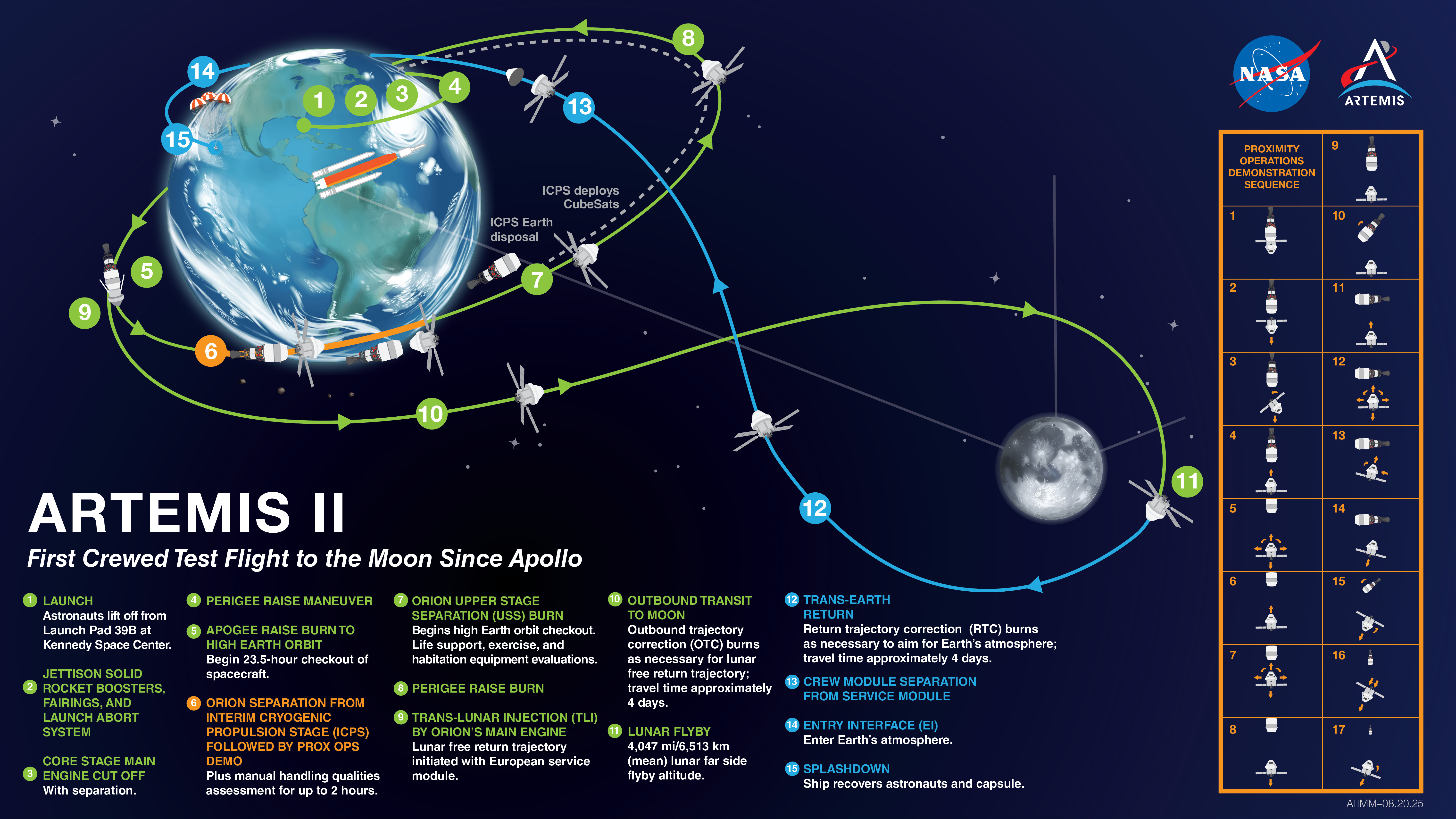
The flight plan for the Artemis-2 mission around the Moon. Click for original.
NASA engineers are now targeting January 31, 2026 for the manned dress rehearsal countdown of the Artemis-2 SLS rocket and Orion capsule.
The upcoming wet dress rehearsal is a prelaunch test to fuel the rocket. During the rehearsal, teams demonstrate the ability to load more than 700,000 gallons of cryogenic propellants into the rocket, conduct a launch countdown, and practice safely removing propellant from the rocket without astronauts inside the spacecraft.
During several “runs,” the wet dress rehearsal will test the launch team’s ability to hold, resume, and recycle to several different times in the final 10 minutes of the countdown, known as terminal count. The rehearsal will count down to a simulated launch at 9 p.m. EST, but could run to approximately 1 a.m. if needed.
This rehearsal will include the four-person crew inside the Orion capsule, which will once launched take them in a wide ten-day Earth orbit that will swing them past the Moon and then back to Earth. The crew entered quarantine at the end of last week to reduce the chance they will catch any illnesses prior to launch.
This mission carries great risk, as the capsule’s life support system has never been used in space before, while the viability of its heat shield remains questionable.
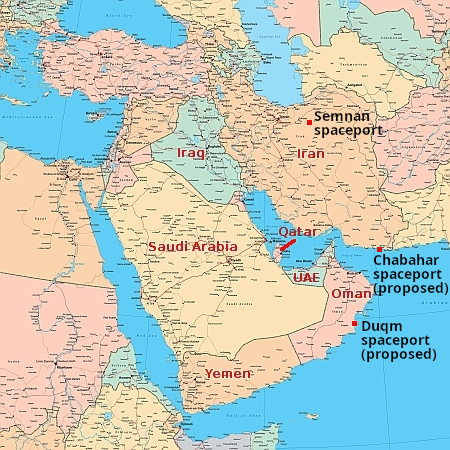
Active and proposed Middle East spaceports
In a press announcement yesterday, NASA officially confirmed that Oman has become the 61st nation to sign the Artemis Accords.
U.S. Ambassador to the Sultanate of Oman Ana Escrogima and NASA’s Deputy Associate Administrator Casey Swails participated in the event held on the opening day of the Middle East Space Conference, an international forum on space and innovation in the region. Said al-Maawali, Oman’s minister of transportation, communication, and information technology signed on behalf of the country.
I had reported early yesterday a story in Oman’s state-run press claiming that its sultan wanted his country to sign the Artemis Accords, a claim put forth by Oman officials during this conference. Apparently that was poor reporting. What actually happened was the event included the official Artemis Accords signing ceremony, which also included a number of other bi-laterial trade agreements.
As I noted yesterday, Oman has been unsuccessful so far in its efforts to bring American rocket and satellite companies to its proposed Duqm spaceport because State Department ITAR regulations, designed to protect American technology from hostile foreign powers, prevent it. This agreement hopefully includes some security guarantees that will ease those regulations and allow such deals.
The full list of all signatories to this American space alliance:
» Read more
An evening pause: A bit of lesser known American history.
Hat tip Wayne DeVette.
Courtesy of BtB’s stringer Jay. This post is also an open thread. I welcome my readers to post any comments or additional links relating to any space issues, even if unrelated to the links below.

Sometimes in art there are times when culture, timing, talent, and teamwork combine to produce a magic that is eternal and beyond measure. For Richard Rodgers and Oscar Hammerstein, that time occurred from 1943 to 1959, when these two men created a string of musicals so grand that each
would become not just familiar but universally beloved, played over and over again until the words and melodies had become meshed, it seemed, with one’s very existence. To have one’s complete score memorized by a whole population would, it would seem for a composer, to have been all that life has to offer.
This quote comes from Meryle Secrest’s fine 2001 biography of Richard Rodgers, Somewhere for me: a biography of Richard Rodgers. It tells a story of a man who from childhood was obsessed with writing music, who struggled for decades to write musicals where the music and song flowed naturally from the plot and characters, and who changed with time as time changed him. Outside of his music and his commitment to it, he was however a very normal man, with a marriage that at times was stormy but held together despite those storms.
But it is Rodgers’ best music — written for the lovely words of Oscar Hammerstein — for which we most remember him. I grew up in the 1950s and 1960s, so I lived at a time when these Rodgers and Hammerstein musicals were being memorized by a whole population. As a child my parents subscribed to a musical record club, which sent them a new album every month. I would spend hours listening to the songs from Oklahoma, South Pacific, The Sound of Music, the King and I, and Carousel. And on television I got to see Julie Andrews in a live production of Cinderella.
In listening to these songs, I quickly realized, even as a child, that there was something deeply profound in those words and music, touching something deeper than mere beauty, a more fundamental but utterly inexplicable aspect of our existence. As I wrote in 2018 when I posted an evening pause of Juanita Hall singing Bali Ha’i from South Pacific,
» Read more

The Middle East, showing the location of
Oman’s proposed spaceport at Duqm.
In a diplomatic meeting between Oman and U.S. state department in Oman, Oman officials announced their Sultan wants his country to sign the Artemis Accords.
The two sides discussed means of maximising the benefits of the Free Trade Agreement between the two countries and augmenting American investments in sectors of priority for the Sultanate of Oman. These sectors include the digital economy, technology and space, in addition to mining, logistics, aviation and infrastructure.
Cooperation in the fields of education and culture was also discussed, particularly educational programmes, academic and professional exchange and investment in research and innovation. The two sides further exchanged views and positions on a number of regional and international issues, emphasising the importance of backing efforts for peace, stability and development.
During the dialogue, the Omani side announced the Sultanate of Oman’s approval to join the ‘Artemis Accords’ for space exploration. A cooperation statement on the 250th anniversary of the founding of the United States of America was also signed. [emphasis mine]
Much of this is diplomatic blather, meaning little. While I would expect the Trump administration welcome Oman as an Artemis Accord partner, in the talks related to the highlighted first paragraph above it likely demanded some concessions first. Free trade in Oman is going to require some protection for American technology.
For example, right now State Department rules make it difficult if not impossible to launch American satellites or rockets from Oman’s proposed spaceport in Duqm, rules imposed because Oman cannot be trusted. I expect the State Department is demanding total security control from U.S. entities on any launch before agreeing to an Oman Artemis Accord agreement.
SpaceX this morning successfully placed another 25 Starlink satellites into orbit, its Falcon 9 rocket lifting off from Vandenberg in California.
The first stage completed its sixth flight, landing on a drone ship in the Pacific.
The 2026 launch race:
10 SpaceX
5 China
1 Rocket Lab
Link here. The point the op-ed makes is fundamental: AI cannot add anything to the information it has. It might be able to compile that information well, but its analysis is always going to be limited because it has no true creative spirit. It is merely a software program, albeit a very sophisticated one.
This quote from the essay will give you the sense:
Maybe you just use AI to clarify your thoughts. Turn the mottle of ideas in your head into coherent communicable paragraphs. It’s OK, you say, because you’re reviewing the results, and often editing the output. You’re ending up with exactly what you want to say, just in a form and style that’s better than any way you could have put it yourself.
But is what you end up with really your thoughts? And what if everyone started doing that?
Stripping the novelty and personality out of all communication; turning every one of our interactions into homogeneous robotic engagements? Every birthday greeting becomes akin to a printed hallmark card. Every eulogy turns into a stamp-card sentiment. Every email follows the auto-response template suggested by the browser.
We do this long enough and eventually we begin to lose the ability to communicate our inner thoughts to others. Our minds start to think in terms of LLM prompts. All I need is the gist of what I want to say, and the system fills in the blanks. [emphasis in original]
Comments are of course welcome. But please read the full essay before doing so.
According to a press release yesterday from the Applied Physics Lab (APL) in Maryland that is building the Dragonfly helicopter that is going to Saturn’s moon Titan, the rotors have completed the first round of testing, and are now about to undergo “fatigue and cryogenic trials under simulated Titan conditions.”
Over five weeks, from August into September, the team evaluated the performance of Dragonfly’s rotor system — which provides the lift for the lander to fly and enables it to maneuver — in Titan-like conditions, looking at aeromechanical performance factors such as stress on the rotor arms, and effects of vibration on the rotor blades and lander body. In late December, the team also wrapped up a set of aerodynamics tests on smaller-scale Dragonfly rotor models in the TDT [Transonic Dynamics Tunnel].
This quote about the manufacture of the rotors however stood out the most:
Pennington and team cut Dragonfly’s first rotors on Nov. 1, 2024. They refined the process as they went: starting with waterjet paring of 1,000-pound aluminum blocks, followed by rough machining, cover fitting, vent-hole drilling, and hole-threading. After an inspection, the parts were cleaned, sent out for welding, and returned for final finishing.
“We didn’t have time or materials to make test parts or extras, so every cut had to be right the first time,” Pennington said, adding that the team also had to find special tools and equipment to accommodate some material changes and design tweaks. [emphasis mine]
In other words, this is another hardware-poor NASA project. What they build is what they have. No time or money for testing of prototypes.
This mission is really pushing the envelope, possibly more than any NASA planetary probe in a half century. I just hope they get it right.
I’m shocked, shocked! According to news reports in Russia yesterday, Roscosmos has now delayed the initial launches for its own copycat “Starlink” constellation because the production of the satellites has fallen behind schedule.
In September 2025, Roscosmos head Dmitry Bakanov promised that by the end of 2025, the first 300 satellites would begin to be deployed in orbit as part of the Rassvet project. They are supposed to become “an analogue of the Starlink system” and provide “access to the internet at any geographical point.”
According to the publication, the postponement of the launch of the first 16 devices until 2026 may be due to the fact that the required number of satellites has not yet been assembled.
The project is being run by a Bureau 1440, supposedly a private Russian commercial company that is providing two thirds of the $5.7 billion budget, with the Russian government picking up the difference. It claims it will begin launching this year and have 318 satellites in orbit by 2028.
Wanna bet? Russia has not been able to complete any space project on time in decades, and even when its projects do finally launch, each routinely has had serious technical and quality control issues.
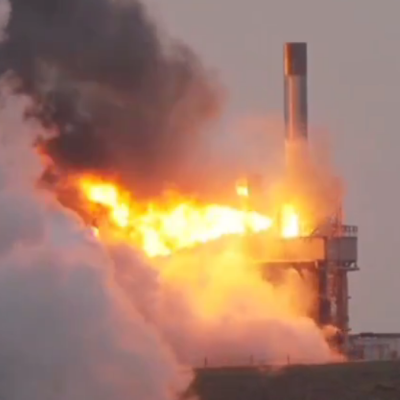
Screen capture from video of the RFA-1
test failure in August 2024. Note the flame
shooting out sideways.
The European Space Agency (ESA) yesterday awarded the German rocket startup Rocket Factory Augsburg a two-launch contract under its “Flight Ticket Initiative”, designed to encourage the development of a commercial independent European launch market.
With these signatures between ESA and Rocket Factory Augsburg (RFA), two more missions will be launched with the RFA One rocket from Saxavord Spaceport in the UK as part of the Flight Ticket Initiative. ESA and the European Commission have thus once again placed their trust in RFA as a future launch service provider.
…The Lurbat mission will fly a collection of demonstrator technologies and is developed by Added Value Solutions based in Spain. … A second mission will see the launch of two CubeSats developed under ESA contract by the Spanish company Indra Space. The CubeSats will hold five experiments selected by the European Commission through the Horizon Europe IOD/IOV call for Expression of Interest
Rocket Factory also has a launch contract with the German government. However it needs to first complete the first launch of its RFA-1 rocket. That launch was originally supposed to occur in 2024 but was canceled when the rocket’s first stage was destroyed during a static fire test on its Saxavord launchpad that year.
Since then the company has released little information about the rocket’s status. According to this news report today, it hopes to finally do that test launch this year. It better do it soon, as there is a slew of other European rocket companies that intend to do the same.
And then of course there is the question of the Saxavord spaceport and the red tape that has crippled all the spaceports in Great Britain. Both Saxavord and Rocket Factory have previously gotten their launch licenses from the UK’s Civil Aviation Authority (CAA), but it is unclear if those licenses remain valid, especially after the static fire explosion. Based on its past behavior, the CAA could have pulled the licenses, and is now reviewing the whole thing.
If so, it might take years for both to get an approval again. In fact, this might very well be the reason Rocket Factory didn’t launch in 2025.
Embedded below the fold.
To listen to all of John Batchelor’s podcasts, go here.
» Read more
An evening pause: Who needs an orchestra when you have a modern synthesizer, properly programmed?
Hat tip Cotour.