January 7, 2026 Quick space links

Courtesy of BtB’s stringer Jay. This post is also an open thread. I welcome my readers to post any comments or additional links relating to any space issues, even if unrelated to the links below.

  • On this day in 1998, Lunar Prospector was launched to the Moon
    It was the first NASA mission to the Moon in a quarter century. Its data confirmed data from Clementine, an earlier Defense Department lunar orbiter, that suggested there was water ice in the Moon’s permanently shadowed polar craters. That conclusion as yet however remains unproven.
8 comments

Scientists: Methane from spacecraft landing on the Moon could “obscure” evidence of life

Chicken Little rules!

Chicken Little stupidity now abounds everywhere! Scientists using computer models say the methane fuel that many lunar landers will use can spread quickly across the entire Moon and then “obscure” any evidence of life that might be found there.

Sinibaldi and Francisca Paiva, a physicist at Instituto Superior Técnico and lead author of the study, built a computer model to simulate how that contamination might play out, using the European Space Agency’s Argonaut mission as a case study. The simulations focused on how methane, the main organic compound released during combustion of Argonaut propellants, might spread across the lunar surface during a landing at the moon’s South Pole. While previous studies had investigated how water molecules might move on the moon, none had done so for organic molecules like methane. The new model also accounted for how factors like solar wind and UV radiation would impact the methane’s behavior.

…The model showed exhaust methane reaching the North Pole in under two lunar days. Within seven lunar days (almost 7 months on Earth), more than half of the total exhaust methane had been “cold trapped” at the frigid poles — 42% at the South Pole and 12% at the North.

Though this result is of interest, as it suggests such exhaust can spread quickly on a low-gravity planet with no atmosphere, these scientists then make themselves look like fools by claiming this quick spread will contaminate the Moon, thus hindering the search for evidence of life there, and thus require new “planetary protection” measures. From their paper’s conclusion:

As lunar exploration unfolds, prioritizing effective and informed planetary protection measures will be key for safeguarding the Moon’s pristine scientific value and paving the way for a sustainable and responsible lunar exploration.

The level of foolishness in these claims is hard to measure. The Moon is the least likely place to search for evidence of past life. And regardless, limiting the use of methane fuel but allowing other exploration is not going to solve their problem. The mere presence of human activity is going to “contaminate” the Moon’s “pristine” environment. To make believe it is possible to impose some rules to prevent it is idiocy.

This whole study and its focus on “planetary protection” is really aimed at protecting the turf of these scientists. If others are allowed to explore the planets with different goals (profit or settlement instead of pure scientific research), their playground will be spoiled. Thus, they write these reports designed to give them ammunition for convincing governments to impose regulations in their favor. And they know they have allies in the UN for this purpose.

They also know they have willing allies in the propaganda press. Be prepared for numerous mainstream stories in the next day or so, touting this study with no skepticism.


16 comments

Rubin Observatory’s first observations detects more than 2,000 asteroids

The first look patch, in which 2,103 asteroids were detected
The first look patch, in which 2,103 asteroids
were detected. Figure 1 of the paper.

Scientists have now published the first results from the Rubin Observatory in Chile during its on-going commissioning phase, during which they detected more than 2,000 asteroids in just one patch in the sky, most of which had been unknown previously and many rotating at record-breaking speeds.

You can read the paper here [pdf]. From the press release:

The study presents 76 asteroids with reliable rotation periods. This includes 16 super-fast rotators with rotation periods between roughly 13 minutes and 2.2 hours, and three ultra-fast rotators that complete a full spin in less than five minutes.

All 19 newly identified fast-rotators are longer than the length of an American football field (100 yards or about 90 meters). The fastest-spinning main-belt asteroid identified, named 2025 MN45, is 710 meters (0.4 miles) in diameter and it completes a full rotation every 1.88 minutes. This combination makes it the fastest-spinning asteroid with a diameter over 500 meters that astronomers have found.

All but one of these fast-rotators are in the main asteroid belt, with the exception a near-Earth asteroid.

This work essentially completes Rubin’s commissioning. It will begin full observations in 2026. From the paper:

Toward the start of 2026, the observatory will begin conducting the Legacy Survey of Space and Time (LSST), a decade-long campaign to repeatedly image the southern sky in multiple bands. The main LSST survey will use six filters spanning near-ultraviolet to near-infrared wavelengths, revisiting the same pointing twice each night, returning to take additional pairs every few nights. … The cadence is designed to result in a dataset capable of answering numerous and varied science cases, from understanding the nature of dark energy to discovering and characterizing millions of asteroids, comets, interstellar objects, and transneptunian objects (TNOs) in the solar system.

In building Rubin the astronomers have always thought their biggest problem was archiving and accessing this large dataset, and much work was spent developing a usable and accessible archive system. Even so, it will take thousands of scientists many decades to mine the discoveries that will be hidden there.

6 comments

Study: If Europa has an underground ocean, it is lifeless and dormant

Scientists analyzing the conditions that are believed to exist in Europa’s theorized underground ocean have concluded there is little geological activity within that ocean, reducing significantly the chances there is life there.

A new study led by Paul Byrne, an associate professor of earth, environmental and planetary sciences, at Washington University in St. Louis, throws cold water on the idea that Europa could support life at the seafloor. Using calculations that consider the moon’s size, the makeup of its rocky core and the gravitational forces from Jupiter, Byrne and a team of scientists conclude that Europa likely lacks the tectonic motion, warm hydrothermal vents or any other sort of underwater geologic activity that would presumably be a prerequisite for life.

“If we could explore that ocean with a remote-control submarine, we predict we wouldn’t see any new fractures, active volcanoes or plumes of hot water on the seafloor,” Byrne said. “Geologically, there’s not a lot happening down there. Everything would be quiet.” And on an icy world like Europa, a quiet seafloor might well mean a lifeless ocean, he added.

You can read the paper here [pdf]. It admits in its conclusion that these results have a lot of uncertainty, and the Europa Clipper mission, set to arrive in orbit around Jupiter in 2031, will reduce that uncertainty but not eliminate it, adding that “Ultimately, however, the true test of our results here will require directly accessing the ocean and, perhaps one day, the ocean floor itself.”

9 comments

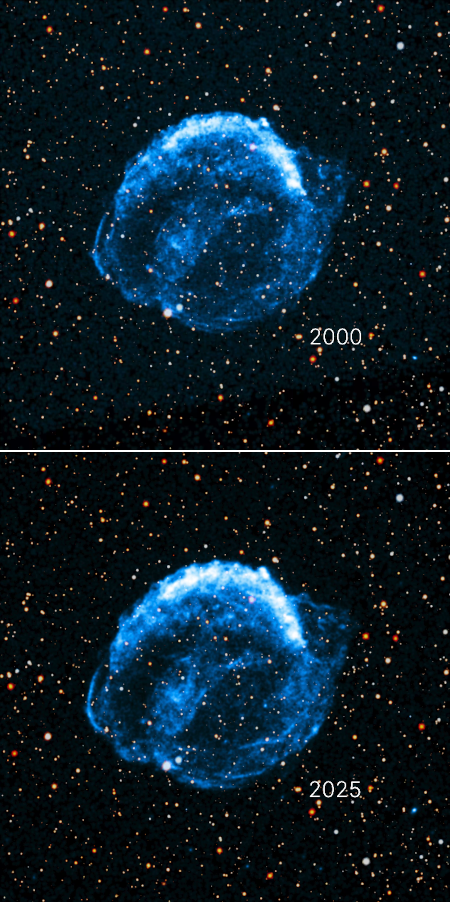
The growing X-ray shell of the 1604 Kepler supernova

Kepler's supernovae remnant over time
Click to see movie.

Cool image time! Astronomers now have created a short movie from X-ray data compiled by the Chandra X-ray Observatory accumulated during the past quarter century showing the expansion of the cloud ejected from the 1604 supernova discovered by astronomer Johannes Kepler.

The two images to the right are the first and last frames in the movie. Though they appear the same, if you look closely you will see that in the more recent image the cloud is larger. From the press release:

Supernova remnants, the debris fields left behind after a stellar explosion, often glow strongly in X-ray light because the material has been heated to millions of degrees from the blast. The remnant is located in our galaxy, about 17,000 light-years from Earth, allowing Chandra to make … detailed images of the debris and how it changes with time. This latest video includes its X-ray data from 2000, 2004, 2006, 2014, and 2025. This makes it the longest-spanning video that Chandra has ever released, enabled by Chandra’s longevity. Only Chandra, with its sharp X-ray images and longevity, can see changes like those seen here.

…The researchers used the video to show that the fastest parts of the remnant are traveling at about 13.8 million miles per hour (2% of the speed of light), moving toward the bottom of the image. Meanwhile, the slowest parts are traveling toward the top at about 4 million miles per hour (0.5% of the speed of light). This large difference in speed is because the gas that the remnant is plowing into toward the top of the image is denser than the gas toward the bottom. This gives scientists information about the environments into which this star exploded.

This is one of the curses that astronomers live with. Things take a loooong time to unfold, often several generations. Thus Kepler might see this supernova when it erupts, but the explosion continues for many centuries.

0 comments

Scientists: We think the little red dots in the early universe are supermassive stars

The uncertainty of science: Using the Webb Space Telescope, scientists now believe that the mysterious little red dots that Webb had previously detected in the early universe are actually supermassive stars, the predicted first stars to form after the Big Bang that also might produce the universe’s first black holes.

In 2022 the first deep images from Webb, a telescope designed to see longer wavelengths of light, revealed little red dots in the distant universe. The new results gave scientists more context into what these mysterious, compact, and very old objects could be. Past theories explaining little red dots required complicated explanations involving black holes, accretion disks and dust clouds, but the new model shows that a single massive star can also naturally produce all of the key signatures in little red dots: extreme brightness, a distinctive V-shaped spectrum, and the rare combination of one bright hydrogen emission.

Now, for the first time, astronomers have created a detailed physical model of a rare, metal-free, rapidly growing supermassive star about a million times the mass of the Sun, and showed that its unique features are a perfect match for little red dots.

Models outlining the early stages of the universe had predicted that the first stars formed after the Big Bang would be much more massive than the stars seen today. This hypothesis fits that model.

At the same time, no one should take any theory to the bank. The data remains very slim, so that all conclusions remain based on a very weak foundation.

1 comment

An excellent summary of Europe’s rocket companies, both established and startups

Link here. This list is a great summary of all the rocket companies in Europe, most of which are startups that haven’t yet launched. It also includes the two companies that are already established, ArianeGroup and Avio.

With each company the report provides a nice quick status overview. It ranks some lower than I (Rocket Factory Augsburg), but the analysis is based on all the same stories I’ve posted here on Behind the Black in the past year, plus a few extra details about companies I had not yet heard of.

Based on this review, it appears that at least three European startups are gearing up for a first launch in 2026. It would be surprising if all three succeed in getting off the ground, but the momentum is definitely building towards a lot of excitement in the next year or two.

1 comment

Computer model: A thin ice cap can preserve liquid water on Mars

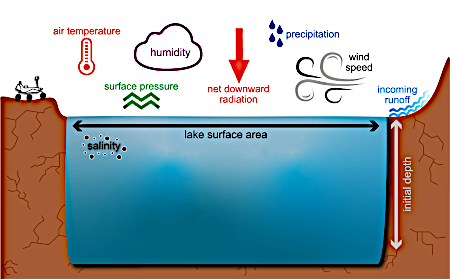
The parameters used in the computer model
Figure 1 of the paper, showing the parameters
used in the computer model

Using a computer model, scientists have found that a thin cap of ice can act to allow liquid water to exist in lakes on Mars, for extended periods of time.

You can read their paper here. From the abstract:

Working at a localized scale, we combine climate input from the Mars Weather Research & Forecasting general circulation model with geologic constraints from Curiosity rover observations to identify potential climatic conditions required to maintain a seasonally ice-free lake. Our results show that an initially small lake system (10 m deep) with ∼50 mm monthly water input and seasonal ice cover would retain seasonal liquid water for over 100 years, demonstrating conditions close to long-term lake survivability.

From the press release:

In some simulations, the lakes completely froze during colder seasons, whereas in others, the lakes remained liquid and were covered by a thin layer of ice instead of freezing solid. This thin ice acted as an insulating lid, significantly reducing water loss while still allowing sunlight to warm the lake ice during warmer months. As a result of this seasonal cycling, some simulated lakes barely changed in depth over decades, suggesting that they could be stable for longer durations even with average air temperatures below freezing for much of the time.

Because this research is based on computer modeling, it carries great uncertainties. At the same time, it seems to explain the puzzling nature of Martian geology, which has repeatedly suggested the existence of liquid water in the past on a planet that has always been too cold with too thin an atmosphere for liquid water to exist. Data has also suggested that pockets of liquid water might have existed at the base of glaciers. This research aligns with that data.

9 comments

Sunspot update: Ramp down to minimum continues?

Another year, another month, another sunspot update! Time to post my monthly update of the never-ending sunspot cycle on the Sun, using NOAA’s own monthly update of its graph of sunspot activity and annotating it with extra information to illustrate the larger scientific context.

The green dot on the graph below indicates the level of sunspot activity on the Sun’s Earth-facing hemisphere during the month of December. Unlike November, when activity plunged, in December the sunspot count recovered, producing more sunspots, though the number still reflected the ramp down to solar minimum that NOAA’s panel of solar scientists had predicted in April 2025 (as indicated by the purple/magenta line).
» Read more

2 comments

Rocketdyne to reappear with sale by L3Harris of its civilian rocket engine division

The name Rocketdyne is about to rise from the ashes with the sale by L3Harris of its civilian rocket engine division to the private equity firm AE Industrial Partners.

The firm is selling a 60 percent stake, worth $845 million, and maintaining about a 40 percent share of the space propulsion business unit, which focuses on technologies related to NASA and civil space activities. For example, its products include nuclear power systems for future missions to the moon and Mars, and the RL10 engine that powers the upper stage for United Launch Alliance’s Vulcan heavy lifter.

That said, the RS-25 rocket engine business is excluded from the sale; the engine is the primary propulsion system on NASA’s Space Launch System being designed to send crews to the moon under the Artemis mission.

When L3Harris purchased Aerojet-Rocketdyne in 2023, the names of these two companies from the very beginnings of the space age vanished. It now appears that AE is going to bring one back.

AE Industrial ― which previously has invested in commercial space companies including York Space Systems, Redwire and Firefly — said in an announcement today that the new entity will be named Rocketdyne “in recognition of its heritage and longstanding innovation within space propulsion technology.”

Aerojet-Rocketdyne had been in trouble for years prior to is purchase, and it remains uncertain whether the engine part of this new Rocketdyne company can compete. Its main business right now is building the engines used by the SLS rocket, which in the long run has a limited future.

4 comments
1 70 71 72 73 74