Chinese pseudo-company building 3/4 billion dollar rocket factory

Though the Chinese pseudo-company Space Epoch has yet to launch any orbital rockets, it has announced it will spend $740 million on a factory for building its reusable rockets, intended to land on a platform at sea.

The 5.2 billion yuan ($740 million) project, led by Beijing-based space launch company Space Epoch, got underway on January 7. According to Hangzhou Daily, it will produce medium-to-large liquid-fueled rockets capable of reuse, high payloads, low cost and sea recovery. The facility, when ready, will manufacture up to 25 of these rockets a year. “A reusable rocket is like a taxi, satellites are the passengers, and a constellation of satellites is a busload of tourists,” Wei Yi, founder and chairman of Space Epoch, told local newspaper Hangzhou Daily.

The cost of space launch vehicles for mainstream rockets in China is approximately 80,000 to 100,000 yuan per kilogram ($11,000 to $14,000), Wei Yi explains. With Space Epoch’s “stainless steel + liquid oxygen and methane” solution, the cost is expected to be slashed to 20,000 yuan per kilogram, he adds.

The only flight tests that Space Epoch has publicly admitted to was a successful hop of a small scale Grasshopper-type prototype in May 2025. This new construction project suggests it has been able to raise the money to build its full scale rocket. I suspect some if not all of that money came from the Chinese government.

0 comments

ISS expedition 11 will return early due to medical issue

Though NASA officials provided no new details on what the medical issue is on ISS nor who it occurred to, in a briefing this afternoon they announced that they have decided to bring the crew home early, and are also looking at launching the next crew earlier than its presently scheduled February launch.

They did say that the medical issue had nothing to do with space operations or the spacewalk the astronauts were getting ready to do. Though NASA’s chief medical officer James Polk was amazingly vague in his comments, he did suggest it was related to the environment of micogravity.

The one comment that struck me during the press briefing was the repeated insistence by all three officials, including NASA administrator Jared Isaacman, that NASA “never compromises safety”. Considering my own op-ed today and the unreasonable risks the agency is taken for the upcoming Artemis-2 mission, as well as its failures with Apollo 1, Challenger, and Columbia, NASA has compromised on safety many times in the past, and is doing it right now.

6 comments

January 8, 2026 Quick space links

Courtesy of BtB’s stringer Jay. This post is also an open thread. I welcome my readers to post any comments or additional links relating to any space issues, even if unrelated to the links below.

4 comments

Icy Mars

Overview map

Icy Mars

Today’s cool image once again illustrates the fact that most of Mars Mars is not a dry desert like the Sahara, as most news sources and the general public still believes, but a cold icy place similar to Antarctica, with plenty of near surface ice covering almost the whole planet, except for the dry equatorial regions (the one region we have sent almost all our landers and rovers).

The picture to the right, rotated, cropped, reduced, and sharpened to post here, was taken on November 26, 2025 by the high resolution camera on Mars Reconnaissance Orbiter (MRO). It shows one small section of the floor of an unnamed very old and eroded 82-mile-wide crater located in the northern mid-latitudes of Mars.

That location is indicated by the white dot on the overview map above. This part of the mid-latitudes is a region I dub “glacier country”, a 2,000-mile long strip where practically every image taken there shows very obvious glacial features.

Today’s image is no different. The 2-mile-wide crater in the upper left appears blobby, as if the impact had landed in mud. Its interior is filled with what the scientists believe is glacial debris. The surrounding landscape has a similar appearance, as if the ground was slushy and easily misshapen by seasonal temperature changes. To the southwest of the crater, within what appears to be a surrounding splash apron, there appears to be an eroded drainage channel, likely created by the flow of glacial ice downward.

So, when you read articles telling you Mars is dry and scientists are still hunting for water there, know that whomever wrote that article had no idea what he or she were talking about. The scientists studying Mars know that Mars has lots of water. Except for the tropics below 30 degrees latitude, there is near surface ice everywhere. Their questions revolve instead on figuring out how deep and extensive it is, and how it has shaped Mars’ overall geology.

1 comment

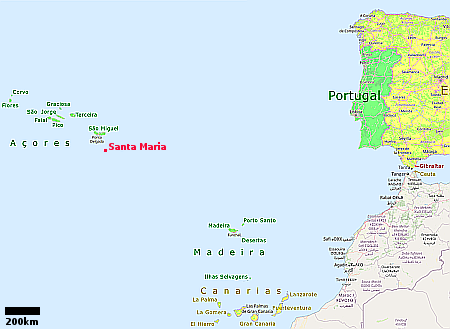
South Korean rocket startup Innospace signs deal with Portugal’s Santa Maria spaceport

Santa Maria spaceport

The South Korean rocket startup Innospace, which just last month attempted its first launch out of Brazil, has now signed a deal to launch its rocket from Portugal’s proposed Santa Maria spaceport in the Azores, located about 900 miles west of the European mainland.

Through this agreement, INNOSPACE has secured priority and long-term access to the Malbusca Launch Center, located on Santa Maria Island in the Azores, Portugal, for a five-year period starting in 2026. The company plans to gradually establish key launch infrastructure required for initial operations, including launch pads, operations and control systems, and testing facilities, with the goal of conducting its first commercial launch in the fourth quarter of 2026.

Despite the launch failure last month, Innospace has been aggressive about obtaining agreements for launching its rockets from multiple locations. That first launch occurred at Brazil’s long unused Alcantera spaceport on its eastern coast, and the company will use it for its second launch attempt later this year. It has also signed agreements with two spaceports in Australia (Southern Launch and Equatorial Launch), though the latter spaceport is not yet operational and might never exist.

0 comments

Billionaire to fund construction of an orbiting optical telescope larger than Hubble

Lazuli
Figure 1 from the proposal paper [pdf].

Schmidt Sciences, a foundation created by one of Google’s founders, announced yesterday it is financing the construction of four new research telescopes, one of which will be an orbiting optical telescope with a mirror 3.1 meters in diameter, larger than the 2.4 meter primary mirror on the Hubble Space Telescope.

Today at a meeting of the American Astronomical Society, Schmidt Sciences, a foundation backed by billionaires Eric and Wendy Schmidt, announced one of the largest ever private investments in astronomy: funding for an orbiting observatory larger than NASAโ€™s Hubble Space Telescope, along with funds to build three novel ground-based observatories. The project aims to have all four components up and running by the end of the decade.

โ€œWeโ€™re providing a new set of windows into the universe,โ€ says Stuart Feldman, president of Schmidt Sciences, which will manage the observatory system. Time on the telescopes will be open to scientists worldwide, and data harvested by them will be available in linked databases. Schmidt Sciences declined to say how much it is investing but Feldman says the space telescope, called Lazuli, alone will cost hundreds of millions of dollars.

Eric Schmidt was once CEO of Google, and in recent years has been spending his large fortune (estimated to exceed $50 billion) on space ventures. For example, in March 2025 he acquired control of the rocket startup Relativity.

While the three new ground-based telescopes will do important work, the Lazuli space telescope is by far the most important, not only scientifically but culturally. » Read more

29 comments

Second Escapade Mars orbiter completes a delayed engine burn

Engineers have now successfully placed both Escapade Mars orbiters in their parking orbit, the second orbiter completed the required engine burn after it was delayed due to unexpected telemetry during an earlier mid-course correction burn.

That unexpected telemetry suggested the engine was firing at a lower thrust than expected. Today’s update did not provide any additional information as to how the thrust issue had been solved or overcome. All it said was that both spacecraft will fire their engines in November 2026 as planned to head to Mars.

0 comments

Medical issue forces NASA to postpone spacewalk and consider an early crew return

An unspecified medical issue by one crew member on ISS last night forced NASA to postpone a planned spacewalk — even as the astronauts were suiting up — and consider bringing the crew back early.

The agency is monitoring a medical concern with a crew member that arose Wednesday afternoon aboard the orbital complex. Due to medical privacy, it is not appropriate for NASA to share more details about the crew member. The situation is stable.

At this moment, we know nothing more, including the name of the astronaut with the problem. Though the crew member is “stable,” it does appear the condition is serious, as it apparently developed quite abruptly, based on the public communications feed.

In a brief space-to-ground radio exchange just after 2:30 p.m. EST, Yui called mission control in Houston and asked for a private medical conference, or PMC. Mission control replied that a PMC, using a private radio channel, would be set up momentarily. Yui then asked if a flight surgeon was available and if flight controllers had a live camera view from inside the station.

“Houston, do we still have, like, a camera view in Node 2, uh, 3, lab?” Yui asked.

“We don’t have any internal cameras right now, but we can put the lab view in if you’d like,” the mission control communicator replied.

“I appreciate that,” Yui replied. He then asked: “Do you have like a crew surgeon? … A flight surgeon?”

No additional exchanges were heard. Later Wednesday, NASA’s space station audio stream, normally carried live around-the-clock on YouTube, went silent without explanation.

Though NASA has never had to return a crew early due to an emergency medical situation, the Russians in the Soviet era did so twice. In 1976 on the Salyut 5 station the crew couldn’t get along, with one member becoming paranoid and both claiming (falsely) that the station’s atmosphere was becoming unbreathable. The crew came home early, but the next crew found nothing wrong with the station.

Then during a mission in 1985 mission to the Salyut-7 space station, one astronaut developed a prostate condition that also cancelled a spacewalk and eventually required an early return to Earth.

26 comments

Zimmerman Op-Ed at PJ Media

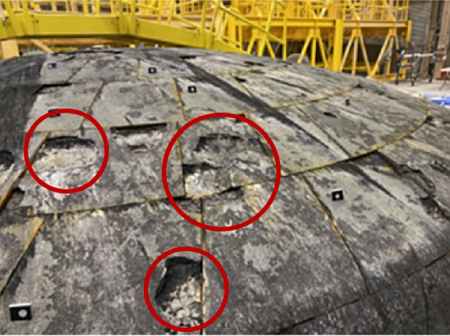
Orion's damage heat shield
Damage to Orion heat shield caused during re-entry in 2022,
including “cavities resulting from the loss of large chunks”

PJ Media this evening published an op-ed I prepared this week in a last desperate effort to convince both President Trump and NASA administrator Jared Isaacman to rethink the manned nature of the Artemis-2 mission scheduled to launch sometime in the next three months.

President Trump and NASA Administrator Isaacman: Please Take the Crew Off of Artemis II

Nothing I say in this op-ed will be unfamiliar to my readers. I choose to farm it to PJ Media because I wanted it to get as much exposure as possible. As big as my audience is becoming, from 4 to 6 million hits per month, PJ Media has a wider reach.

I also decided in the op-ed to make no general arguments against SLS or Orion. Though my opposition to them is long standing and well known, this is not the time to fight that battle. My goal was simply to get NASA to put engineering ahead of schedule, so as to avoid the possibility of it repeating another Apollo 1 fire or Challenger accident.

I doubt at this point this op-ed will make a difference, but to paraphrase a quote written by Gordon Dickson in his wonderful science fiction book Way of the Pilgrim, there was a hand pushing me from behind, forcing me forward. I had no choice. The image of Orion’s heat shield to the right, after the 2022 return from the Moon, required action.

25 comments
1 69 70 71 72 73 74