
Jonasquin – If Stayin’ Alive Had Been Written in 16th Century
An evening pause: Hat tip Diane Zimmerman.
An evening pause: Hat tip Diane Zimmerman.
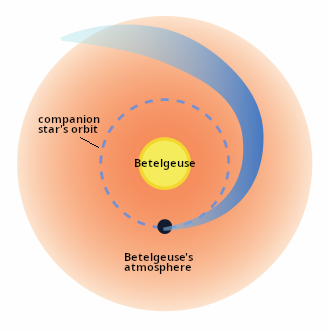
Astronomers believe they have detected evidence of the wake created by Betelgeuse’s companion star as it plows through the primary star’s vast atmosphere.
You can read their paper here [pdf]. The cartoon to the right, annotated by me to post here, is figure 5 of the paper, looking down at Betelgeuse’s pole. It is not to scale. The scientists have nicknamed the companion Siwarha.
The team detected Siwarha’s wake by carefully tracking changes in the star’s light over nearly eight years. These changes show the effects of the previously unconfirmed companion as it plows through the outer atmosphere of Betelgeuse. This discovery resolves one of the biggest mysteries about the giant star, helping scientists to explain how it behaves and evolves while opening new doors to understanding other massive stars nearing the end of their lives.
Located roughly 650 light-years away from Earth in the constellation Orion, Betelgeuse is a red supergiant star so large that more than 400 million Suns could fit inside. Because of its enormous size and proximity, Betelgeuse is one of the few stars whose surface and surrounding atmosphere can be directly observed by astronomers, making it an important and accessible laboratory for studying how giant stars age, lose mass, and eventually explode as supernovae.
Using NASA’s Hubble and ground-based telescopes at the Fred Lawrence Whipple Observatory and Roque de Los Muchachos Observatory, the team was able to see a pattern of changes in Betelgeuse, which provided clear evidence of a long-suspected companion star and its impact on the red supergiant’s outer atmosphere. Those include changes in the star’s spectrum, or the specific colors of light given off by different elements, and the speed and direction of gases in the outer atmosphere due to a trail of denser material, or wake. This trail appears just after the companion crosses in front of Betelgeuse every six years, or about 2,100 days, confirming theoretical models.
Betelgeuse is essentially a giant blob that undulates like a blob of water floating in weightlessness on ISS. Knowing the location and orbit of this companion will help astronomers better understand the central star’s periodic inexplicable changes.
Courtesy of BtB’s stringer Jay. This post is also an open thread. I welcome my readers to post any comments or additional links relating to any space issues, even if unrelated to the links below.

Click for original image.
Today’s cool image could also be entered into my “What the heck?!” category of strange Martian geology. The picture to the right, cropped, reduced, and sharpened to post here, was taken on October 19, 2025 by the high resolution camera on Mars Reconnaissance Orbiter (MRO).
The science team labels this as “Round Deposits in Crater.” And yup, that’s what we have, round and flat small mesas inside an unnamed 3,500-foot-wide very shallow crater (no more than 10-20 feet deep) that also appears to be sitting higher than the surrounding landscape. Furthermore, several nearby craters are also raised, with one having its own oblong flat interior mesa. Moreover, the terrain around the crater appears stippled, as if it has been eroding or sublimating away.
The latitude, 37 degrees north, provides the first clue for explaining this weird landscape.
» Read more

Proposed or active spaceports in North Europe
If I had any remaining hopes that the United Kingdom might finally begin to reform its Byzantine space regulations that bankrupted one rocket company and has blocked any launches from its proposed spaceports for almost a decade — allowing other spaceports in Europe to attract rocket companies and leap ahead — those hopes vanished in reading an article in the Shetland Times today, in which a professor specializing in UK space law described its red tape as “very good,” drawing “on best practice from other industries and jurisdictions.”
Alexander Simmonds of the University of Dundee says a balance should be struck to avoid launch operators being put off by strict regulatory requirements. The lecturer in space law and writer behind The Space Legislation of the United Kingdom says UK regulation of the space industry is “very good” and draws on best practice from other industries and jurisdictions.
Licences are in place for SaxaVord to host the first vertical satelite launch in 2026, and Dr Simmonds says operators have taken responsibilities “very seriously”. But he fears future operators could look elsewhere if compliance becomes too much of a problem and more cost-effective alternatives are available.
“My own view is we’re in a very good place at the moment, as regards to regulation,” Dr Simmonds told The Shetland Times. “I think that the legilsators have been cautious with this and have been very entitled to be, given the nature of what we are dealing with.”
Both this so-called expert and the journalist interviewing him appear entirely ignorant about the history of past decade. While red tape in the UK has blocked or seriously delayed launches, rocket startups have “looked elsewhere,” signing deals and launching from Norway’s long established Andoya spaceport that has now gone commercial with enthusiastic government support. At the same time, new spaceport projects have begun at three other locations, all of which appear to also have support from their local governments in Sweden and Germany. While the UK government has choked off business, the governments at these other spaceports have moved aggressively to ease regulation.
The cluelessness of both Simmonds and the Shetland Times reporter indicates there is absolutely no urgency in the UK to fix things, and in fact it appears they aren’t even aware their emperor is wearing no clothes.
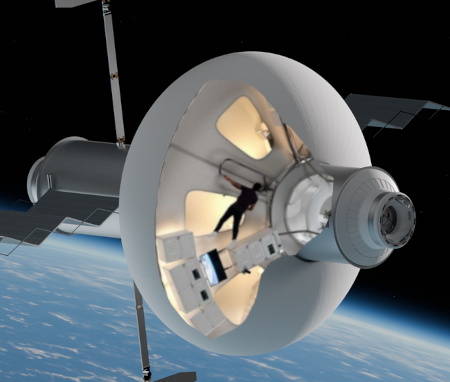
Max Space’s proposed Thunderbird station, with cut-out showing
interior and person for scale. Click for original images.
The space station startup Max Space has apparently decided to establish its manufacturing facility at the Kennedy Space Center in Florida, and expects to hire its first 30 to 50 employees there this year.
Currently working with Space Florida, Max Space is moving toward setting up operation in Exploration Park on Space Commerce Way, and has already begun hiring. While the company already has a address in Exploration Park, they are seeking to set up in an existing 20,000 to 30,000 square-foot manufacturing facility. This is where the large space habitat modules will be manufactured.
While Space Florida confirmed Max Space’s intentions to move into the area, no further details were provided. Max Space said they expect to bring 30 to 50 new hires onboard within the first half of 2026.
The company had previously positioned itself as the builder of modules that any one of the four other commercial private space stations could buy and add to their stations. It now appears it has decided to enter the competition as its own station, proposing Thunderbird as its bid. It is gearing up to fly a smaller demonstration mission in ’27 to prove its inflatable design that is based on the same technology used by the modules built by the now-defunct company Bigelow.
With this in mind, I have now added Max Space to my rankings of the commercial stations under construction, and have placed it ahead of Blue Origin’s Orbital Reef station, based on my impression of where both projects presently stand. Essentially, they are tied for last place, but I put Max Space ahead because it seems to have positive momentum, while the partnership of Blue Origin and Sierra Space appears to be faltering.
» Read more
The South Korean rocket startup Innospace last week released its first preliminary results of its investigation into the December 22, 2025 failure during the first orbital launch attempt of its Hanbit-Nano rocket.
Based on video footage and preliminary data available to date, the vehicle achieved approximately 30 seconds of nominal ascent. During its passage through cloud layers, communication between the vehicle and ground systems was lost. Subsequently, the vehicle sustained structural damage of an undetermined cause, leading to separation into multiple sections and indications of first-stage engine thrust termination. As a result, the vehicle lost propulsion and attitude control and entered free fall, separating into the first stage, second stage, and smaller debris fragments.
As the calculated Instant Impact Point (IIP) remained within the launch site’s designated safety perimeter, and to prevent debris dispersion and residual hazards, the Flight Termination System (FTS) was activated in accordance with procedures pre-coordinated with Brazilian safety authorities. The launch vehicle was detonated at the point of ground impact, resulting in early mission termination.
In plain language, the rocket broke up about 30 seconds after lift-off, and as its pieces hit the ground engineers activated the self-destruct software.
The company says it hopes to try again in ’26, launching once again from Brazil’s Alcantera spaceport. I suspect it will take longer than that to pin down the cause of the rocket’s “structural damage” and fix it. The data so far suggests a fundamental flaw that require a major redesign.
Link here. The article begins by reviewing the work SpaceX is doing at both Boca Chica in Texas and Cape Canaveral in Florida. In the end, the company is aiming to have two Starship launchpads at Boca Chica and three launchpads in Florida, with both locations have extensive manufacturing facilities capable of building ships and boosters almost continually.
It then provides a nice review of all five Superheavy/Starship test flights that took place in 2025, a review that makes it very clear how much was accomplished, and indicates the possibilities for ’26. If SpaceX could manage almost one flight every two and a half months last year, despite two test stand explosions, the odds are excellent it will exceed that pace this year.
The beat goes on: SpaceX tonight successfully launched another 29 Starlink satellites, its Falcon 9 rocket lifting off from Cape Canaveral in Florida.
This was SpaceX’s second launch in 2026. At this moment the company is the only one to have launched anything this year.
The rocket’s first stage was on its first flight, landing successfully on a drone ship in the Atlantic. As new boosters are now introduced so rarely, I decided to look back at how many new stages SpaceX has been introducing each year to get a sense of the size of its fleet. The rough chart below is based on the data on this Wikipedia page. It begins in 2018 because that is when SpaceX introduced the Block 5 version of the stage that it still uses, and says is designed to do as many as 40 flights.
New stages introduced each year:
—————————————–
2018: 6 (all now deactivated or expended)
2019: 7 (all now deactivated or expended)
2020: 4 (all now deactivated or expended)
2021: 3
2022: 7 (5 deactivated or expended)
2023: 9 (5 deactivated or expended)
2024: 9 (3 deactivated or expended)
2025: 8
According to that webpage, SpaceX has approximately 25 active stages in its fleet. The numbers above suggest the company has been increasing the size of its fleet steadily. In fact, since 2022 it appears the company has added 23 stages to the fleet. In 2025 it appears it added a new stage about every 20 launches.
This estimate is rough and is almost certainly not precisely accurate. For example, several stages listed as active have flown only once, or have not flown in awhile.
Nonetheless, this rough count helps explain how SpaceX can launch so frequently. It now has a robust fleet of Falcon 9 boosters to draw on, and it is growing that fleet to meet its needs. All it needs to do is make sure it can manufacture enough upper stages and satellites to fill its launch manifest.
According to one NASA official, the leaks in the Zvezda module on ISS that have been on-going for more than five years have apparently all been sealed.
However, recently two sources indicated that the leaks have stopped. And NASA has now confirmed this. “Following additional inspections and sealing activities, the pressure in the transfer tunnel attached to the Zvezda Service Module of the International Space Station, known as the PrK, is holding steady in a stable configuration,” a space agency spokesman, Josh Finch, told Ars. “NASA and Roscosmos continue to monitor and investigate the previously observed cracks for any future changes that may occur.”
While good news, no one should feel sanguine. The leaks occurred because the hull of Zvezda has developed stress fractures, due to age (more than a quarter century in orbit) and the repeated dockings to its aft port. Future fractures and leaks are still possible, with the chance of a catastrophic failure very possible.
It would be prudent for NASA to continue to shut the hatch between the U.S. and Russian halves of the station, whenever a docking is taking place.
According to remarks by the head of India’s space agency ISRO last week, the agency is planning at least six launches in 2026, including two unmanned test flights of its Gaganyaan manned capsule.
Also planned will be the first launch of its PSLV rocket that was manufactured entirely by commercial vendors, rather than ISRO itself. The goal by the Modi government had been to transfer ownership of the rocket to private companies, but ISRO revised that to retain control and ownership while giving manufacture to the private companies HAL & L&T, thus defeating the essential goal of shifting power to the private sector.
The total does not include possible orbital attempts by two rocket startups, Skyroot and Agnikul.
The beat goes on! SpaceX tonight successfully placed an Italian Earth observation satellite into orbit, its Falcon 9 lifting off from Vandenberg Space Force Base.
The satellite’s data will be used by Italy for both military and civil purposes. The rocket’s first stage completed its 21st flight, landing back at Vandenberg. The two fairings completed their 2nd and 23rd flights respectively.
At this moment, SpaceX has the only launch in 2026.