
Feathery eroding layers on Mars

Click for original image.
Cool image time! The picture to the right, cropped, reduced, and enhanced to post here, was taken on February 23, 2026 by the high resolution camera on Mars Reconnaissance Orbiter (MRO). It shows what the science team calls “layers exposed around [a] streamlined feature”.
The elevation difference between the mesa top on the left and the canyon floor on the right is about 1,000 feet. The layers are the terraces stepping downward along that drop.
What makes these layers interesting is how they have been exposed. The material that makes up the layers appears very sandy and delicate, so it breaks away it very small pieces, just like sand on a beach. The result is this feathery look. If you look close you can see that some small craters have been partly obliterated by that erosion, with their existence only marked by their remaining rim, on the high side.
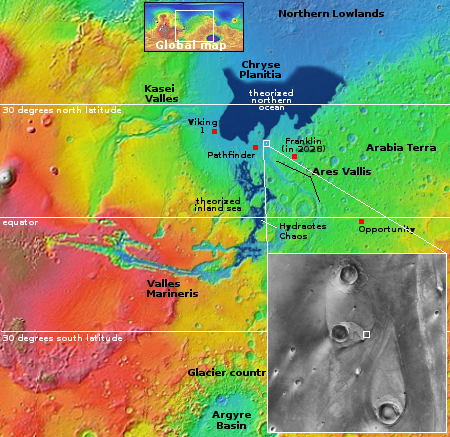
The white dot on the overview map to the right marks the location, about 89 miles to the northeast from where Mars Pathfinder landed in 1997, depositing the small Sojourner rover. This is the outlet point for the canyon dubbed Ares Vallis. It is also part of the major drainage outlet coming from Mars’ biggest canyon, Valles Marineris. The streamlined features noted by the science team are those tear-dropped shaped mesas shown in the inset, suggesting a strong flow of liquid moving from the south to the north.
The most popular present hypothesis to explain these features is that one or several catastrophic floods poured out from Valles Marineris several billion years ago, flooding and reshaping these mesas and producing for a short time that inland sea and northern ocean. The layers are evidence that there were multiple floods, each depositing a layer of silt and sand. Wind erosion in the eons that followed has now exposed those multiple layers.
At least, that’s one theory. We are working with largely superficial data from orbit, so no theory can be taken very seriously at this point.

On Christmas Eve 1968 three Americans became the first humans to visit another world. What they did to celebrate was unexpected and profound, and will be remembered throughout all human history. Genesis: the Story of Apollo 8, Robert Zimmerman's classic history of humanity's first journey to another world, tells that story, and it is now available as both an ebook and an audiobook, both with a foreword by Valerie Anders and a new introduction by Robert Zimmerman.
The print edition can be purchased at Amazon or from any other book seller. If you want an autographed copy the price is $60 for the hardback and $45 for the paperback, plus $8 shipping for each. Go here for purchasing details. The ebook is available everywhere for $5.99 (before discount) at amazon, or direct from my ebook publisher, ebookit. If you buy it from ebookit you don't support the big tech companies and the author gets a bigger cut much sooner.
The audiobook is also available at all these vendors, and is also free with a 30-day trial membership to Audible.
"Not simply about one mission, [Genesis] is also the history of America's quest for the moon... Zimmerman has done a masterful job of tying disparate events together into a solid account of one of America's greatest human triumphs."--San Antonio Express-News