
Four medical research organizations sign deals to do work on Vast’s space stations
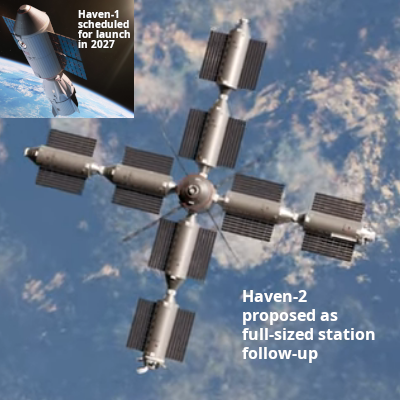
Capitalism in space: The space station startup up Vast yesterday announced that three medical research companies and one university institute have signed preliminary agreements to continue and expand their ISS biological research on Vast’s Haven-1 and Haven-2 space stations.
Vast, the company building next-generation space stations and space infrastructure, announced today memorandums of understanding (MoUs) with UC San Diego’s Sanford Stem Cell Institute, Auxilium Biotechnologies, LambdaVision, and BioOrbit, advancing its network of microgravity research and manufacturing partners. Vast’s network brings together world-class universities, pioneering researchers, and cutting-edge technology providers to shape the future of microgravity research and manufacturing conducted in low-Earth orbit (LEO).
Though all four have done pure research on ISS, none have been permitted to produce products there for sale on Earth, due to NASA’s anti-commercial regulations. This will change on the new private stations. For example, LambdaVision has already signed an earlier agreement with the Starlab station to use it to manufacture its artificial retinas for sale. Auxilium meanwhile has already demonstrated on ISS the ability to create implantable medical devices using 3D printing. On Vast’s stations it will be able to expand this work by producing saleable products. BioOrbit in turn will use the Haven stations to begin manufacturing the zero gravity pharmaceuticals it has already tested on ISS.
Below is my updated ranking of the five American space stations presently under development:
- Haven-1 and Haven-2, being built by Vast, with no NASA funds. The company plans to launch its single module Haven-1 demo station in 2027 for a three-year period during which it will be occupied by at least four 2-week-long manned missions, one of which will include a French astronaut. It planned manned mission to ISS in ’28 will also include both a French and Czech astronaut. It has also made preliminary deals with Lithuania, Colombia, Uzbekistan, Japan, the Czech Republic, and the Maldives for possible astronaut flights to Haven-1, as well as four biomedical companies. It has raised more than a billion in cash for this work, and has already tested an unmanned small demo module in orbit.
- Starlab, being built by a consortium led by Voyager Space, Airbus, and Northrop Grumman, with extensive partnership agreements with the European Space Agency, Mitsubishi, and others. Though no construction has yet begun on its NASA-approved design, it has raised $383 million in a public stock offering, the $217.5 million provided by NASA, and an unstated amount from private capital. It has also begun signing up station customers, as well as a number of companies to build the station’s hardware. It also plans a mission to ISS in ’28.
- Axiom, being built by Axiom, has launched four tourist flights to ISS, with the fourth carrying government passengers from India, Hungary, and Poland. A fifth mission is now planned for ’27. The company has now raised $625 million in private investment capital. Thales Alenia in Europe has been building its first two modules, with the first scheduled to launch in 2028. The company has also now established a subsidiary in Europe as well as signed Redwire to build that module’s solar panels.
- Thunderbird, proposed by the startup Max Space. It is building a smaller demo test station to launch in ’27 on a Falcon 9 rocket, and has begun work on its manufacturing facility at Kennedy in Florida. Its management includes one former NASA astronaut and one former member of the Bigelow space station team that built the first private orbiting inflatable modules, Genesis-1, Genesis-2, and BEAM (still operating on ISS).
- Orbital Reef, being built by a consortium led by Blue Origin and Sierra Space. This station looks increasingly dead in the water. Blue Origin has built almost nothing, as seems normal for this company. And while Sierra Space has successfully tested its inflatable modules, including a full scale version, its reputation is soured by its failure in getting its Dream Chaser cargo mini-shuttle launched to ISS.

On Christmas Eve 1968 three Americans became the first humans to visit another world. What they did to celebrate was unexpected and profound, and will be remembered throughout all human history. Genesis: the Story of Apollo 8, Robert Zimmerman's classic history of humanity's first journey to another world, tells that story, and it is now available as both an ebook and an audiobook, both with a foreword by Valerie Anders and a new introduction by Robert Zimmerman.
The print edition can be purchased at Amazon or from any other book seller. If you want an autographed copy the price is $60 for the hardback and $45 for the paperback, plus $8 shipping for each. Go here for purchasing details. The ebook is available everywhere for $5.99 (before discount) at amazon, or direct from my ebook publisher, ebookit. If you buy it from ebookit you don't support the big tech companies and the author gets a bigger cut much sooner.
The audiobook is also available at all these vendors, and is also free with a 30-day trial membership to Audible.
"Not simply about one mission, [Genesis] is also the history of America's quest for the moon... Zimmerman has done a masterful job of tying disparate events together into a solid account of one of America's greatest human triumphs."--San Antonio Express-News
I think I know why Vast insists on remaining in California—since so many others left, they get to be arm candy/trophy escorts for photo ops, as long as the state money keeps flowing–right Gavin?
Maybe.
But I suspect that Vast is in a very bad position for moving, right now. If they move, not only will it cost them money that they don’t have, but it will delay the construction of their space stations, and they are in need of revenue sooner rather than later.
SpaceX’s strategy has been to stop building facilities in California and build all newly needed facilities in friendlier places. Eventually, they can begin to shutdown their California plants as other plants can be made to take their place. There is also the difficult part about not abandoning loyal employees when the plant(s) moves. Not everyone can move easily out of their area to another state.
At the rate that California is screwing its businesses and citizens, Vast is likely to begin a similar strategy to abandon the state that has turned on them and bites them in the bottom line.
I agree. SpaceX was and is in a great position to expand its operations in other states, having a good income stream already, and no requirement that their new business efforts had to be set up in California to be functional. Vast’s situation is dramatically different.
Jeff: California hasn’t given Vast money, this is a tax offset based on them meeting employment and investment targets. If they don’t meet said targets, they have to pay those taxes. If they claim the tax credit but fire people or leave California within a certain window, they have to pay those taxes and possibly penalties as well.
Tax offset, cash gift–call it what you like. Things go on behind the scenes and off the books.
If you want to know how business really works–one year as a caddy is worth any number of MBAs.
If you want to know how things really go in a plant, listen to maintenance on a Motorola—not the manager.
ADIENT thought it was being cute using cheap Chinese steel. I could spend an afternoon shooting the breeze about what the suits in the front office won’t tell you.
How can something so public be ‘behind the scenes’? That’s absurd. It’s not ‘calling it what I like,’ it’s calling it what it is. Words have meanings, not just valences, otherwise we may as well not have a language because communication becomes impossible.
Jeff Wright,
“If you want to know how business really works …” try running one sometime. A caddy only sees one tiny part of the interactions between some of the people who run some businesses. The real workings happen at the office, where payroll is met every week and the invoices are paid 2% ten, net thirty.