
An icy Martian crater filled with brain terrain

Click for original image.
Cool image time! The picture to the right, rotated, cropped, and reduced to post here, was taken on March 26, 2026 by the high resolution camera on Mars Reconnaissance Orbiter (MRO). It shows what the scientists label an “ice-rich crater fill.”
And yup, that’s what we got. The floor of this 2.8-mile-wide unnamed crater is filled with what planetary scientists have labeled brain terrain, a feature found only on Mars that they associate with the sublimation of near surface ice, but as yet do not fully understand its entire formation process. In the upper right is a full resolution inset of that brain terrain, to give a good sense of its strange nature.
On that floor there are also several small fresh impact craters, as well as older small impacts that have faded almost to obscurity due to that mysterious process forming the brain terrain.
Its iciness of the terrain is also indicated by the rim of the crater, which is distorted as well as blobby. At impact or subsequently the ground here was soft like mud, and thus easy to shape into these cushioned features. Thus, though the rim was almost certainly circular after impact, time and the muddy nature of this ground allows it to get bent and warped.
Nor is it surprising there is near surface ice at this location. We are at 41 degrees south latitude, well away from the dry Martian tropics. This picture simply provides more evidence that once you get above 30 degrees latitude, it will not be hard to find water on Mars.
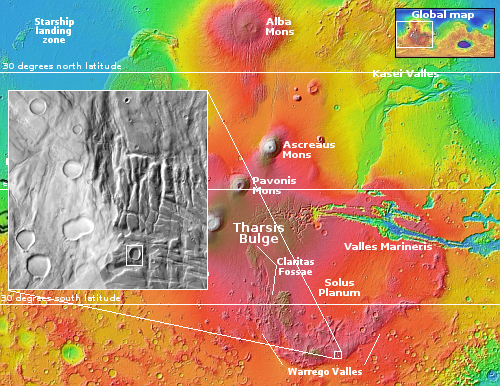
The white dot inside the rectangle on the overview map to the right marks the location, in the middle of a mountain chain dubbed Warrego Valles due to its many channels and cracks. Warrego is thought to have initially formed in connection to the rise of the Tharsis Bulge, on which four of Mars’ biggest volcanoes grew.
The inset not only adds weight to the icy nature of this landscape — as noted by the other blobby craters to the west — but it also illustrates the cracked tectonic nature of the Warrego mountains. The west half of that inset is not blobby, but rough mountains split repeatedly by parallel fissures.
Initially the ground here was stretched as it rose, cracking as it did so. Later the presence of near-surface ice softened and smoothed out those cracks and fissures on the west half of the inset. For some reason however the same thing did not happen to the east, even though the crater above proves the ground has as much ice within it.
The downhill grade of these mountains, descending to the south, helps explain the crater’s warped shape. It appears this crater actually slumped downhill in that direction.

On Christmas Eve 1968 three Americans became the first humans to visit another world. What they did to celebrate was unexpected and profound, and will be remembered throughout all human history. Genesis: the Story of Apollo 8, Robert Zimmerman's classic history of humanity's first journey to another world, tells that story, and it is now available as both an ebook and an audiobook, both with a foreword by Valerie Anders and a new introduction by Robert Zimmerman.
The print edition can be purchased at Amazon or from any other book seller. If you want an autographed copy the price is $60 for the hardback and $45 for the paperback, plus $8 shipping for each. Go here for purchasing details. The ebook is available everywhere for $5.99 (before discount) at amazon, or direct from my ebook publisher, ebookit. If you buy it from ebookit you don't support the big tech companies and the author gets a bigger cut much sooner.
The audiobook is also available at all these vendors, and is also free with a 30-day trial membership to Audible.
"Not simply about one mission, [Genesis] is also the history of America's quest for the moon... Zimmerman has done a masterful job of tying disparate events together into a solid account of one of America's greatest human triumphs."--San Antonio Express-News