
Two launches by China and SpaceX
Since yesterday there were two more launches by the global rocket industry.
First, China placed a “communication technology experimental satellite” into orbit, its Long March 7A rocket lifting off from its coastal Wenchang spaceport. No other information was provided.
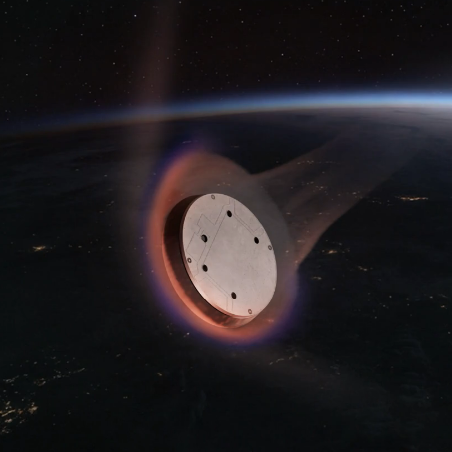
Artist’s rendering of Starfall provided during today’s live steam
Next, SpaceX launched in the early morning the first demo mission for its Starfall recoverable capsule, its Falcon 9 rocket lifting off from Cape Canaveral Space Force Station in Florida. The company has released little information about this project, including not showing the deployment or splashdown of Starfall in the launch broadcast. Its short description of Starfall during the live stream made it sound very similar to Varda’s recoverable capsule, though larger. According to Wikipedia,
Starfall has a circular, disk-shaped form measuring 10′ in diameter and 2′ 6″ in height. Its empty mass is 2,100 kg (4,600 lb). Starfall carries up to 1,000 kilograms of payload in a volume of 2.5 by 0.5 meters and a total mass of about 3,100 kilograms. The vehicle consists of a top plate with maneuvering thrusters and a heat shield that jettisons before a parachute assisted splashdown. Starfall reaches orbit as a payload on Falcon 9 or Starship. The design focuses on precision delivery to specific locations, supporting rapid delivery for critical cargo.
The company has at this time provided no information about the results of this demo mission.
The rocket’s two fairings completed their 24th and 36th flights respectively. The first stage (B1078) completed its 29th flight (29 days after its previous mission), landing on a drone ship in the Atlantic. With this flight this booster moved past the space shuttle Columbia into a seventh place tie in the rankings for the most reused launch vehicle:
39 Discovery space shuttle
35 Falcon 9 booster B1067
34 Falcon 9 booster B1071
33 Atlantis space shuttle
33 Falcon 9 booster B1063
31 Falcon 9 booster B1069
29 Falcon 9 booster B1077
29 Falcon 9 booster B1078
28 Columbia space shuttle
The leaders in the 2026 launch race:
75 SpaceX
41 China
9 Rocket Lab (plus two suborbital HASTE launches)
8 Russia
For the third straight year SpaceX leads the entire world combined in total launches, 75 to 70.

On Christmas Eve 1968 three Americans became the first humans to visit another world. What they did to celebrate was unexpected and profound, and will be remembered throughout all human history. Genesis: the Story of Apollo 8, Robert Zimmerman's classic history of humanity's first journey to another world, tells that story, and it is now available as both an ebook and an audiobook, both with a foreword by Valerie Anders and a new introduction by Robert Zimmerman.
The print edition can be purchased at Amazon or from any other book seller. If you want an autographed copy the price is $60 for the hardback and $45 for the paperback, plus $8 shipping for each. Go here for purchasing details. The ebook is available everywhere for $5.99 (before discount) at amazon, or direct from my ebook publisher, ebookit. If you buy it from ebookit you don't support the big tech companies and the author gets a bigger cut much sooner.
The audiobook is also available at all these vendors, and is also free with a 30-day trial membership to Audible.
"Not simply about one mission, [Genesis] is also the history of America's quest for the moon... Zimmerman has done a masterful job of tying disparate events together into a solid account of one of America's greatest human triumphs."--San Antonio Express-News