
Smooth on Mars is apparently not so smooth
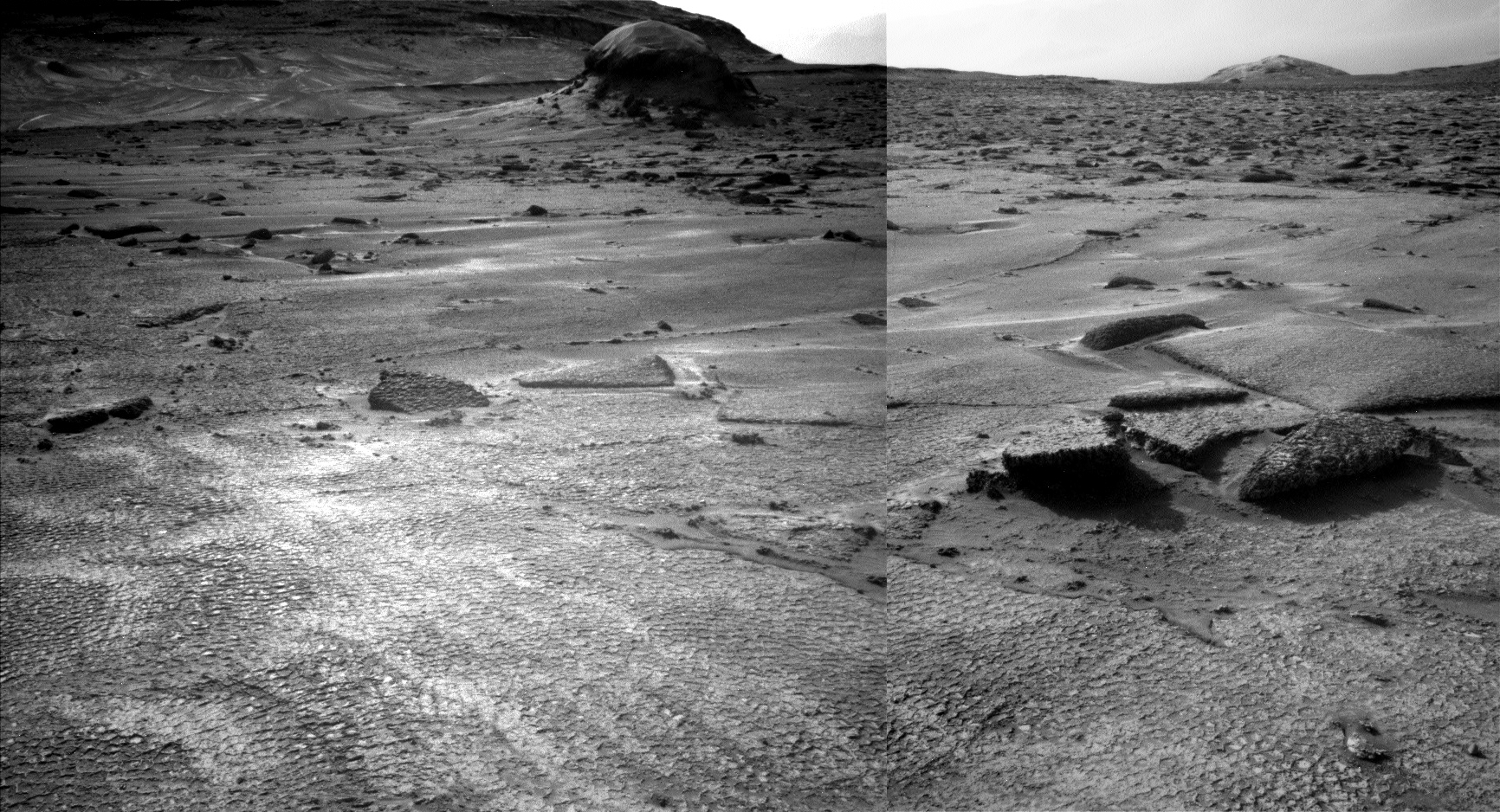
Click for full resolution. For original images, go here and here.


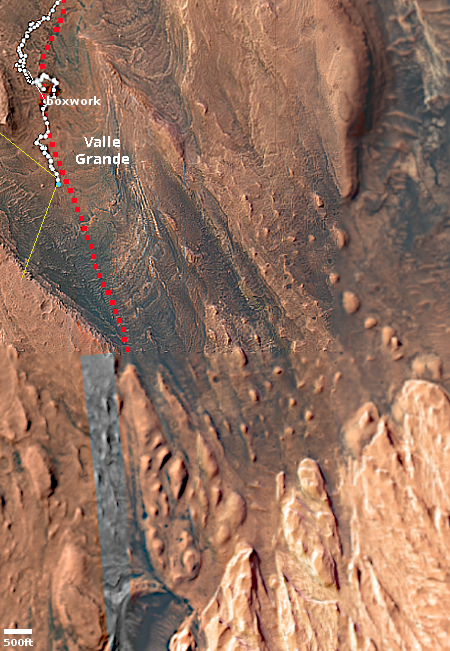
Click for interactive map.
Last week I noted how the terrain that stood ahead of Curiosity in its travels on Mount Sharp on Mars appeared to be the smoothest the rover had seen in years.
This week it turns out that upon closer inspection, smooth on Mars is not as smooth as it seems. The panorama above, created from two pictures taken by the rover’s left navigation camera on June 17, 2026
(here and here), provides a much closer view of that smooth ground, and revealed that it isn’t actually smooth at all, but covered with small polygons. The inset on the left shows the area in the white rectangle at full resolution, making the patterned nature of the ground very obvious. From today’s update by the science team:
From up close, the parking spot looks anything but smooth. … There are polygons, veins, lamination, and probably more, once we inspect the higher-resolution images taken today. “Higher-resolution” is the key for why we were in for such a surprise! The features are quite small, a few centimeters across, and therefore we could not see them in the orbital images or from a distance in our navigation and mast camera images. The camera resolution from a distance just isn’t enough to see them. But up close, the terrain revealed all its beauty!
The blue dot on the overview map to the right marks Curiosity’s present position, the white dotted line its actual travels, the red dotted line its planned route. The yellow lines indicate roughly the area covered by the panorama above. The rim of Gale Crater can dimly be seen through the dusty atmosphere 20 to 30 miles away.
Explaining the geological process that caused this patterned surface is beyond my pay grade. My first guess would be it is related to the past presence of water, in the form of liquid or ice, but no one should take that guess very seriously.
As I have said many times, Mars is strange, Mars is wonderful, but above all, Mars is alien.

On Christmas Eve 1968 three Americans became the first humans to visit another world. What they did to celebrate was unexpected and profound, and will be remembered throughout all human history. Genesis: the Story of Apollo 8, Robert Zimmerman's classic history of humanity's first journey to another world, tells that story, and it is now available as both an ebook and an audiobook, both with a foreword by Valerie Anders and a new introduction by Robert Zimmerman.
The print edition can be purchased at Amazon or from any other book seller. If you want an autographed copy the price is $60 for the hardback and $45 for the paperback, plus $8 shipping for each. Go here for purchasing details. The ebook is available everywhere for $5.99 (before discount) at amazon, or direct from my ebook publisher, ebookit. If you buy it from ebookit you don't support the big tech companies and the author gets a bigger cut much sooner.
The audiobook is also available at all these vendors, and is also free with a 30-day trial membership to Audible.
"Not simply about one mission, [Genesis] is also the history of America's quest for the moon... Zimmerman has done a masterful job of tying disparate events together into a solid account of one of America's greatest human triumphs."--San Antonio Express-News
I dub this place Lizard Skin Planitia.