
Some details about SpaceX’s secretive Starfall demo mission
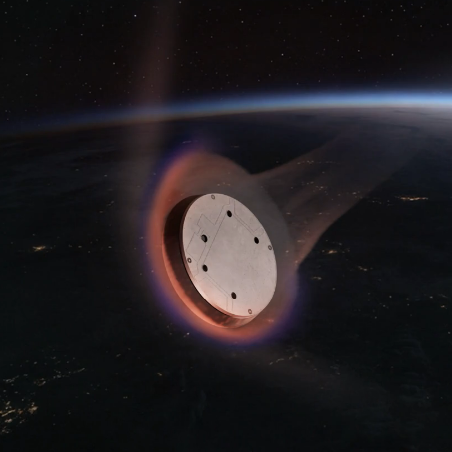
Artist’s rendering of Starfall provided during the launch live steam
In reading every report in the past day about SpaceX’s Starfall demo mission, in which it tested a returnable capsule capable of doing manufacturing in space or point-to-point transportation of cargo, the only one that appeared to provide any details about the mission itself was this article at NASAspaceflight.com.
And even those details are unconfirmed and somewhat sparse:
The Starfall demonstration vehicle stayed attached to the Falcon 9 second stage in LEO [low Earth orbit] for around 1.5 orbits. The second stage then deorbited itself and the Starfall capsule, after which Starfall was jettisoned and prepared for reentry. SpaceX released limited information about the mission, and it is unknown whether the Starfall demonstration vehicle carried any payloads, though instrumentation was likely used to measure reentry forces.
Following reentry, Starfall separated its two halves, deployed its parachutes, and splashed down in the Pacific, approximately 1,300 km off the west coast of the United States.
That’s all we presently know. Based on SpaceX’s tight-lipped approach, this mission was probably paid for by the War Department. In 2021 the Air Force had issued the company a $47.9 million contract to test point-to-point cargo transport by rocket “anywhere on the Earth in less than one hour, with a 100-ton capacity.” That cargo requirement suggested the rocket had to be Starship. It is very possible the contract was later amended to fit the 20 ton capability of Falcon 9, and this flight was the first demonstration of this cargo transport capability.
On Christmas Eve 1968 three Americans became the first humans to visit another world. What they did to celebrate was unexpected and profound, and will be remembered throughout all human history. Genesis: the Story of Apollo 8, Robert Zimmerman's classic history of humanity's first journey to another world, tells that story, and it is now available as both an ebook and an audiobook, both with a foreword by Valerie Anders and a new introduction by Robert Zimmerman.
The print edition can be purchased at Amazon or from any other book seller. If you want an autographed copy the price is $60 for the hardback and $45 for the paperback, plus $8 shipping for each. Go here for purchasing details. The ebook is available everywhere for $5.99 (before discount) at amazon, or direct from my ebook publisher, ebookit. If you buy it from ebookit you don't support the big tech companies and the author gets a bigger cut much sooner.
The audiobook is also available at all these vendors, and is also free with a 30-day trial membership to Audible.
"Not simply about one mission, [Genesis] is also the history of America's quest for the moon... Zimmerman has done a masterful job of tying disparate events together into a solid account of one of America's greatest human triumphs."--San Antonio Express-News
Just add to that “recovered by a submarine” and it will be about as black as you can get.
Submarine? We’re SpaceX, we don’t need no stinkin’ submarine!
‘That’s all we presently know. Based on SpaceX’s tight-lipped approach, this mission was probably paid for by the War Department. In 2021 the Air Force had issued the company a $47.9 million contract to test point-to-point cargo transport by rocket “anywhere on the Earth in less than one hour, with a 100-ton capacity.” That cargo requirement suggested the rocket had to be Starship. It is very possible the contract was later amended to fit the 20 ton capability of Falcon 9, and this flight was the first demonstration of this cargo transport capability.’
Johnny Rico leads his platoon out of a smoking, pinging tin can…..
This is probably a more realistic implementation of “point to point” than early speculation about using Starship (the entire second stage). ITAR restrictions alone would prohibit Starship landing outside the US. “One hour” still excludes launch availability, and transporting recovered payload to the point where it is needed. Starfall version “n+1” would include soft landing on land.
There is speculation that in addition to the Starfall payload, there may have been other deployable hardware used to test ground-based intercept systems. Evidence is that the F9 booster had to land downrange on ASOG, as opposed to a RTLS. Also, other orgs are now posting about their ride on the launch, although SpX did not broadcast any of the second stage flight. And, coming via the Sec of War, who posted on X yesterday (6/23):
“Today, the first milestone test of Golden Dome for America (GDA) was a full mission success — and I was honored to witness it firsthand.
Cutting edge directed energy was harnessed and the Dynamic Defense Autonomous Defeat (DDAD) system flawlessly and autonomously cued, targeted, and eliminated a multitude of incoming threats. This test was executed on schedule — and dynamically
defeated every threat.
I watched our elite warfighters integrate with next-generation technology to stop incoming drones and cruise missiles dead in their tracks.”
Timing just seems way too coincidental . . .
Reference: https://x.com/SecWar/status/2069596091234857455?s=20
Good news. Sounds like a nice “two-fer” mission. If there were a bunch of simulated warheads and penetration aids sharing a ride with Starfall I wonder where the directed-energy weapon that shot them down was located in the Pacific. No shortage of possibilities.
Chuck-
Thanks for the additional info.
I have been tied up at work training all week so I have been seriously disconnected from society. (It was FANTASTIC)
I too saw the DOW Sec’s statements and thought it was too great a coincidence.
It’s been a minute since Spcx debuted any significant new hardware, I am excited for the new post ipo era.
Thanks Bob for covering the good stuff!
The weight of a typical light infantry rifle platoon table of equipment might have a combined mass of roughly 15–17 metric tons less the 3 to 4 metric tons of vehicles. These would include
4x M4A1 carbines, 4xM9/M17 pistols, 2x40mm grenade launchers and 1× M224 mortar
1× water/cargo trailer (≈ 0.5–1.0 tons)
Food, Ammunition, fuel, and spare parts to support 36 to 50 men
That mass of equipment could sustain the light infantry platoon for a day + under high intensity combat and several weeks in low intensity operations. Imagine the ability to reinforce troops at the Alamo, or the 1864 Siege of Petersburg, the defense of Bastogne in 1944, the French in Dien Bien Phu in 1954 or the 1993 siege in Mogadishu