
Long term monitoring of the dry-ice cap at the Martian south pole
For original images go here and here.


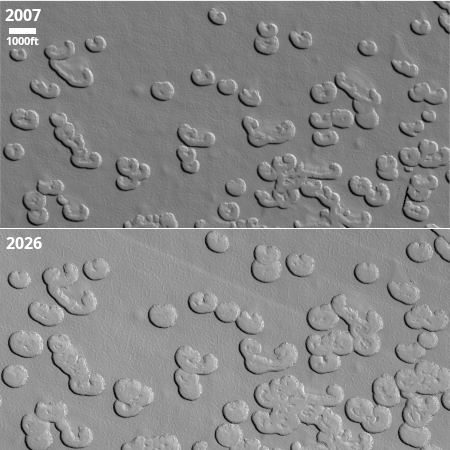
Cool image time! The two pictures to the right, cropped and reduced to post here, were taken more than two decades apart by the high resolution camera on Mars Reconnaissance Orbiter (MRO). The show a specific spot on the Martian south pole ice cap, at a location where there is also a perennial cap of dry ice that is also slowly shrinking in size.
The top picture was taken on May 14, 2007, the first close-up of this location. At the time the science team titled it “Fast Evolution of Landforms on the Southern Residual Caps,” which suggests that even then they had a sense from one earlier MRO picture that these strange forms were changing. As a result, scientist have used MRO to monitor this site repeatedly over the years, taking dozens of images of this location on a regular basis to track changes, both seasonally and over years.
The bottom picture is the most recent, taken on May 3, 2026. If you compare the two pictures closely, you can see that all these depressions have grown in some manner over the past two decades. (The blobs you see are all depressions. Optically your mind might make them appear as humps, but they are actually places where the cap’s top layer of dry ice has sublimated away.)
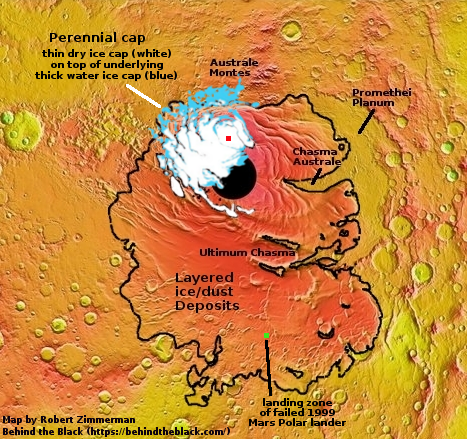
The red dot on the overview map to the right marks the location, deep inside the thin but permanent dry-ice cap at the south pole that sits on top of a larger water-ice cap. The data from MRO and other orbiters say that this dry-ice cap has been slowly shrinking during the decades we have been monitoring its existence.
That it exists at all however is a mystery. The north pole does not have a permanent dry-ice cap. Instead, it like the south pole gets a temporary thin mantle of dry ice every winter, as the carbon dioxide in the atmosphere falls as snow with the coming of colder temperatures. When spring comes however this mantle sublimates away, the CO2 returning to atmosphere as gas.
For reasons that are not yet understood, though they are probably partly related to the higher elevation of the south pole, there remains a permanent dry-ice cap there that the north pole lacks. The data however is telling us that this dry-ice is slowly going away. The two pictures above illustrate this fact.

On Christmas Eve 1968 three Americans became the first humans to visit another world. What they did to celebrate was unexpected and profound, and will be remembered throughout all human history. Genesis: the Story of Apollo 8, Robert Zimmerman's classic history of humanity's first journey to another world, tells that story, and it is now available as both an ebook and an audiobook, both with a foreword by Valerie Anders and a new introduction by Robert Zimmerman.
The print edition can be purchased at Amazon or from any other book seller. If you want an autographed copy the price is $60 for the hardback and $45 for the paperback, plus $8 shipping for each. Go here for purchasing details. The ebook is available everywhere for $5.99 (before discount) at amazon, or direct from my ebook publisher, ebookit. If you buy it from ebookit you don't support the big tech companies and the author gets a bigger cut much sooner.
The audiobook is also available at all these vendors, and is also free with a 30-day trial membership to Audible.
"Not simply about one mission, [Genesis] is also the history of America's quest for the moon... Zimmerman has done a masterful job of tying disparate events together into a solid account of one of America's greatest human triumphs."--San Antonio Express-News