
Is Dragonfly’s power source less capable than planned?
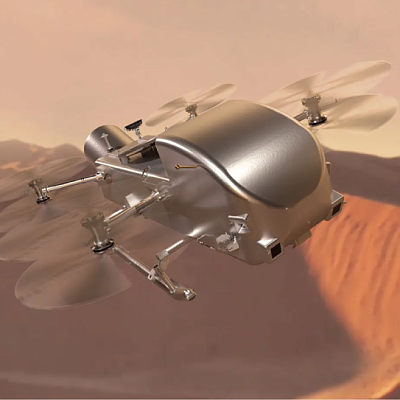
Artist rendering of Dragonfly soaring
over Titan’s surface
According to a French source yesterday on X, the Department of Energy (DOE) recently informed NASA that the radioisotope thermoelectric generator (MMRTG) that will be used to provide power and heat to the Dragonfly helicopter in its mission on Titan will produce less power than expected.
The source stated the following (translated by Google):
The DOE recently informed NASA that the MMRTG intended for Dragonfly will provide less thermal power than specified. This reduction will result in lower electricity production than initially anticipated.
Dragonfly operates using a large lithium-ion battery pack that is slowly recharged by the MMRTG. Flights and scientific experiments take place during the Titanian day, while the long nights are primarily dedicated to recharging. This reduction in power will extend recharge times between flights. It could reduce the number of trips, limit the distances traveled, or cut the time available for scientific observations at each site.
The heat produced by the MMRTG is also essential for maintaining equipment temperatures. Lower thermal power will make this thermal management more complex throughout the mission.
I can find no other reports about this at NASA, DOE, or in the American press. If true, this issue raises the risks of this very risky $3 billion mission that is vastly overbudget and, according to a September 2025 inspector general report, not likely to meet its 2028 launch window. Recent NASA press releases have implied it is on schedule, but we shall see.
And while NASA has built a helicopter that worked on Mars, the environment of Titan is far more alien. Worse, no NASA mission has ever attempted to function in such conditions. Thus, Dragonfly will not only be going to a very strange place, it will be trying to do so with engineering never tried before.
Hat tip BtB’s stringer Jay.

On Christmas Eve 1968 three Americans became the first humans to visit another world. What they did to celebrate was unexpected and profound, and will be remembered throughout all human history. Genesis: the Story of Apollo 8, Robert Zimmerman's classic history of humanity's first journey to another world, tells that story, and it is now available as both an ebook and an audiobook, both with a foreword by Valerie Anders and a new introduction by Robert Zimmerman.
The print edition can be purchased at Amazon or from any other book seller. If you want an autographed copy the price is $60 for the hardback and $45 for the paperback, plus $8 shipping for each. Go here for purchasing details. The ebook is available everywhere for $5.99 (before discount) at amazon, or direct from my ebook publisher, ebookit. If you buy it from ebookit you don't support the big tech companies and the author gets a bigger cut much sooner.
The audiobook is also available at all these vendors, and is also free with a 30-day trial membership to Audible.
"Not simply about one mission, [Genesis] is also the history of America's quest for the moon... Zimmerman has done a masterful job of tying disparate events together into a solid account of one of America's greatest human triumphs."--San Antonio Express-News
I’d like to see a (reliable) American source on this before I hit the panic button. And if we do, I’d really like to see Jared Isaacman field a question about it on X, and clarify just exactly where things stand with the power situation.
Until then, I remain grateful that the science directorate stuck its head out of its usual safety net to green light a mission as ambitious as this; this is easily the planetary science mission I am most excited about. I do wish they had been more candid at the outset about the likely costs, even setting aside the unanticipatable COVID supply chain hiccups.
In this matter we disagree. I have from day one thought this mission as being too ambitious by three times over. It is like sending Curiosity to Mars before Mariner 9 had mapped it from orbit.
Actually it is far worse, as the Martian environment is not that alien. Titan has an alien atmosphere, super-cold temperatures, and a surface that at present is very poorly understood. Moreover, it is many light hours away. To attempt Dragonfly without any simpler scouting missions beforehand, at relatively low cost so if they fail we don’t lose much, is foolish. At a minimum we need a better understanding of Titan’s methane/ethanol lakes.