
Europa’s mysterious stained grooves
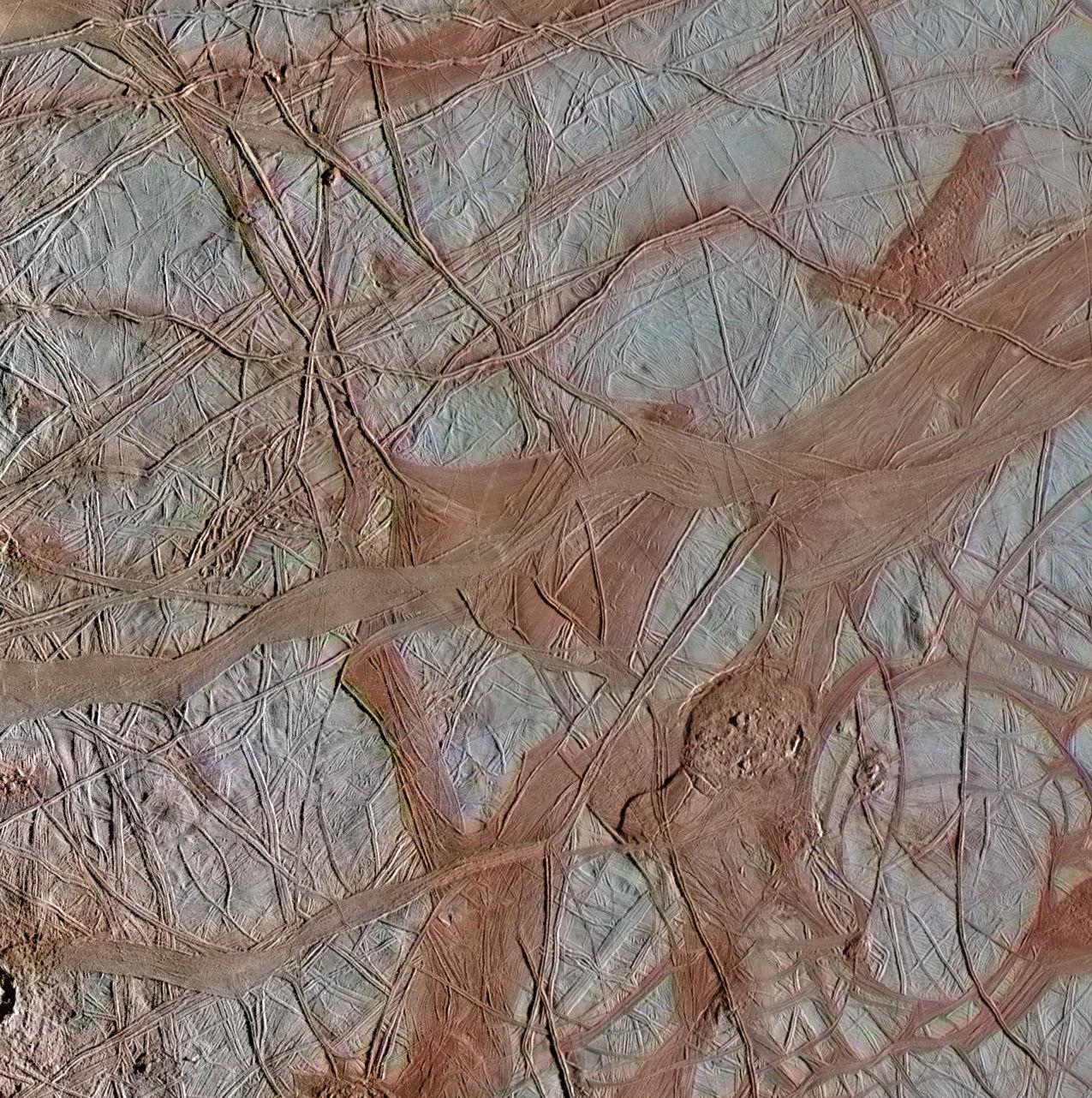
Click for full image.
From 1995 to 2003 the Galileo orbiter circled Jupiter 34 times. During those orbits the spacecraft made numerous close fly-bys of Jupiter’s moons, including eleven past the tantalizingly mysterious moon Europa.
The image to the right was taken during the eighth fly-by of Europa. It is one of three Galileo images of Europa that scientists have pulled from the Galileo archive and subjected to modern computer processing in order to improve what can be seen. The other two can be found here and here. From the release for the image to the right:
All three images were captured along the same longitude of Europa as Galileo flew by on Sept. 26, 1998, in the spacecraft’s 17th orbit of Jupiter (orbit E17). It was the eighth of Galileo’s 11 targeted flybys of Europa. High-resolution images were taken through a clear filter in grayscale (black and white). Using lower-resolution, color images of the same region from a different flyby (orbit E14), technicians recently mapped color onto the higher-resolution images.
In other words, they laid the colors from a lower resolution color image on top of the high resolution black & white image so that we could see these three images in color. The blue and white areas are made of up water ice, while the reddish areas are made up of “more non-ice materials.”
The vagueness for describing the non-ice materials is intentional, as scientists still do not know what they made of. They do believe that this material came from the planet’s interior, as the red material is always found aligned with the cracks, fissures, and grooves, as illustrated clear by this image.
What has always struck me about this surface of Europa since I first saw similar Galileo images back in 1998 and wrote about them for the magazine The Sciences is how much it resembles the Arctic ice pack as seen by early explorers during their attempts to reach the North Pole, jumbled jigsaw pieces of ice packed together but moving slowly so that the cracks between them shift and change over time.
The resemblance adds weight to the theory that there is a liquid ocean below Europa’s icepack, and the red material hints at some intriguing chemistry coming from that ocean.

On Christmas Eve 1968 three Americans became the first humans to visit another world. What they did to celebrate was unexpected and profound, and will be remembered throughout all human history. Genesis: the Story of Apollo 8, Robert Zimmerman's classic history of humanity's first journey to another world, tells that story, and it is now available as both an ebook and an audiobook, both with a foreword by Valerie Anders and a new introduction by Robert Zimmerman.
The print edition can be purchased at Amazon or from any other book seller. If you want an autographed copy the price is $60 for the hardback and $45 for the paperback, plus $8 shipping for each. Go here for purchasing details. The ebook is available everywhere for $5.99 (before discount) at amazon, or direct from my ebook publisher, ebookit. If you buy it from ebookit you don't support the big tech companies and the author gets a bigger cut much sooner.
The audiobook is also available at all these vendors, and is also free with a 30-day trial membership to Audible.
"Not simply about one mission, [Genesis] is also the history of America's quest for the moon... Zimmerman has done a masterful job of tying disparate events together into a solid account of one of America's greatest human triumphs."--San Antonio Express-News
Col Beausabre: I think you posted this comment in the wrong thread.
i agree,reposting, please delete this
Col Beausabre: Done.
Iron is a common element in meteors, shattering on Inpact, stirring up the muck blow the ice and superheating it forcing the red rust to the surface to flow away from the impact site and the radial cracks around the impact site. You can see the shifting sections were older cracks are misaligned.
I think the red colors Is just dirty ice because of mineral content.
But I can’t figure out is the striations in the cracks where the fluid has refrozen. They’re all aligned in the same direction. Freezing during high and low tides?
I have the uncontrollable urge to seed Europa with deep sea Earth life forms.
Oh I know thats a evil thought. So many scientists will be upset. And we might harm the life already there, if it exists at all.
We are going to contaminate that planetiod anyways so why not do it now and watch to see what happens.