
Vast has apparently reconfigured and scaled down its proposed Haven-2 full space station
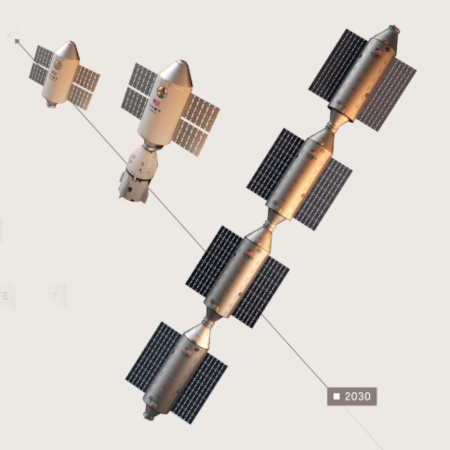
Click for original animation.
In a X tweet in early May that I only saw today, the space station startup Vast touts its series of orbital missions, beginning with its Haven demo test satellite that flew last year, followed by its Haven-1 single module station that will launch in 2027, and finally its proposed full multi-module Haven-2 station targeting a 2030 launch date.
The screen capture to the right shows Haven-1 (unmanned and manned with a docked Dragon capsule) and the Haven-2 station, comprising four Haven-1 modules attached in a single line.
What makes this newsworthy to me is that it is a major simplification and reduction in size for Haven-2. Until recently the company had planned to build Haven-2 with a central docking hub with eight modules attached in a cross, two for each arm (See the graphic here).
It appears the company has scaled down Haven-2 in anticipation of reduced funding from NASA. The original plan was to win a big contract allowing the company to build the full Haven-2 station. This smaller Haven-2 appears to recognize that even if Vast gets a contract from NASA, it won’t be enough to build the full station. This smaller design can serve NASA’s needs, while also serving the needs of Vast’s other private customers, which include foreign nations who want to send their astronauts to space and a number of companies that want to use Haven-2 to manufacture pharmaceuticals and other products for sale back on Earth.
This configuration also allows the company some flexibility. Because it uses those Haven-1 modules, it can always add that docking hub later, and add or shift modules to recreate the full original design.

On Christmas Eve 1968 three Americans became the first humans to visit another world. What they did to celebrate was unexpected and profound, and will be remembered throughout all human history. Genesis: the Story of Apollo 8, Robert Zimmerman's classic history of humanity's first journey to another world, tells that story, and it is now available as both an ebook and an audiobook, both with a foreword by Valerie Anders and a new introduction by Robert Zimmerman.
The print edition can be purchased at Amazon or from any other book seller. If you want an autographed copy the price is $60 for the hardback and $45 for the paperback, plus $8 shipping for each. Go here for purchasing details. The ebook is available everywhere for $5.99 (before discount) at amazon, or direct from my ebook publisher, ebookit. If you buy it from ebookit you don't support the big tech companies and the author gets a bigger cut much sooner.
The audiobook is also available at all these vendors, and is also free with a 30-day trial membership to Audible.
"Not simply about one mission, [Genesis] is also the history of America's quest for the moon... Zimmerman has done a masterful job of tying disparate events together into a solid account of one of America's greatest human triumphs."--San Antonio Express-News
Updates have not hit the company website. The Vastspace website still shows the hub and spoke Haven-2 configuration.
Looking at the X post, the Haven-2 modules are longer than the Haven-1 module plus the solar cells are configured differently.
I went to the Vast Space web site and thence to the Haven-2 page. The four module configuration is just an intermediate configuration on the way to the cross configuration.
The linear arrangement has always been on the path to the hub version. I can’t watch the full animation on X (no account) but I don’t see anything in the post that indictates plans have changed.
On July 3, Ashlee Vance posted a YouTube video on the Core Memory channel where he toured Vast and interviewed CEO Max Haot among others. Looks like the larger stations are still planned even though the dates have slipped. Some good info there.
https://youtu.be/wcKv5ClYHkA?is=Lcq0MqpulWo7CGui
Vast calls its approach to assembling Haven-2 a “stepping stone” approach. If Vast thinks that there may be delays or shortfalls as they step from one stone to the next, then they may try to manage expectations. I still have confidence that the commercial space stations will have plenty of business. None has yet flown, but they seem to be attracting business commitments, not just interest. The demand for space stations exists, but can the space stations satiate that demand?
My worry is that there may not be sufficient transit spacecraft to keep the commercial space stations occupied with all the business that they are already able to muster. Right now, only Dragon is available. Starliner is looking unlikely as an alternative, but India’s Gaganyaan manned spacecraft could conceivably be for rent. If Russia’s manned space program collapses after ISS is finally abandoned then perhaps the Soyuz would be available for commercial space station missions. Dream Chaser may not fly as a cargo craft, much less as a manned spacecraft.
Starship seems like an alternative, but its size and mass could make a space station have a difficult time maintaining its attitude control. I am concerned that the forces experienced during docking could exceed the currently designed space stations’s design specifications.
I am not in favor of a scenario in which one or more Starships are pressed into service as pseudo space stations, launching with crew onboard and staying in low Earth orbit for the duration of the mission, then returning and being prepared for a next “space station” mission. This scenario may be good for the customers, but not for the rest of the space industry. Not only would this take business away from the true space stations, it would distract SpaceX from other missions that the company has. However, SpaceX may perform one or two similar missions in low Earth orbit as test runs for manned missions to Mars, giving the crews some science experiments in order to pass the time.