A National Research Council panel today proposed creating a massive data network using the private health records of patients.

What could possibly go wrong? A National Research Council panel today proposed creating a massive data research network using the private health records of patients.

As a pilot project, the report recommends sequencing the whole genomes of 1 million Americans and combining the data with medical histories to look for genetic links to disease. That may sound expensive—even if sequencing costs drop to $1000 per genome, it would cost $1 billion—but $1000 is in the range of what a routine MRI scan costs, Desmond-Hellmann pointed out. Another pilot project would use metabolomic profiles of patients’ blood to help predict which patients with insulin resistance will go on to develop type II diabetes.

Creating the network over the next decade or two shouldn’t require new funding, the report says. “This is not the Human Genome Project,” said Sawyers. “It’s taking advantage of things happening anyway and bringing them together and doing it at the point of care.” NIH needs to redirect resources and push for more long-term studies that combine research with health care, the report says. Building the network might also require a revision of patient privacy rules and an “evolution” in the public’s attitudes about allowing researchers to use their medical data. [emphasis mine]

The last sentence, highlighted by me, was also the last sentence in the article, added almost as a minor aside. Yet, it is probably the most important aspect of this story, since the right of each of us to control our personal health records is directly threatened by this proposal.

0 comments

The offices of French satirical weekly Charlie Hebdo have been destroyed by a petrol bomb, a day after it named the Prophet Mohammed as its “editor-in-chief” for this week’s issue.

The tolerance of Islam: One day after a French satirical weekly published an issue poking fun of Islam and naming Mohammed its “editor-in-chief”, its offices were firebombed and its website hacked with these words:

You keep abusing Islam’s almighty Prophet with disgusting and disgraceful cartoons using excuses of freedom of speech. Be God’s curse upon you!

0 comments

Astronomers prepare for an asteroid fly-by on November 8, using the Earth as the spacecraft

Astronomers prepare for an asteroid fly-by on November 8, using the Earth as the spacecraft.

Large enough to cause regional devastation if it were to hit the Earth, 2005 YU55 is the closest pass by an asteroid this big since 1976, and there won’t be another until 2028. The near miss provides an unparallelled opportunity for radar, optical and infrared observations of a mysterious charcoal-black world similar to the type of asteroid that astronauts may one day set foot on.
Radar bonanza “It’s a bit like a spacecraft fly-by with the Earth being the spacecraft,” says astronomer Don Yeomans at NASA’s Jet Propulsion Laboratory (JPL) in Pasadena, California. “It’s going to be an extraordinary target for radar.”

2 comments

Senate approves NASA budget

The Senate today approved a NASA budget of $17.9 billion, 2.8 percent less than last year and about equivalent to NASA’s 2009 budget.

The Senate bill included $500 million for commercial space, $3 billion for NASA’s heavy-lift rocket, and $500 for the James Webb Space Telescope. This must now be reconciled with the House budget, which called for a $16.8 billion total budget, with $300 million for commercial space and no money at all for Webb.

0 comments

Wildlife Biologist Found Guilty of Attempting to Poison Feral Cats

Another scientist who doesn’t understand science: A former biologist at the Smithsonian National Zoo’s Migratory Bird Center has been found guilty of attempting to poison feral cats in Washington, DC.

It isn’t her crime here that disturbs me. It is her own research and testimony during her trial:

In addition to the videotaped evidence, prosecutors also introduced evidence that Dauphiné has a long history advocating in academic literature for the control of feral cat populations in order to protect native bird populations. In one paper, in the 2009 Proceedings of the Fourth International Partners in Flight Conference: Tundra to Tropics, Dauphiné and co-author Robert J. Cooper, a wildlife biologist at the University of Georgia in Athens, argue that feral cats kill upwards of 1 billion birds in the United States every year. They also argue that the “trap-neuter-release” model for population control, which is advocated by many animal rights organizations, does a poor job of managing feral cat populations.

Yesterday, Judge Truman A. Morrison III noted in his remarks that, during Dauphiné’s testimony during the trial, she declined to discuss whether she agreed with various academic papers on which she was listed as an author, and said she wasn’t familiar with many of their statements about the danger that feral cats pose to birds. In delivering his verdict, Morrison said that the notion that Dauphiné wouldn’t be familiar with papers she authored or co-authored “doesn’t have the ring of the truth.” He also “found that her inability, indeed her unwillingness to own up to her own professional writings … undermined her credibility.” [emphasis mine]

First, the claim that feral cats kill a billion birds a year in the U.S. seems extremely implausible. Second, for this scientist to then pretend she “wasn’t familiar” with this claim, written in her own work, tells us just how untrustworthy she and her work are.

1 comment

An investigation has concluded that a fired Dutch researcher falsified data on dozens of papers

Why even peer-reviewed research must always be questioned: An investigation has concluded that a fired Dutch researcher falsified data on dozens of papers.

[Diederik] Stapel’s work encompassed a broad range of attention-catching topics, including the influence of power on moral thinking and the reaction of psychologists to a plagiarism scandal. The committee, which interviewed dozens of Stapel’s former students, postdoctoral researchers, co-authors, and colleagues, found that Stapel alone was responsible for the fraud. The panel reported that he would discuss in detail experimental designs, including drafting questionnaires, and would then claim to conduct the experiments at high schools and universities with which he had special arrangements. The experiments, however, never took place, the universities concluded. Stapel made up the datasets, which he then gave the student or collaborator for analysis, investigators allege. In other instances, the report says, he told colleagues that he had an old dataset lying around that he hadn’t yet had a chance to analyze. When Stapel did conduct actual experiments, the committee found evidence that he manipulated the results.

I’m not sure which is worst about this scandal, that Stapel’s dishonesty has tainted the PhD’s of 21 innocent students, or that none of his fellow researchers ever had the brains, skepticism, or mental muscle to challenge his results.

Stapel’s fabrications weren’t particularly sophisticated, the committee says, and on careful inspection many of the datasets have improbable effect sizes and other statistical irregularities. His colleagues, when they failed to replicate the results, tended to blame themselves, the report says. Among Stapel’s colleagues, the description of data as too good to be true “was a heartfelt compliment to his skill and creativity,” the report says.

Update: I’d like to add one more addendum to this story, (covered today by Nature with its own long article). Unlike the climate field, where the scientists circled the wagons and protected the scientists who committed the frauds with whitewashed investigations, the field of social psychology and the scientists in the Netherlands have been refreshingly blunt and forthright in trying to clear the air by tracking down all Stapel’s corrupt papers. For this at least they deserve kudos.

0 comments

The Haunting

An evening pause: Once again, for Halloween, this short but truly unnerving scene from Robert Wise’s The Haunting (1963), based on the story by Shirley Jackson. Captures what everyone imagines it would be like to sleep in a haunted house. And with no special effects at all.

0 comments

The long minimum continues

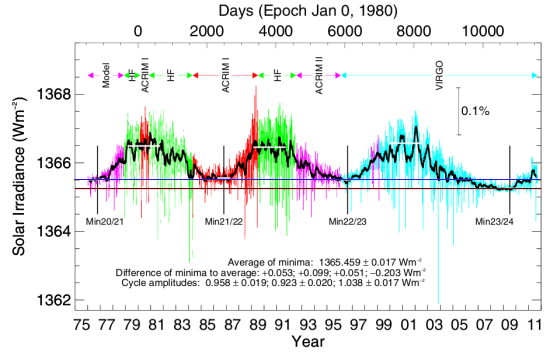
Though it has been very clear for the past few months that the sun has finally transitioned from solar minimum and begun its ramp up to solar maximum, that ramp up has also been very slow and wimpy.

On October 9, 2011 the scientists at Physikalisch- Meteorologisches Observatorium Davos (PMOD) posted an updated summary of the satellite data that has been carefully measuring the variation of the sun’s total solar irradiance since 1978. The graph below, which can be found here [pdf], brings that data up through the present. (I had posted the previous update about a year ago.)

Total solar irradiance

I have added a brown line to illustrate how deep the recently ended solar minimum was, compared to previous minimums. Note also that this most recent minimum would also be far below the minimum prior to 1975. I have also added a blue line to show that the sun has only very recently finally brightened enough to finally exceed the previous minimum. All told, the sun remained dimmer than the previous minimum for over five years!
» Read more

2 comments
1 1,561 1,562 1,563 1,564 1,565 1,773