A new deal has been announced to fly tourists to ISS using Russian Soyuz capsules. According the arrangement between Space Adventures and the Federal Space Agency of the Russian Federation (FSA) and Rocket Space Corporation Energia (RSC Energia), three seats will be made available on Soyuz spacecraft bound for the International Space Station (ISS), beginning in 2013.
These seats will be made available through the increase of Soyuz production, from four to five spacecraft per year. Each flight will be short duration, approximately 10 days, and will contribute to the increase of launch capacity to the ISS.
From today’s first press conference at the AAS meeting, astronomers have found that two of the fundamental objects they use as units of measure might not be as reliable a unit of measure as they thought.
Astronomers have discovered that the Cepheid variable stars that they use to estimate the distances to the nearest galaxies are not necessarily the stars they thought. At least two Cepheids, which are variable stars, do not pulse reliably (one actually stopped pulsing entirely). Another is surrounded by a previously unknown nebula cloud, which affects its apparent brightness, an essential data-point when using these stars as a measuring tool. Here’s one press release.
The Crab Nebula threw out some gigantic gamma ray bursts last fall. In addition, astronomers have found that the nebula actually flickers wildly, and is also changing in gamma ray energy output over the long term, declining by seven percent in the last two years. No one yet knows what exactly causes these different variations. Like Cepheids, the Crab has been used as a standard for measuring the energy of astronomical gamma ray objects. This is no longer reliable. Here’s one press release, plus images.
Look, I agree that we’ve got to tone down the rhetoric. And I also agree that conservatives bear as much responsibility to do this as anyone. Free debate in a civilized society requires reasoned discussion of the issues, and a willingness to tolerate disagreement. It should not include ad hominen attacks, or the wishful desire to murder your opponents.
However, it is not the tone of rightwing discourse that worries me much these days. You would be hard pressed to find any examples of any Republicans or Tea Party activists suggesting it would a good thing to kill Democrats. Such suggestions are not only considered unacceptable, everyone on the right knows that to say such a thing would probably destroy your career in the public arena. Thus, it just doesn’t happen.
Instead, it is the left, the press, and the Democratic Party’s efforts to whip up anger at the right that scares me. Nor did this ugly behavior begin on Saturday after the Tucson murders. In the past decade there have been the numerous examples (which I have been documenting these past few days) of leftwing activists, Hollywood movies, talk radio hosts, and Democratic officials advocating violence against the right. (For a talk radio host example, see this new list of liberals calling for the murder of conservatives.) Worse, such behavior has almost become routine in recent years. It seems that every random violent act has become a vehicle for the left and the press to attack and slander conservatives, despite the fact that there is no evidence that any of these accusations are true.
This behavior must stop. Violent and angry rhetoric can and will cause violence. And it probably has, considering the fact that a large number of the random violent acts in recent years have actually been committed by deranged individuals with liberal, not conservative, leanings. This is not to say that I blame the left for this violence, but that the left has as much of a responsibility as the right to think carefully about what it says, before it says it. Otherwise, they might find that they have made their less rational followers more angry than they ever imagined, or can control.
Or as Michael York says to his NAZI friend at the end of this scene from the 1972 movie, Cabaret. “You still think you can control them?”
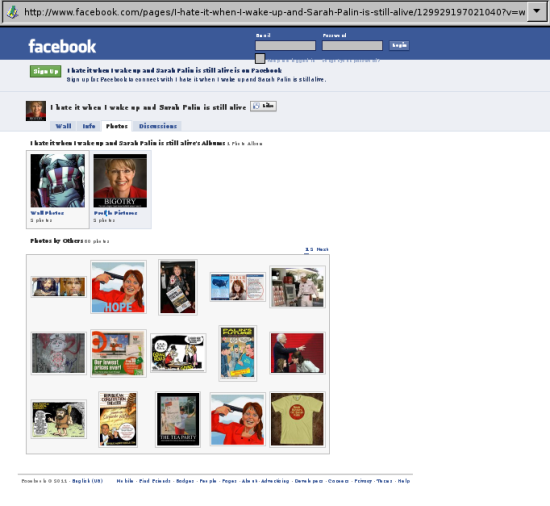
Is this an example of toning down the rhetoric? The Facebook Group “I Hate It When I Wake Up & Sarah Palin Is Still Alive” has more than 2,000 members.
So you have no doubt about the ugly tone of this Facebook group, here is a screen capture from the page. Note the desire to kill Palin (and Bush) in several images.
The money is not there, and Treasury Secretary Geithner agrees. On January 6 he wrote a letter to Congress, stating that the US will go into default if the debt ceiling is not raised.
An evening pause:The Roaring Twenties (1939). Humphrey Bogart and James Cagney were often cast as gangsters. However, their film personas’ were very different. Bogart’s characters generally showed a trace of weakness in his soul, while Cagney’s characters were rock solid no matter how much things fell apart. The finale of this classic Hollywood film, in which each man dies, illustrates this difference quite starkly.
From the second press conference at the AAS meeting today, results from the Sloan Digital Sky Survey, which has been surveying the sky in incredible detail over the past eleven years:
The largest digital color image of the heavens, covering one third of the sky, imaging a half a billion stars and galaxies. Despite looking the sky in wide-field view, the data also has incredible close-up detail. This has and will continue to provide astronomers a precise baseline reference for future research.
A 3D reconstruction of the local galactic neighborhood, showing the three dimensional position of the visible galaxies within a billion light years. They plan to use the new Sloan color image above to further extend this 3D reconstruction out to seven billion light years.
The largest map of the Milky Way’s outer regions, showing the streams of stars captured from other galaxies, absorbed in the past galactic mergers that formed the Milky Way.
From the first press conference at the AAS meeting today, focused on recent discoveries from the European space telescope Planck:
has identified 10,000 cold spots in Milky Way, all believed to be places where stars will soon begin to form. They range widely in size, and are from 30 to 10,000 light years from us.
Planck’s all sky survey has found 189 giant galaxy clusters, 20 of which are newly discovered. “The largest gravitationally bound objects in the universe.” Very hot, filled with hot gas.