
NASA outlines new program of unmanned missions to Moon
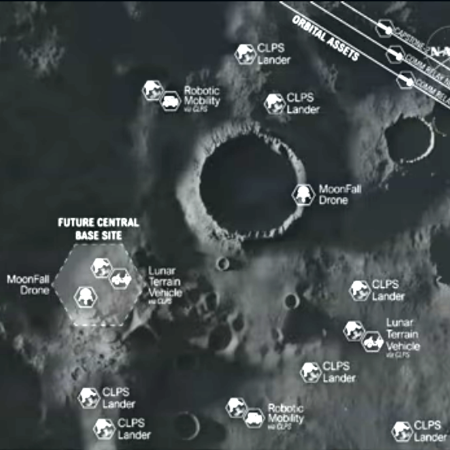
NASA’s Moon base plans as of May 2026.
NASA officials today outlined its new reshaped program of unmanned missions to Moon, designed it says to lay the first groundwork for the manned lunar base to follow.
You can watch the press conference here. The map to the right comes from one viewgraph during that conference, and apparently shows the planned lunar base area, which officials said could cover about 100 square miles. Though officials said this is in the south pole region, I have not been able to identify the precise location, using the global map produced by Lunar Reconnaissance Orbiter. The large crater northeast of the base does not appear to be Shackleton Crater.
The schedule includes four already planned missions, two new missions awarded to Blue Origin in a $188 million contract to deliver two new rovers, and a new hopper mission mission to be delivered by Firefly’s Blue Ghost lander. The schedule is as follows:
- Moon Base I: Targeted for launch no earlier than fall 2026 using Blue Origin’s Blue Moon Mark 1 Endurance lander to deliver NASA payloads. The mission will land on the rim of Shackleton crater to demonstrate capabilities that reduce risk for future crewed Artemis landing missions in 2028.
- Moon Base II: Also planned for launch before the end of 2026, using Astrobotic’s Griffin lander to deliver more than 1,100 pounds of cargo, including Astrolab’s small unmanned FLIP rover.
- Moon Base III: Also targeted for this year, using Intuitive Machine’s Nova-C Trinity lunar lander. In addition to NASA payloads, it will include payloads from Europe and South Korea.
- Sometime in 2027 Blue Origin’s Mark-2 manned lunar lander will deliver NASA’s Viper rover to the Moon.
- In 2028 two Blue Origin landing missions using its unmanned Mark-1 lander will carry two newly awarded manned rover contracts to the south pole region, Astrolab getting $219 million and Lunar Outpost getting $$220 million. NASA wants at least one to get there ahead of the Artemis-4 manned landing so the astronauts will have it for use.
- Also in 2028 NASA is planning a mission dubbed Moonfall, managed by JPL and using Firefly’s Blue Ghost lander to send four hoppers to the south pole region. Those drones will also be used to lay out the perimeter of the planned lunar base.
The agency added that it plans to award more contracts for unmanned missions by June and again later in the fall, as part of a plan that calls for as many as 25 landings by 2029. And that is only the first phase in this plan.
This schedule is very ambitious, kind of similar to an Elon Musk schedule. Thus, no one should be surprised or disappointed if things don’t happen as scheduled. Nonetheless, it is the most coherent plan for lunar exploration put forth by NASA since the 1960s. And it is very clearly asking the private sector to do the job. Nothing here except some science instruments is being built by NASA.
In addition, the hopper mission is clearly designed to place a U.S. claim as quickly as possible to the territory it wants to use for its lunar base, not withstanding the Outer Space Treaty’s ban on claiming territory. NASA administrator Jared Isaacman very much understands that possession is nine-tenths of the law, regardless of any treaty, and he is moving as fast as he can to establish that possession.

On Christmas Eve 1968 three Americans became the first humans to visit another world. What they did to celebrate was unexpected and profound, and will be remembered throughout all human history. Genesis: the Story of Apollo 8, Robert Zimmerman's classic history of humanity's first journey to another world, tells that story, and it is now available as both an ebook and an audiobook, both with a foreword by Valerie Anders and a new introduction by Robert Zimmerman.
The print edition can be purchased at Amazon or from any other book seller. If you want an autographed copy the price is $60 for the hardback and $45 for the paperback, plus $8 shipping for each. Go here for purchasing details. The ebook is available everywhere for $5.99 (before discount) at amazon, or direct from my ebook publisher, ebookit. If you buy it from ebookit you don't support the big tech companies and the author gets a bigger cut much sooner.
The audiobook is also available at all these vendors, and is also free with a 30-day trial membership to Audible.
"Not simply about one mission, [Genesis] is also the history of America's quest for the moon... Zimmerman has done a masterful job of tying disparate events together into a solid account of one of America's greatest human triumphs."--San Antonio Express-News
‘Moonfall’ is a Bond movie waiting to happen.
Elon turns “impossible to late”, as he says.
NASA turns trivial to exorbitant and very late, in the case of SLS.
Hopefully, the current administrator can turn around parts of it culturally and financially. His plan to revitalize NASA is as close to perfect as I can come up with, in terms of taking a titanic organization and trying to make it relevant and innovative again.
Odd Nasa has not defined exact location. Wonder why? Perhaps the image was AI and for descriptive purposes only?
Every time I see a schedule like that, I am reminded of this……LOL!
https://www.bing.com/videos/riverview/relatedvideo?q=spring+mars+animation+2020&&mid=33EC477CE7F12236D2F633EC477CE7F12236D2F6&churl=https%3a%2f%2fwww.youtube.com%2fchannel%2fUC5md-VJO5YaE6OqaB_GzGxA&FORM=VRDGAR
“I have not been able to identify the precise location”
No, you will not know the precise location. They did say “Shackleton Connecting Ridge” area which is one of the Artemis landing regions. This image appears to be a synthetic lunar terrain simulation to keep it generic.
J Fincannon: Interesting. You are the second person to tell me that NASA is purposely keeping this location secret. The first suggested the agency was doing so because it wants to keep the information away from the Chinese, a point I consider very valid.
I also thought that if this location is not adjacent to Shackleton, NASA might want to keep that fact secret because it would raise lots of questions it doesn’t want to deal with right now.
Meanwhile, the “Shackleton Connecting Ridge” was only mentioned as the landing site for Blue Origin’s first mission in the fall. That ridge is on the crater’s rim, and has been studied as a base location extensively over the years by NASA.
I don’t think I said it was “secret”. It is general until validated and confirmed via detailed site analysis (via DEM and high res imagery). There are landing ellipses of some size (e.g. 100m radius) to find with the right slope, hazard level over the entire area So, when you said “precise”, for instance +-1m, I doubt that is going to available. Yet.
J Fincannon: You may not have meant it as implying secretiveness, but the wording “No, you will not know the precise location.” implies that very directly. Had you instead simply said they don’t yet know the precise site from their nine candidate sties you would have been much clearer.
It is incredibly frustrating for all of us space afficionados that it will have taken us nearly six decades to get back to the Moon, with only the solace that it looks like it will be sustainable and even economically useful this time around. You can argue, as I might, that we were really well ahead of any reasonable schedule when we did it in 1969, but thanks to Apollo that is not the psychological baseline from which we have got accustomed to thinking about this.
In this connection I got lured down an unexpected rabbit hole today when I got sucked into the biography of Jimmy Doolittle, of Doolittle Raid fame. I had known the bald fact that Doolittle had served as chairman of the National Advisory Committee for Aeronautics (NACA) in the 50’s, but what I had not known was just how long he had been an enthusiast for developing rocket technology. It turns out that in October 1938, he had flown down for a tour of Robert Goddard’s workshop in Roswell, New Mexico, and was wholly won over, He wrote a memo about it for the Army, in which he closed with an amazing line: “Interplanetary transportation is probably a dream of the very distant future, but with the moon only a quarter of a million miles away—who knows!”
I think he ended up astonished that his musing was fulfilled less than 31 years later — well within his lifetime! — but maybe he would have been even more astonished that we’d end up taking nearly 60 years to go back there again.
My gut feeling is that they’re still sussing out the final location and threw this stuff out as a kind of placeholder. Just sloppy.
But I think it’s not impossible that the other possible reasons Bob offers here could be in operation.
Richard M,
Extremely interesting Doolittle stuff. Hadn’t know any of that. Just goes to show what a genuinely remarkable fellow Jimmy Doolittle was. In light of this little-known biographical information about him it seems that a lunar crater should be named for him. According to Wikipedia, that hasn’t yet been done.
Heck, I would support naming an entire mountain range after Doolittle.