
To read this post please scroll down.


As I do every July, it is once again time for my annual anniversary fund-raising campaign to support this website and the work I do here.


This year I celebrate Behind the Black’s sixteenth anniversary. In those sixteen years I have done more than 35,000 posts (which means I added more than 2,000 in the last year), with my main focus covering the global space industry and the related planetary and astronomical science that comes from it. Along the way I sometimes also post my thoughts on the politics and culture of the time, partly because I think it is important for free Americans to do so, and partly because those politics and culture have a direct impact on the future of our civilization and its on-going efforts to explore and eventually colonized the solar system.


You can’t understand one without understanding the other.


For those who still wish to support my work, please consider donating or subscribing to Behind the Black, either by giving a one-time contribution or a regular subscription. There are five ways of doing so:


1. Zelle: This is the only internet method that charges no fees. All you have to do is use the Zelle link at your internet bank and give my name and email address (zimmerman at nasw dot org). What you donate is what I get.


2. Patreon: Go to my website there and pick one of five monthly subscription amounts, or by making a one-time donation. Takes about a 10% cut.


3. A Paypal Donation or subscription, which takes about a 15% cut:


4. Donate by check. I get whatever you donate. Make the check payable to Robert Zimmerman and mail it to

Behind The Black
c/o Robert Zimmerman
P.O.Box 1262
Cortaro, AZ 85652


You can also support me by buying one of my books, as noted in the boxes interspersed throughout the webpage or shown in the menu above.


Firefly to build descent aeroshell for NASA’s Mars Skyfall helicopter mission
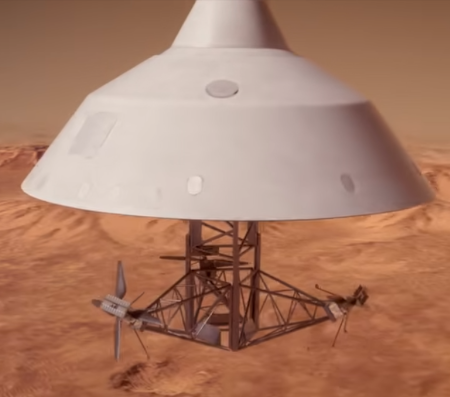
Skyfall concept
SkyFall helicopter deployment. Click for original animation.

In a press release yesterday, Firefly Aerospace announced it has won a $13 million contract to build the descent aeroshell that will be used to protect the three Ingenuity-class helicopters being sent to Mars in 2028 on NASA’s proposed Skyfall mission.

The SkyFall aeroshell, comprising both the backshell and heatshield, will be developed within Firefly’s new Gloworks innovation lab and manufactured at the company’s Rocket Ranch in Briggs, Texas. Firefly will utilize advanced carbon composite technologies from its proven Blue Ghost lunar landers, Elytra orbiters, and Alpha and Eclipse launch vehicles to rapidly produce high-strength, lightweight structures.

This press release provides the most details yet about the mission. The graphic to the right is a screen capture from a video from JPL, showing the mission concept. First the helicopters would descend through the Martian atmosphere encapsulated in Firefly’s aeroshell. The bottom half would then drop off, and parachutes would release from above. Once close to the ground, the helicopters would be lowered out of the shell on the frame shown to the right, turn on their rotors, and then be released to fly away and land on their own.

This technique utilizes an entry capsule to release the three helicopters during descent, eliminating the need for a landing platform. The helicopters will then fly to the surface and capture high-resolution surface imagery and subsurface radar data.

We still do not know the chosen landing location on Mars, though the press release mentions a search for water ice, suggesting it will not be in the dry equatorial regions, where almost all landers and rovers have gone, but in mid-latitudes or higher where glaciers and lots of near surface ice has been detected.

The mission is intended after launch to use the nuclear propulsion engines NASA is developing jointly with the Energy Department to get to Mars. I remain skeptical those engines will be ready by 2028.

Hat tip BtB’s stringer Jay.

Genesis cover

On Christmas Eve 1968 three Americans became the first humans to visit another world. What they did to celebrate was unexpected and profound, and will be remembered throughout all human history. Genesis: the Story of Apollo 8, Robert Zimmerman's classic history of humanity's first journey to another world, tells that story, and it is now available as both an ebook and an audiobook, both with a foreword by Valerie Anders and a new introduction by Robert Zimmerman.

The print edition can be purchased at Amazon or from any other book seller. If you want an autographed copy the price is $60 for the hardback and $45 for the paperback, plus $8 shipping for each. Go here for purchasing details. The ebook is available everywhere for $5.99 (before discount) at amazon, or direct from my ebook publisher, ebookit. If you buy it from ebookit you don't support the big tech companies and the author gets a bigger cut much sooner.


The audiobook is also available at all these vendors, and is also free with a 30-day trial membership to Audible.
 

"Not simply about one mission, [Genesis] is also the history of America's quest for the moon... Zimmerman has done a masterful job of tying disparate events together into a solid account of one of America's greatest human triumphs."--San Antonio Express-News

7 comments

7 comments

  • Max

    I know this is still in the conceptual stage, they need to prove the capabilities before expanding the project. It will be fun to see what they do with it, if they keep them in a group or send them in different directions once they completed their mission in the localized area where they landed.

    Personally I’m hoping that they will inflate the parachutes into hydrogen or helium balloons as the package descends, utilizing the stripped down dissent stage as a low altitude platform, suspended in air for close up optical with laser spectrograph imaging, radar imaging, broad spectrum communication, RTG instead of solar panels for circuit heating and balloon lift. Continuous recharging for spent batteries, for faster availability for sending out the helicopters for close-up details as needed. (Atomic batteries usually have an efficiency of 0.1–5%. High-efficiency betavoltaic devices can reach 6–8% efficiency)

    A directional propeller can steer the observational platform near the volcanoes so the drones can check out lava tubes, volcanic vents and windows, while the spectrograph is looking for ore bodies, especially in areas of meteor impacts.
    Helenais basin may have been violent enough to create radioactive isotopes for nuclear power. Geiger counters on cables to remove them from the proximity of the RTG would be very beneficial.

    The main point is exploration of the close surface would be performed in miles per day instead of miles per year. No tires to wear out. Can retreat to higher atmosphere, or to a different latitude to avoid dust storms. The data collected would be overwhelming for years. Discoveries would be daily, and exciting.

  • pzatchok

    I was wondering how small of a solar powered camera with a positioning sensor set up could be made and flown by a balloon? Something to last a week or more.

  • Jeff Wright

    There is new tech to help prevent drones from crashing:

    https://techxplore.com/news/2026-07-autonomous-drone-real.html

  • Sounds a bit like the dirigible aircraft carriers of the 1930’s. Come to think of it, that might not be a bad idea for extraterrestrial exploration.

  • COL BEAUSABRE

    Why do I see an image of a scantily clad blonde posed provocatively alongside a heroically posed male as a zeppelin looms in the background?

    • Max

      You’re funny. I’ve seen those old advertisements as well, sex sells and draws the attention. There’s even rumors of another Disney remake of John Connor on Mars…

      The incentive to own what you make is attractive to those would put their investment into a lunar colony. A successful venture is determined by its outcome… Where there’s no incentive there is no investment.
      I would also point out that if you can own property on the moon, it can be sold/purchased/hostile takeover of the property. Like any commodity, the upgrades increases its value… My concern is negotiations with the new owners and the colonist for air, food and water.

      The first colony on Mars should be located at the ice caps… Only slightly colder, on a frozen planet, with resources frozen “on the surface” that can be melted and separated into ammonia (nitrogen/hydrogen) methane (carbon/hydrogen) water (hydrogen/oxygen) and electrically separated carbon dioxide (carbon/oxygen) for spray on carbon insulation/synthetic rubber and other needed resources for life and rocket fuel. Not to mention the heating of ice CO2 (available everywhere as a waste product) expands to a gas, then to a high pressure liquid that you get a larger return from the thermal expansion turning a two stage power turbine than you do directly from the “electrical conversion” of the RTG that heated it up. (this will all work so much better when a nuclear reactor goes online, the liquid CO2 that cools the reactor will also heat the colony… and provide water and nutrients and carbon for the other colonies in abundance)(Living in the outgassing ice tunnels is far less toxic then in the ore mines, and much cleaner being mostly dust free)
      A cost benefit location analysis must be performed for the best viable site. Processing frozen mud at the current chosen locations seems problematic to me. Ever try to dig permafrost? There’s a reason Eskimos graveyards are above ground.

      • “There’s a reason Eskimos graveyards are above ground.”

        I don’t think they have nukes for power. New Orleans has above-ground graveyards for the opposite reason: too much unfrozen water. One of the more complete, and famous, ones, is in a Bad Neighborhood. You almost want to leave the engine running while you snap pictures. It’s a rental, so their problem if it’s stolen. On the other hand, you’d have to walk out of the ‘hood.

Leave a Reply

Your email address will not be published. Required fields are marked *

Readers: the rules for commenting!

No registration is required. I welcome all opinions, even those that strongly criticize my commentary.

However, name-calling and obscenities will not be tolerated. First time offenders who are new to the site will be warned. Second time offenders or first time offenders who have been here awhile will be suspended for a week. After that, I will ban you. Period.

Note also that first time commenters as well as any comment with more than one link will be placed in moderation for my approval. Be patient, I will get to it.

Formatting buttons insert safe HTML. Links and comments with more than one link will still be moderated.