
To read this post please scroll down.


As I do every July, it is once again time for my annual anniversary fund-raising campaign to support this website and the work I do here.


This year I celebrate Behind the Black’s sixteenth anniversary. In those sixteen years I have done more than 35,000 posts (which means I added more than 2,000 in the last year), with my main focus covering the global space industry and the related planetary and astronomical science that comes from it. Along the way I sometimes also post my thoughts on the politics and culture of the time, partly because I think it is important for free Americans to do so, and partly because those politics and culture have a direct impact on the future of our civilization and its on-going efforts to explore and eventually colonized the solar system.


You can’t understand one without understanding the other.


For those who still wish to support my work, please consider donating or subscribing to Behind the Black, either by giving a one-time contribution or a regular subscription. There are five ways of doing so:


1. Zelle: This is the only internet method that charges no fees. All you have to do is use the Zelle link at your internet bank and give my name and email address (zimmerman at nasw dot org). What you donate is what I get.


2. Patreon: Go to my website there and pick one of five monthly subscription amounts, or by making a one-time donation. Takes about a 10% cut.


3. A Paypal Donation or subscription, which takes about a 15% cut:


4. Donate by check. I get whatever you donate. Make the check payable to Robert Zimmerman and mail it to

Behind The Black
c/o Robert Zimmerman
P.O.Box 1262
Cortaro, AZ 85652


You can also support me by buying one of my books, as noted in the boxes interspersed throughout the webpage or shown in the menu above.


Japan’s Ispace signs deal with SpaceX to use Starship for lunar cargo delivery
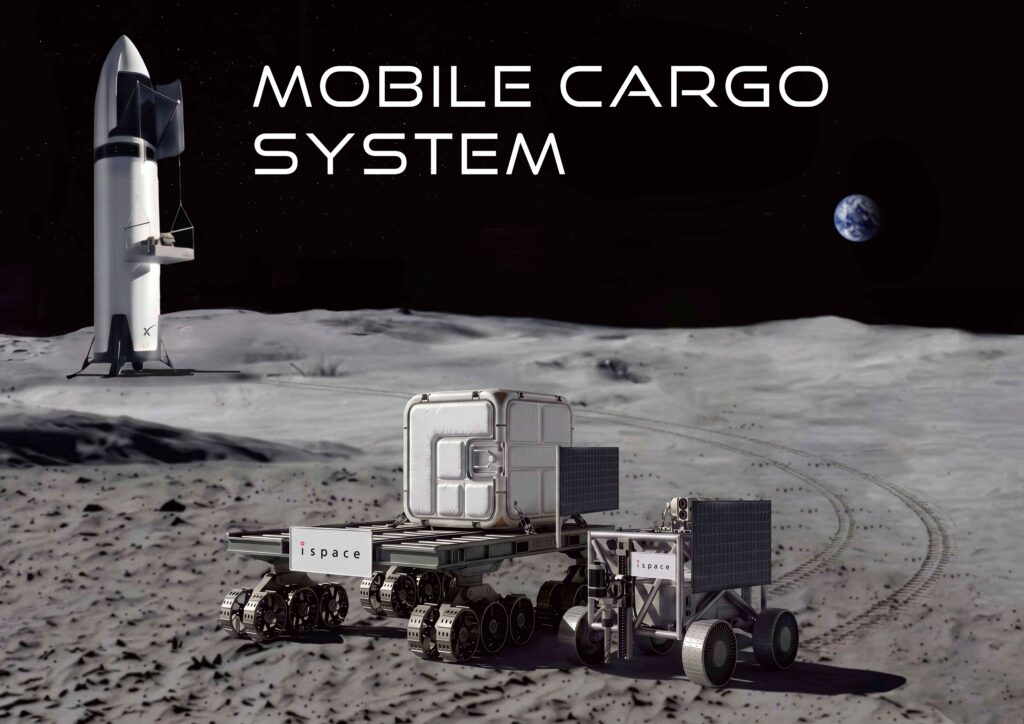
Ispace's mobile cargo system
Click for original.

The Japanese lunar lander startup Ispace yesterday announced it has signed an agreement with SpaceX to use its Starship lunar lander to transport cargo to the Moon’s surface.

The Ispace graphic to the right shows the company’s proposed “Mobile Cargo System” on the Moon after deployment from Starship.

In preparation for the new business offering, Ispace has secured 500 kilograms of payload capacity on Starship, scheduled for launch as early as 2030. Ispace is offering global customers with relatively small payload delivery needs, weighing 500 kilograms or less, a comprehensive service to integrate, transport and operate their payloads on the Moon.

As part of the integration process, Ispace will assess each customer’s payload requirements and implement the quality control necessary for lunar transportation. Ispace will then integrate multiple payloads into the dedicated “Mobile Cargo System” in development by the company and provide services, including interface coordination with Starship as part of the system. Upon landing on the Moon, Ispace aims to provide operational support through the “Mobile Cargo System” to ensure the smooth deployment of payloads onto the lunar surface, their movement across the lunar surface, and access to other infrastructure.

Ispace is clearly hoping this cargo system will be of interest to NASA for its Moonbase project. It is also something that will appeal to other commercial customers who want to get a payload to the Moon cheaply.

Genesis cover

On Christmas Eve 1968 three Americans became the first humans to visit another world. What they did to celebrate was unexpected and profound, and will be remembered throughout all human history. Genesis: the Story of Apollo 8, Robert Zimmerman's classic history of humanity's first journey to another world, tells that story, and it is now available as both an ebook and an audiobook, both with a foreword by Valerie Anders and a new introduction by Robert Zimmerman.

The print edition can be purchased at Amazon or from any other book seller. If you want an autographed copy the price is $60 for the hardback and $45 for the paperback, plus $8 shipping for each. Go here for purchasing details. The ebook is available everywhere for $5.99 (before discount) at amazon, or direct from my ebook publisher, ebookit. If you buy it from ebookit you don't support the big tech companies and the author gets a bigger cut much sooner.


The audiobook is also available at all these vendors, and is also free with a 30-day trial membership to Audible.
 

"Not simply about one mission, [Genesis] is also the history of America's quest for the moon... Zimmerman has done a masterful job of tying disparate events together into a solid account of one of America's greatest human triumphs."--San Antonio Express-News

22 comments

22 comments

  • COL BEAUSABRE

    Wow. It seems to me that the world’s space efforts outside of what might be going on in China is riding on one vehicle made by one company controlled by one man

    Does the type of Master of the Universe sound about right?

    • You build a better mousetrap the world will beat a path to your door.

      The simple solution to this is for others to step up and compete. And I have only been saying this now for thirty years.

    • Jeff Wright

      Dolph Lundgren does have a Master’s degree in chemical engineering… don’t know if he used it against Skeletor….

    • Yngvar

      Intuitive Machines also had nice flat landing sites in their ‘artists impression’. Starship will tip over in most landing attempts.

      • Dick Eagleson

        Well, that’s not going to age well.

      • Nate P

        There’s an implicit assumption here that there will never be landing pads.

      • Curious if anyone has considered lightering loads to and from LLO. Rather than put the expensive part at risk, park in orbit, and have semi-autonomous landers ferry loads in standardized containers. There’s that vertical integration, again. This seems a more adaptable and flexible system, two desirable things when pioneering.

  • Ronaldus Magnus

    Re: Starship will tip over.

    Probably. Then again, science fiction sometimes becomes science fact.

    “”Whatever you can do, or dream you can, begin it. Boldness has genius, power and magic in it. When imagination meets action, the seemingly impossible becomes a reality.””. W. H. MURRAY

    Just imagine SpaceX sending a Starship full of robots to the Moon. They could purposely “crash” (land on its side). The robots could prepare a proper landing sites for the next Starship(s) to land vertical.

    The ultimate: “”If you build it, he will come.””

    • Dick Eagleson

      Probably not. The HLS Starship lander will have self-leveling legs – which have been under test in a giant tent at MacGregor – and can settle onto them gradually while throttling down its landing thrusters. If initial footing proves completely unacceptable, it can just rise a bit, move sideways as required and set down again.

      • COL BEAUSABRE

        A triangle is inherently stable – hence the expression ‘right as a trivet’. So betcha it has three landing tegs

  • GeorgeC

    The thing is that Ispace has real experience and data in an area that SpaceX has not had yet, and that is approaching the Moon and landing on it (hard), and in reviewing what went right and what went wrong. That has got to be worth something.

  • I am curious about Lunar, or, for that matter, any extraterrestrial, property rights. How is that going to work? Does the colonizing entity own the land on which they sit? Are we going to use some version of the ‘township’ system? Is it going to be the New World colonization (without those pesky natives) effort all over again? You take what you can, and keep that which you can defend. My understanding is that the Outer Space Treaty prevents outright ownership of celestial bodies. There seem to be some real serious questions that need to at least be a addressed, before people start plopping habs down everywhere.

    • I have been writing about this issue of property rights now since the 1990s. Most recently I discussed the issue at length in chapter 14 of my last book, Conscious Choice. This quote is key, though there’s a lot more to it:

      The Outer Space Treaty’s ban on national sovereignty prevents [land ownership]. The treaty’s prohibition means that no framework exists for nations to establish safe and secure borders. No colony of any nation will have a secure right to its location, as according to the treaty all other nations have an equal right to the same territory.

      …Without a mechanism for claiming ownership or sovereignty to its lunar base, [nations] would have to use force to guarantee that ownership.

      The last sentence is exactly what is happening now. Both China and the U.S. have every intention of maintaining control over their bases on the Moon, and will brook no interference. They will do it by force, not treaty, because the Outer Space Treaty literally requires it.

      See also my 2017 op-ed for The Federalist: How President Trump Could Jumpstart Space Settlements.

      Also see my 2017 policy paper, Capitalism in Space. I do not discuss the Outer Space Treaty specifically, but emphasize throughout the importance of the government allowing ownership in space by private entities.

      You note these issues need to be addressed. I have been addressing them for decades. The real problem has been that no one listens, or if they do, they don’t want to take action. See for example the swamp’s immediate response in 2017 to Capitalism in Space. It was if they were vampires and I was holding a cross to their face (which may very well be a perfect analogy).

      • Hi Robert,

        Thank you for addressing my comment; but I submit, that the response does not answer the question. While a few (such as yourself) may have addressed the issue; it does not seem to be of importance, yet, where it will matter: e.g. Established Law. I think that promulgating presence before there is a legal framework is putting the cart before the horse. Even the Oklahoma Land Rush, and the opening of Western lands under the auspices of Government-subsidized railroad expansion, had some rules.

        “The seat of purpose is on land.” as Captain Wayne P. Hughes had it. Easily enough translated to the nascent off-world political environment; just trade ‘land’, for Earth, For the foreseeable future, whatever happens Up There will be heavily influenced, and controlled, by Earth-side interests. I don’t think the space industry is quite up to influencing the People’s priorities, but it’s very close. There should be a tipping point where people realize that Space benefits them, too. Then it will be Katy-bar-the-door for a multitude of interests. Better to get ahead of that curve.

      • Edward

        Blair Ivey,
        I think that promulgating presence before there is a legal framework is putting the cart before the horse. Even the Oklahoma Land Rush, and the opening of Western lands under the auspices of Government-subsidized railroad expansion, had some rules.

        Putting the cart before the horse may be necessary. As our host pointed out, no one is doing anything to solve this problem, despite the imminence of permanent lunar bases by both the U.S. and China. Since water ice is one of the expected treasures, property rights and mining rights (including strip mining) will very soon become an issue. If it is not dealt with now, it will be dealt with later.

        Although the Moon is a foreign object, we have plenty of experience on Earth to give us some ideas for how to create property rights. The main problem is the stupidity and shortsightedness of the Outer Space Treaty. Among the problems it creates is the use of space to benefit all mankind. It is a noble goal as stated in the treaty, but the implementation is to forbid property rights and make everything owned by everyone — which ultimately means owned by no one. Due to this stupidity, we have been using space for two-thirds of a century with very little real benefit. The world’s governments, through the treaty, have only given us the benefit of improved weather prediction and little else. Commercial companies (largely government controlled) have given us improved communications, until recently when non-government-controlled private companies got involved and gave us significantly improved communications and we now get some orbital manufacturing.

        The governments of the world have fallen far short of their goal of benefits from space, but the commercial businesses of the world are rapidly correcting that despite the lack of private property ownership in space, so we know that we can get some things done in space under the stupidity of the treaty.

      • I have already noted repeatedly that the U.S. will use the American alliance created by the Artemis Accords to override the Outer Space Treaty. I also presented as proof of the first hints of this in a May 8, 2026 post about Paraguay signing the accords. Isaacman’s comments made it clear he will treat the ground our Moonbase is on as “our” territory.

        Isaacman’s statement yesterday is the first time in years that any NASA official has focused on this issue in any way. Trump originally created the Artemis Accords as a first step to overcome the Outer Space Treaty’s ban on private property in space. The thinking appeared to be: Make a large American alliance that would eventually have the clout to change that ban.

        During the Biden administration that goal was dumped and was replaced with using the accords to encourage global collectivism. It appears Isaacman is very carefully returning to that original goal, laying out the initial political steps for doing what Trump first wanted the accords to accomplish. He is clearly indicating here that the American moon base will function under an American legal framework, even if initially for diplomatic reasons no one will make that obvious.

        This action will eventually I think force the space-faring nations to work out some mutally agreeable system for claiming territory, superseding the Outer Space Treaty. (Think of the deal the Pope imposed on Portugal and Spain for settling the New World.)

    • Dick Eagleson

      The main thing that will work is what has worked immemorially on Earth – possession is nine-tenths of the law.

      As a practical matter, the only two Earthly powers capable of even modest settlement efforts on the Moon are the US and the PRC. No one else has the means or the ability to acquire the means to do so. People of many national origins may eventually travel to, and even reside on, the Moon, but they will do it by buying tickets from US companies and paying rent to US companies, not by trying to stake out and maintain their own lunar infrastructures.

      And the future of PRC efforts of this sort are rendered problematic by that nation’s severe problems, the combination of which will see its collapse as a nation-state well before mid-century. After that, the question of who owns the Moon will be settled. The US will own the Moon until, and unless, its residents decide otherwise.

  • Lambert's Problem

    (For Blair Ivey)

    In an ideal world, a near-ideal world, or an even vaguely ideal-adjacent world, that plan of “settle the law first, then settle the Solar System” would make a lot of sense.

    That ideal world is so far away from our actual reality today, and for the last several decades (since “space law” even became a thing with Sputnik and Vostok and Vanguard and Mercury and Gemini and their later kin), you can’t see a thing credibly like ideal-ity even as a tiny little dot in the distance.

    Before those (late 50s to early-mid 60s) developments, there was a just about perfect vacuum on this — the “right of overflight in orbit” that we take for granted today didn’t even exist. Sputnik could’ve been shot down by any nation it passed over, by the rules of “airspace” — the same for any American or other satellite or vehicle. So, it’s pretty fair to say, the actual history of space law has mostly been catching up with events.

    (That’s why I’m inclined to be generous, by the way, about the 1967 Outer Space Treaty — it dates from the Cold War, Gemini-to-Apollo days; when no one that I’ve ever heard of, outside of genuine visionaries like Konstanin Tsiolkovsky around the turn of the last century, was seriously talking or even visibly thinking about ideas like space colonization.

    By comparison, the arguably-failed Moon Treaty of 1979/1983 is a genuine UN-centric socialism-in-space hot mess. Texts freely available online.)

    Now today, we have a somewhat smaller vacuum, but (exactly as Mr. Zimmerman just pointed out) no framework at all for ever establishing national claims; while the one framework we might’ve had (unilateral, national land claims) has been explicitly ruled out by the Outer Space Treaty since 1967.

    And the Moon Treaty, if we (or indeed any other major spacefaring nation) had ever accepted it, overtly forbids just about any kind of ownership of land off Earth — except implicitly, by its notional ‘international regime’ to be based, apparently, at the UN — so no help there, just a brick wall. (You want to go read its Article 11.3 on that. Assuming you can stomach it.)

    International law is a pretty blunt tool, in the first place, to establish good rules and organization for much of anything. Especially on civil or individual rights — since the ‘individuals’ it deals with are nations, not people. But, in our current sorry situation, it’s likely the best tool we’ve got.

    By my reading, the Artemis Accords (along with the Artemis ‘Alliance’ they create) are an incredibly subtle, clever, incremental and long-term but really sneaky-smart way to ignore the Moon Treaty into irrelevance, creep up slowly but steadily on a situation where international law recognizes and supports something increasingly like national law over pieces of land in space. But it’s not going to happen anything like fast, if it works.

    And the Artemis Accords themselves embody the opposite idea to “law first, then mining/settlement/etc.” From their Section 10.2:

    The Signatories affirm that the extraction of space resources does not inherently constitute national appropriation under Article II of the Outer Space Treaty, and that contracts and other legal instruments relating to space resources should be consistent with that treaty.

    Which sounds an awful lot to me like “mine first, settle the law later” at the very least — and a mining base is just a tiny, possibly-transient space colony. (See also Section 11, “Deconfliction of Space Activities” on the Accords’ ‘safety zones’ — which do look like a work-alike for mining claims, and/or at least temporary site claims for short-term colonies.)

    Finally, actual space-law experts remind us that international law comes, basically, from two sources: treaties and actual practice. Sometimes, the best way to get new international law recognized is to boldly, carefully, light-footedly, and respectfully… Just Do It.

    Preferably in the merry company of several dozen good national friends.

    • COL BEAUSABRE

      Where’s the recruiting office for the Space Commandos?

      ‘The Big Night is my beat and it’s a long and lonely street.’

  • Richard M

    Hello Blair,

    But as you surely must know, there IS an effort underway to create a legal framework for such activity: the Artemis Accords. Properly understood and interpreted, this at least attempts to provide, to some degree, the key advantages of property rights to commercial or state entities attempting to extract and employ material resources in space.

    Granted, it’s not perfect, even with conservative/populist governments interpreting it, and some major players refuse to sign it (China, Russia). In the long term, a major revision or replacement of the OST which provides for formal, enforceable property rights is going to be necessary. But there isn’t any consensus for that yet. A significant, sustained human presence on other worlds (firstly the Moon, to be followed soon after by Mars) will likely be necessary to force the issue. In the mean time, we will have to rely on the Artemis Accords and some reasonable restraint from the Chinese to keep conflicts over resource claims from breaking out in earnest. Fortunately, space is a very big place. That will buy us some time.

    In the meantime, vigilance is needed against actors who demand something like the Antarctic Treaty for all of Outer Space, i.e., look but don’t touch, no economic development whatsoever.

    • “Fortunately, space is a very big place. That will buy us some time”

      Space *is* a big place, but the desirable parts; resources and particular orbits, are not widely spread. Low-hanging fruit will be desirable and contested. Maybe people will respect words on paper; maybe people will follow in the paraphrased words of Charter KKK Grand Wizard Nathan Bedford Forrest; and get there fustest with the mostest.

  • Max

    People colonizing the moon/mars at this point is a novelty. Untell resources are discovered and the technology to extract, manipulate / manufacture, for utilization of a viable colony is demonstrated, then there is no reason to go there. (The ultimate money pit for the billionaire class) on the other hand, if they find gold expect the gold rush… To keep your claim, you must defend your claim.

    Russia and China do not need to sign the Artemis Accords, Civility between nations is necessary inspite of signing a treaty or not. In other words, if they live by the accords, they do not need to sign the accords. Mutual respect the with the offer of neighborly help when in crisis (or the withdrawal of offered help when rights and privileges are violated) will do more to establish an inner connective network a free thinkers exploring novel situations with opportunities to learn from each other for best practices and design which will lead to “free trade” among lunar colony’s! The human community relationship emphasizing commonalities over differences is better then any treaty.

    In the short term, Mars is the easy target, hopefully resources will be discovered there besides the ice caps which makes it a destination choice for a viable future.
    Mercury is as dense as the earth and its most likely to be the manufacturing center of a future inter-solar system community. (also the most difficult /costly to get to… but no environmental concerns to allow easy access to larger ore bodies in low gravity with plenty of solar for energy especially useful in remote locations)
    Any establishment there will have a high military value and will be strongly defended. Any relationships created in the colonies on the moon will determine the outcome of other colonies in other places.
    Europa, Titan, Ganymede, Vista and others will be high priority if mars doesn’t work out. (If the cost is greater than the economic return)
    Ore from the astroid belt will be sent to Vista, if not processed on the ship itself, before being sent to trade centers in lunar orbit. (Earth has its own resources, trade with earth will only be for the exotic goods)

    Quick comment on the artist illustration of SpaceX on the moon. In that form, a landing leg will sink in and the ship will tip over being top-heavy. (just the slosh in the tanks when it “starts to tip” will have a cascade action because of inertia to cause it to continue, no matter how fast the hydraulics try to compensate in low gravity)
    It would not surprise me to learn what SpaceX has in mind for the final concept would be similar to the “Apollo lander” leaving the bulk of the fuel in orbit! No need to bring the extra mass to the surface for convenience… A waste of resources when there’s an economical alternative.
    A squat wide dissent module with the reaction motors above the payload to prevent excessive dust and blow back damage is foolproof. In fact, sci-fi style Jetpacks under computer control… can return the landing motors from the payload to orbit for another cargo box. (spaceX specializes in reusable rockets) it may also be possible for astronauts (after set up and distribution of cargo) to catch a ride back to the orbiting platform individually!

    After a nuclear power plant is established that extracts oxygen/nitrogen/carbon/Iron from the regolith processing, melting the moon dust into glass and poured into meter thick slabs for rocket landing platforms, only then we may see tall rockets on the surface. (Or not)
    Building above ground infrastructure and roads will be low priority compared to tunneling for habitats and ore bodies for needed elements that is too bulky to come from earth. Priorities will come in steps before human occupation… Even tunnels will outgas toxic air /elements making underground habitation undesirable until a barrier can be constructed.
    For visiting other locations, I picture ballistic jumps consuming a little fuel a better alternative to long trips needing food water and air over rough terrain. Even works better for the personal exploration of the moon, to land at your destinations, take your samples and do your surveying measurements, and return to low orbit in a personal backpack lander to refuel for the next trip. (we all know that robots will be performing most of this, human verification of “a find” is not only satisfying, but will fulfill any claim to be registered at the claim office)
    Moon buggies will be for short trips, low gravity recreation, electric car speedway competition racing around circular craters and pirates.

Leave a Reply

Your email address will not be published. Required fields are marked *

Readers: the rules for commenting!

No registration is required. I welcome all opinions, even those that strongly criticize my commentary.

However, name-calling and obscenities will not be tolerated. First time offenders who are new to the site will be warned. Second time offenders or first time offenders who have been here awhile will be suspended for a week. After that, I will ban you. Period.

Note also that first time commenters as well as any comment with more than one link will be placed in moderation for my approval. Be patient, I will get to it.

Formatting buttons insert safe HTML. Links and comments with more than one link will still be moderated.