
More “Fluvial Processes” on Mars

Click for original image.
Cool image time! The picture to the right, cropped, reduced, and sharpened to post here, was taken on June 4, 2026 by the high resolution camera on Mars Reconnaissance Orbiter (MRO).
The scientists label this “Fluvial processes inside crater,” an apt description based not only on the small section of the full image to the right, but on the full image itself. The entire surface of the crater floor’s western end appears filled with glacial material, in many places twisted and warped by past slow motion movements.
I picked out the area in the picture because of its particularly warped nature. It appears as if the material in the higher elevations to the upper right have been flowing downward, and in the process have pushed the glacial debris on the crater floor to the southwest.
It also appears that in the higher locations the near surface ice has been sublimating away, giving the surface a corroded look.
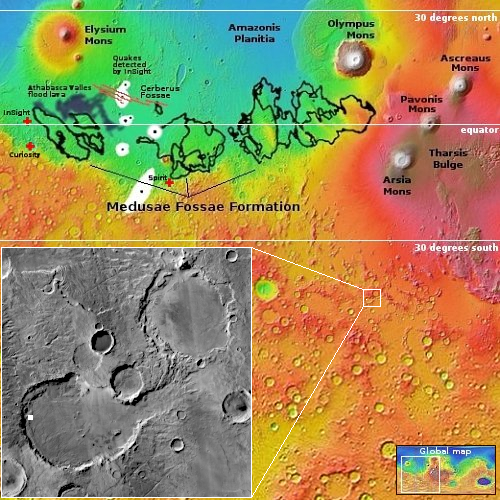
The rectangle on the overview map to the right marks the location, on the southwest edge of the lava flood plains that flowed down from the Tharsis Bulge (where three of Mars’ largest volcanoes are found) and inundated the southern cratered highlands.
The inset shows this location is just inside the western interior rim of a very misshapen 43-mile-wide unnamed crater. The closeness to the rim wall as well as the flow direction away from that wall strongly suggests these “fluvial processes” involved drainage of underground near-surface ice from that wall and down into the crater floor. At present, based on the orbital data we have as well as the corroded nature of the upper levels, these processes are now inactive. The visual evidence also strongly tells us they were active in the past, and could be active again in the future.
More important, the evidence tells us that there is a lot of near surface ice here, at 43 degrees south latitude. Nor is this data point unique. The mid-latitudes of Mars are filled with such features. Only last week I posted similar evidence 560 miles to the west at almost the same exact latitude.
The strange shape of this crater appears to be the result of a string of impacts, with the later smaller impacts occurring to the east and overlapping the first and largest.

On Christmas Eve 1968 three Americans became the first humans to visit another world. What they did to celebrate was unexpected and profound, and will be remembered throughout all human history. Genesis: the Story of Apollo 8, Robert Zimmerman's classic history of humanity's first journey to another world, tells that story, and it is now available as both an ebook and an audiobook, both with a foreword by Valerie Anders and a new introduction by Robert Zimmerman.
The print edition can be purchased at Amazon or from any other book seller. If you want an autographed copy the price is $60 for the hardback and $45 for the paperback, plus $8 shipping for each. Go here for purchasing details. The ebook is available everywhere for $5.99 (before discount) at amazon, or direct from my ebook publisher, ebookit. If you buy it from ebookit you don't support the big tech companies and the author gets a bigger cut much sooner.
The audiobook is also available at all these vendors, and is also free with a 30-day trial membership to Audible.
"Not simply about one mission, [Genesis] is also the history of America's quest for the moon... Zimmerman has done a masterful job of tying disparate events together into a solid account of one of America's greatest human triumphs."--San Antonio Express-News
The Mars pictures are my favorite thing you do. Thank you!