
Scientist use Juno to get first below surface temperature reading of Jupiter’s moon Io
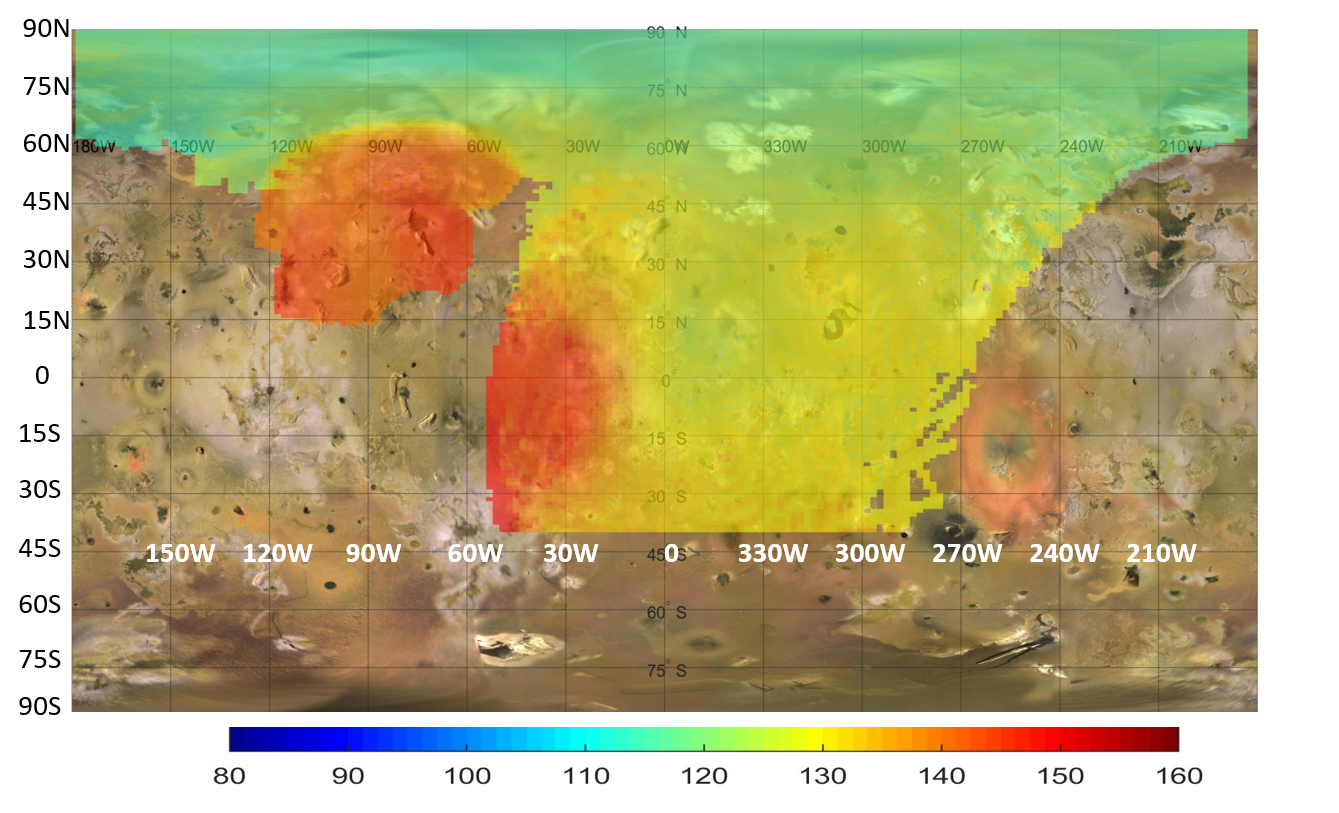
Global map of Io’s temperature, just below the surface.
Click for original.
Using data obtained during two fly-bys of Jupiter’s volcanic moon Io, scientists have now been able to measure for the first time the temperature up to ten to thirty feet below the surface.
The global map to the right, Figure 9 from their paper, shows the range of temperatures detected. Io is known for its many active volcanoes, generated by the tidal heat created by Jupiter’s gravitational pull.
During flybys on Dec. 30, 2023, and Feb. 3, 2024, the solar-powered Juno spacecraft came within about 930 miles (1,500 kilometers) of the moon’s surface. “The instrument measured Io’s thermal emission at depths ranging from a few inches down to tens of feet. Everywhere we looked, we found the temperature rising by more than 40 degrees Fahrenheit just several feet into the surface — a gradient far steeper than solar heating alone can explain,” said Shannon Brown, the paper’s lead author at NASA’s Jet Propulsion Laboratory in Southern California.
The data suggests two possible explanations. First, heat could be rising steadily through a conductive crust. While this background heat flow — measured at 1 to 3 watts per square meter — is relatively gentle on a local scale (roughly equivalent to a small nightlight glowing under every square yard), across the entire moon it represents a release of energy up to 30 times Earth’s average.
Alternatively, the signal could be coming from cooling lava flows, capped by roughly 30 to 35 feet (9 to 11 meters) of solidified crust, that cover about 10% of the moon’s surface at any given time.
The data also suggested that between Io’s volcanic mountains the rest of the planet is remarkable smooth, like the Great Plains of the U.S. That smoothness is not surprising, as it is probably the result of numerous flood lava events that have coated the surface.

On Christmas Eve 1968 three Americans became the first humans to visit another world. What they did to celebrate was unexpected and profound, and will be remembered throughout all human history. Genesis: the Story of Apollo 8, Robert Zimmerman's classic history of humanity's first journey to another world, tells that story, and it is now available as both an ebook and an audiobook, both with a foreword by Valerie Anders and a new introduction by Robert Zimmerman.
The print edition can be purchased at Amazon or from any other book seller. If you want an autographed copy the price is $60 for the hardback and $45 for the paperback, plus $8 shipping for each. Go here for purchasing details. The ebook is available everywhere for $5.99 (before discount) at amazon, or direct from my ebook publisher, ebookit. If you buy it from ebookit you don't support the big tech companies and the author gets a bigger cut much sooner.
The audiobook is also available at all these vendors, and is also free with a 30-day trial membership to Audible.
"Not simply about one mission, [Genesis] is also the history of America's quest for the moon... Zimmerman has done a masterful job of tying disparate events together into a solid account of one of America's greatest human triumphs."--San Antonio Express-News