
Starfish finally gets a docking target for its Otter Pup 2 orbital tug demo
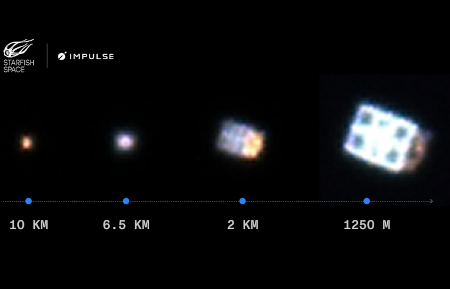
Images taken by Starfish’s camera on Impulse mission
in December 2025.
The orbital tug company Starfish Space has finally found a docking target for its Otter Pup 2 orbital tug demo satellite that has been in orbit since 2025. Otter Pup 2 was originally supposed to dock with D-Orbit’s ION satellite, but for unknown reasons that docking was cancelled. Since then Otter Pup 2 has remained in orbit as the company searched for an alternative target.
It has now made a deal with the Australian rocket startup Gilmour Space to use its own first demo satellite, ElaraSat.
Over the past couple of months, the Starfish team has been maneuvering Otter Pup 2 into the proper orbit to catch up with ElaraSat. The next phase will be to close the gap between the two satellites to about 6 miles (10 kilometers). Then Otter Pup 2 will transition into an acquisition phase. “Acquisition is the stage for us where Otter Pup’s onboard cameras start taking pictures of a large satellite regularly — lock onto it, if you will — and start maneuvering much, much closer,” Bennett said. “This is what will bring us down to the kilometer-type range.”
Otter Pup 2 will fly itself around ElaraSat for a thorough inspection and calibration of Otter Pup’s sensors and control system. Then the satellite will close in to attach itself to ElaraSat using an electrostatic docking mechanism.
The company’s goal is to demonstrate the practicality of that “electrostatic docking mechanism” so as to encourage as many satellite makers as possible to use it. Apparently Gilmour had agreed to do so on ElaraSat before launch, allowing for this switch when D-Orbit backed out.
On another mission in 2025 Starfish demonstrated that its software and camera design for rendezvous and proximity maneuvers works, as shown by the image above. On that mission this equipment was installed on a Mira orbital tug, built by Impulse Space, and was used to maneuver within 4,100 feet of another Mira tug.
As competitive as free enterprise normally is, note the amount of cooperation between multiple orbital tug and satellite companies, including Starfish, Impulse, and Gilmour. It proves that if a company can demonstrate it has a product of value, others — even its competitors — will be willing to buy it.

On Christmas Eve 1968 three Americans became the first humans to visit another world. What they did to celebrate was unexpected and profound, and will be remembered throughout all human history. Genesis: the Story of Apollo 8, Robert Zimmerman's classic history of humanity's first journey to another world, tells that story, and it is now available as both an ebook and an audiobook, both with a foreword by Valerie Anders and a new introduction by Robert Zimmerman.
The print edition can be purchased at Amazon or from any other book seller. If you want an autographed copy the price is $60 for the hardback and $45 for the paperback, plus $8 shipping for each. Go here for purchasing details. The ebook is available everywhere for $5.99 (before discount) at amazon, or direct from my ebook publisher, ebookit. If you buy it from ebookit you don't support the big tech companies and the author gets a bigger cut much sooner.
The audiobook is also available at all these vendors, and is also free with a 30-day trial membership to Audible.
"Not simply about one mission, [Genesis] is also the history of America's quest for the moon... Zimmerman has done a masterful job of tying disparate events together into a solid account of one of America's greatest human triumphs."--San Antonio Express-News