
The geology of the Moon’s far side, revealed in pictures taken during Artemis-2
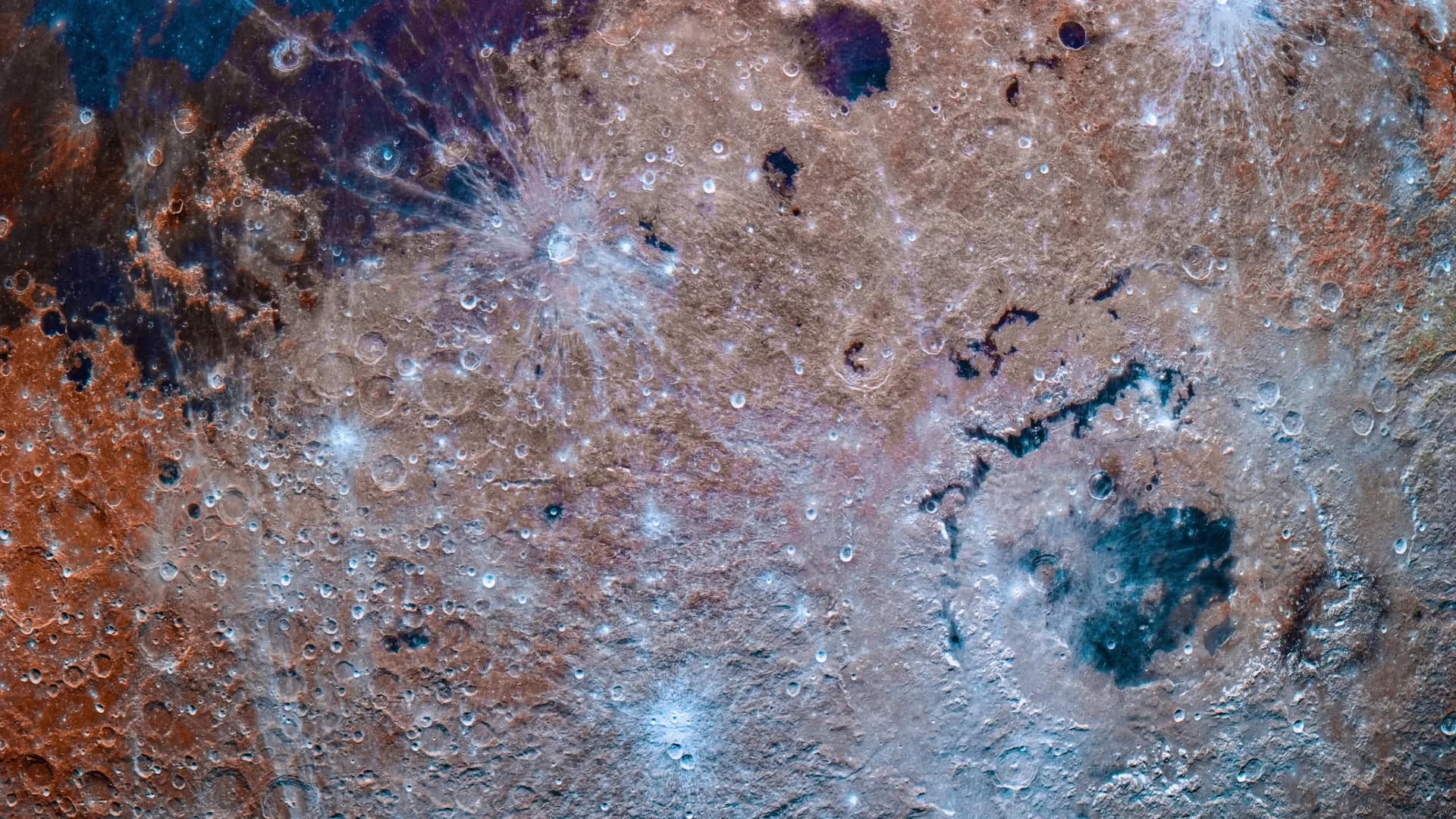
A sample of Andrew McCarthy’s work. Click for original.
When Artemis-2 commander Reid Wiseman took pictures as his Orion capsule swung around the far side of the Moon, he did so as per the instructions of astrophotographer Andrew McCarthy, thus producing enhanced-color photographs capable of distinguishing the lunar geology with more detail.
Astrophotographer Andrew McCarthy is known for turning the moon into something it decidedly isn’t to the naked eye; a colorful, mineral-rich landscape that looks more like a geological survey than the grey orb hanging in the night sky. His technique relies on stacking hundreds or thousands of images together to suppress noise and amplify the subtle spectroscopic differences between different surface materials. The result is both scientifically accurate and visually arresting.
Linking up with ArtemisAs Space.com details, just weeks before the Artemis II launch window, McCarthy DM’d mission commander and NASA astronaut Reid Wiseman with a proposal: could Wiseman shoot the moon the same way McCarthy shoots the moon? It turns out he could. “He was immediately onboard,” McCarthy said. “It was a dream come true, obviously, for me, but I saw it as this very unique opportunity.”
McCarthy worked up a plan alongside Wiseman and NASA’s lunar photography team, the same group that had trained the Orion crew on their camera kit. As regular readers will already know, the primary workhorse was a Nikon D5 DSLR paired with an 80–400 mm Nikkor lens, a decade-old body chosen specifically for its exceptional high-ISO performance. Wiseman shot burst sequences at varying exposures throughout the flyby, generating a dataset McCarthy could stack back on Earth.
The picture to the right is a small sample of McCarthy’s work.
Hat tip to reader Ferris Akel.

On Christmas Eve 1968 three Americans became the first humans to visit another world. What they did to celebrate was unexpected and profound, and will be remembered throughout all human history. Genesis: the Story of Apollo 8, Robert Zimmerman's classic history of humanity's first journey to another world, tells that story, and it is now available as both an ebook and an audiobook, both with a foreword by Valerie Anders and a new introduction by Robert Zimmerman.
The print edition can be purchased at Amazon or from any other book seller. If you want an autographed copy the price is $60 for the hardback and $45 for the paperback, plus $8 shipping for each. Go here for purchasing details. The ebook is available everywhere for $5.99 (before discount) at amazon, or direct from my ebook publisher, ebookit. If you buy it from ebookit you don't support the big tech companies and the author gets a bigger cut much sooner.
The audiobook is also available at all these vendors, and is also free with a 30-day trial membership to Audible.
"Not simply about one mission, [Genesis] is also the history of America's quest for the moon... Zimmerman has done a masterful job of tying disparate events together into a solid account of one of America's greatest human triumphs."--San Antonio Express-News