Rick Beato – The Real Reason Why Music Is Getting Worse
An evening pause: His conclusions have implications far beyond music itself and on the entire worsening of our culture.
Hat tip Chris McLaughlin.
An evening pause: His conclusions have implications far beyond music itself and on the entire worsening of our culture.
Hat tip Chris McLaughlin.
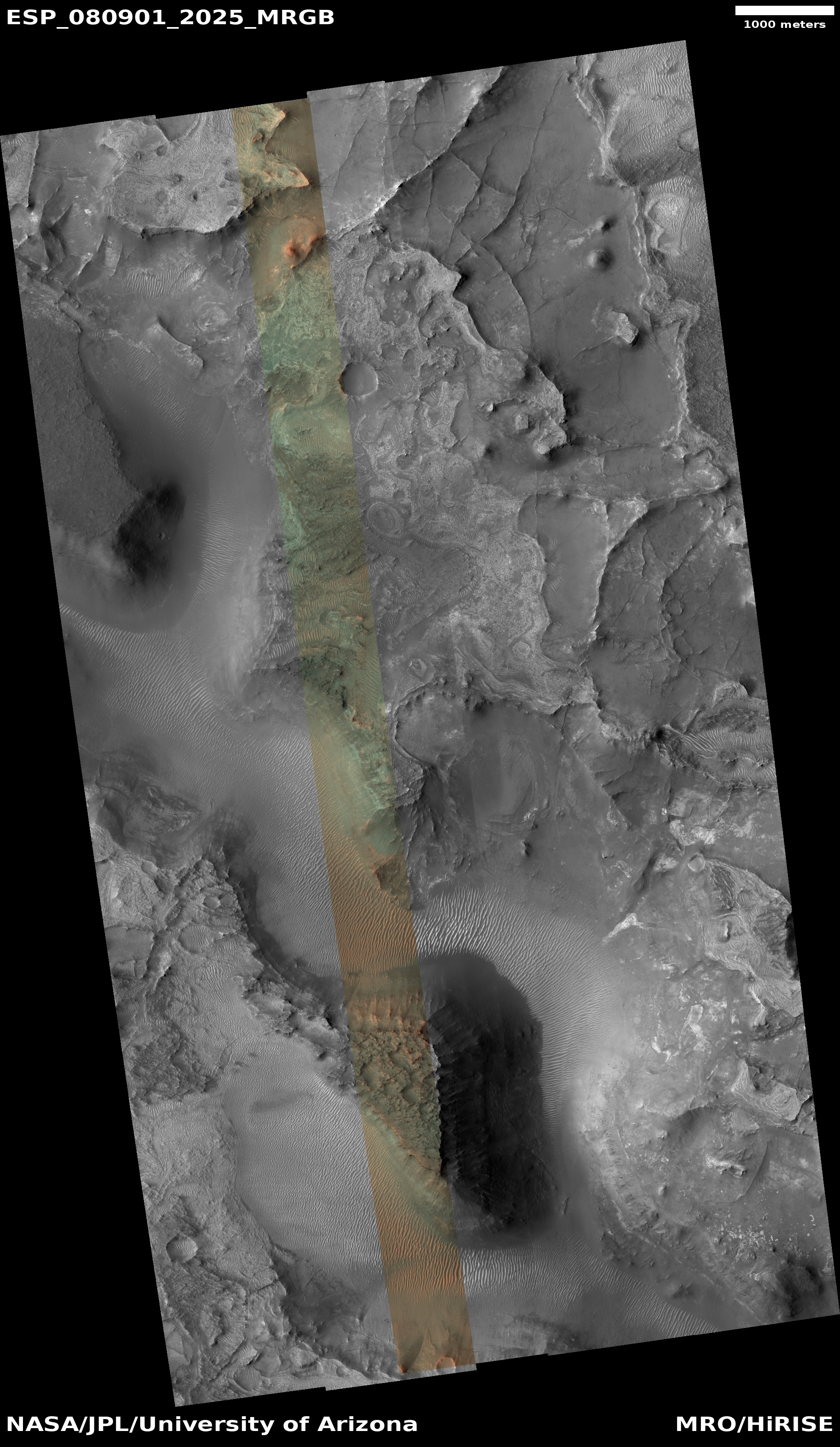
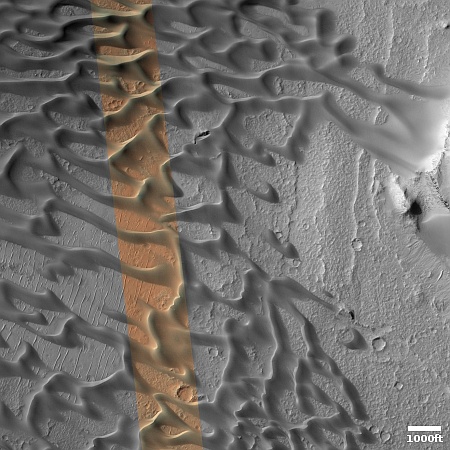
Today’s cool image is another example of what I call a “What the heck!” image. The picture to the right, simply cropped to post here, was taken on September 22, 2024 by the high resolution camera on Mars Reconnaissance Orbiter (MRO).
It shows what the scientists label as “etched terrain,” an incredibly twisted and eroded landscape that to me actually defies description. In trying to research what scientists have learned and theorized about this terrain, it appears they think it is material that flowed over older terrain (thus its lack of many craters) that was subsequently eroded by later processes.
Why it eroded so strangely however is not really understood. It could have been caused by near-surface ice sublimated to the surface and thus causing many breaks, but since this terrain is located right on the equator in the dry tropics, it is a very long time since water was present here.
» Read more
Time for two cool images of the same galaxy! The picture above shows the Sombrero Galaxy as taken by the Hubble Space Telescope in 2003. The picture below is that same galaxy as seen by the Webb Space Telescope in the mid-infrared using false colors. From the press release:
In Webb’s mid-infrared view of the Sombrero galaxy, also known as Messier 104 (M104), the signature, glowing core seen in visible-light images does not shine, and instead a smooth inner disk is revealed. The sharp resolution of Webb’s MIRI (Mid-Infrared Instrument) also brings into focus details of the galaxy’s outer ring, providing insights into how the dust, an essential building block for astronomical objects in the universe, is distributed. The galaxy’s outer ring, which appeared smooth like a blanket in imaging from NASA’s retired Spitzer Space Telescope, shows intricate clumps in the infrared for the first time.
Researchers say the clumpy nature of the dust, where MIRI detects carbon-containing molecules called polycyclic aromatic hydrocarbons, can indicate the presence of young star-forming regions. However, unlike some galaxies studied with Webb … the Sombrero galaxy is not a particular hotbed of star formation. The rings of the Sombrero galaxy produce less than one solar mass of stars per year, in comparison to the Milky Way’s roughly two solar masses a year. Even the supermassive black hole, also known as an active galactic nucleus, at the center of the Sombrero galaxy is rather docile, even at a hefty 9-billion-solar masses. It’s classified as a low luminosity active galactic nucleus, slowly snacking on infalling material from the galaxy, while sending off a bright, relatively small, jet.
In infrared the galaxy’s middle bulge of stars practically vanishes, exposing the weak star-forming regions along galaxy’s disk.
Both images illustrate the challenge the universe presents us in understanding it. Basic facts are often and in fact almost always not evident to the naked eye. We always need to look deeper, in ways that at first do not seem obvious. This is why it is always dangerous to theorize with certainty any explanation too soon, as later data will always change that explanation. You can come up with an hypothesis, but you should always add the caveat that you really don’t know.
By the way, this concept applies not just to science. Having absolute certainty in anything will almost always cause you to look like a fool later. Better to always question yourself, because that will make it easier for you to find a better answer, sooner.
We need only look at the idiotic “mainstream press” during the months leading up to the November election to have an example of someone with certainty who is now exposed as an obvious fool.
According to a media update from NASA yesterday, Firefly’s Blue Ghost lunar lander now targeting mid-January launch window for its unmanned mission to the Moon.
A six-day launch window opens no earlier than mid-January 2025 for the first Firefly Aerospace launch to the lunar surface.
The Blue Ghost flight, carrying 10 NASA science and technology instruments, will launch on a SpaceX Falcon 9 rocket from Launch Complex 39A at the agency’s Kennedy Space Center in Florida. Media prelaunch and launch activities will take place at NASA Kennedy.
The first quarter of 2025 will be a busy time for unmanned missions to the Moon. In addition to Firefly’s mission, the American startup Intuitive Machines also hopes to launch its Athena lander to the Moon’s south pole in February. Though it will launch after Blue Ghost, it will get to the Moon first, as it is taking a more direct week-long route compared to Blue Ghost’s 45-day journey. In addition, the Japanese company Ispace is targeting its own January launch for its Resilience lander.
If all three lift off as planned, there will be three landers heading for the Moon in early 2025.
For the second time in a row an engine for Japan’s new Epsilon-S rocket has exploded during a static fire test.
The test was conducted inside of the restricted area at Japan’s Tanegashima Space Center in southwestern Japan, and the Japan Aerospace Exploration Agency is investigating, Chief Cabinet Secretary Yoshimasa Hayashi told reporters.
An Epsilon project manager, Takayuki Imoto, told an online press conference from Tanegashina that the explosion occurred 49 seconds into the planned two-minute test, causing fire and scattering broken parts of the engine and damaging the facility.
The Epsilon-S is being built by Japan’s space agency JAXA. It is intended to replace the solid-fueled Epsilon rocket that was initially conceived in 2013 to lower launch costs and provide JAXA with a rocket that could complete with the many new smallsat rocket startups worldwide. That rocket however only launched six times and never achieved its goals. JAXA had been targeting March for the first launch of Epsilon-S, but that is now unlikely, especially considering these two engine failures during tests.
Now that France’s space agency CNES has taken the management of its French Guiana spaceport back from the European Space Agency’s Arianespace government company, it has been moving to make the spaceport more attractive to multiple future launch customers. Previously it announced that it is offering launchpads to multiple new rocket startups. Now it has announced that has signed a contract with the French startup Optus Aerospace to reopen its closed suborbital launchpad for the first time in decades.
Officially inaugurated in 1968, the Ensemble de Lancement Fusées-Sondes (ELFS) launch complex hosted the Guiana Space Centre’s first launch on 9 April 1968, with a Véronique sounding rocket that reached an altitude of 113 kilometres. Between 1968 and 1992, more than 350 sounding rockets were launched from the facility.
On 25 November, CNES announced that it had signed a contract with Opus Aerospace to use the ELFS facility for the launch of its Mésange rocket.
In other words, under the control of a government entity, Arianespace, which also controlled all European launches for decades, the variety of launches declined. As soon as control was lifted from this government monopoly however the possibilities expanded quickly.
NASA yesterday announced that it has awarded the launch contract for sending its Dragonfly mission to Titan to SpaceX’s Falcon Heavy rocket.
The firm-fixed-price contract has a value of approximately $256.6 million, which includes launch services and other mission related costs. The Dragonfly mission currently has a targeted launch period from July 5, 2028, to July 25, 2028, on a SpaceX Falcon Heavy rocket from Launch Complex 39A at NASA’s Kennedy Space Center in Florida.
Dragonfly is a truly cutting edge mission. Though we have relatively limited information about Titan’s atmosphere and the environment on its surface, it will attempt to fly there like a helicopter, landing and taking off multiple times.
And though there are certainly additional costs required for such a mission, that quarter-billion dollar contract price probably triples what it normally costs SpaceX for a Falcon Heavy mission. Even if it requires the expending of all three first stages, the company is almost certainly getting a big windfall from this deal.
An evening pause: Performed live 1968 on the Smothers Brothers television show. Nicely performed but it is still the typical self-righteous tripe from the baby boom generation.
Hat tip Judd Clark.
Courtesy of BtB’s stringer Jay. This post is also an open thread. I welcome my readers to post any comments or additional links relating to any space issues, even if unrelated to the links below.

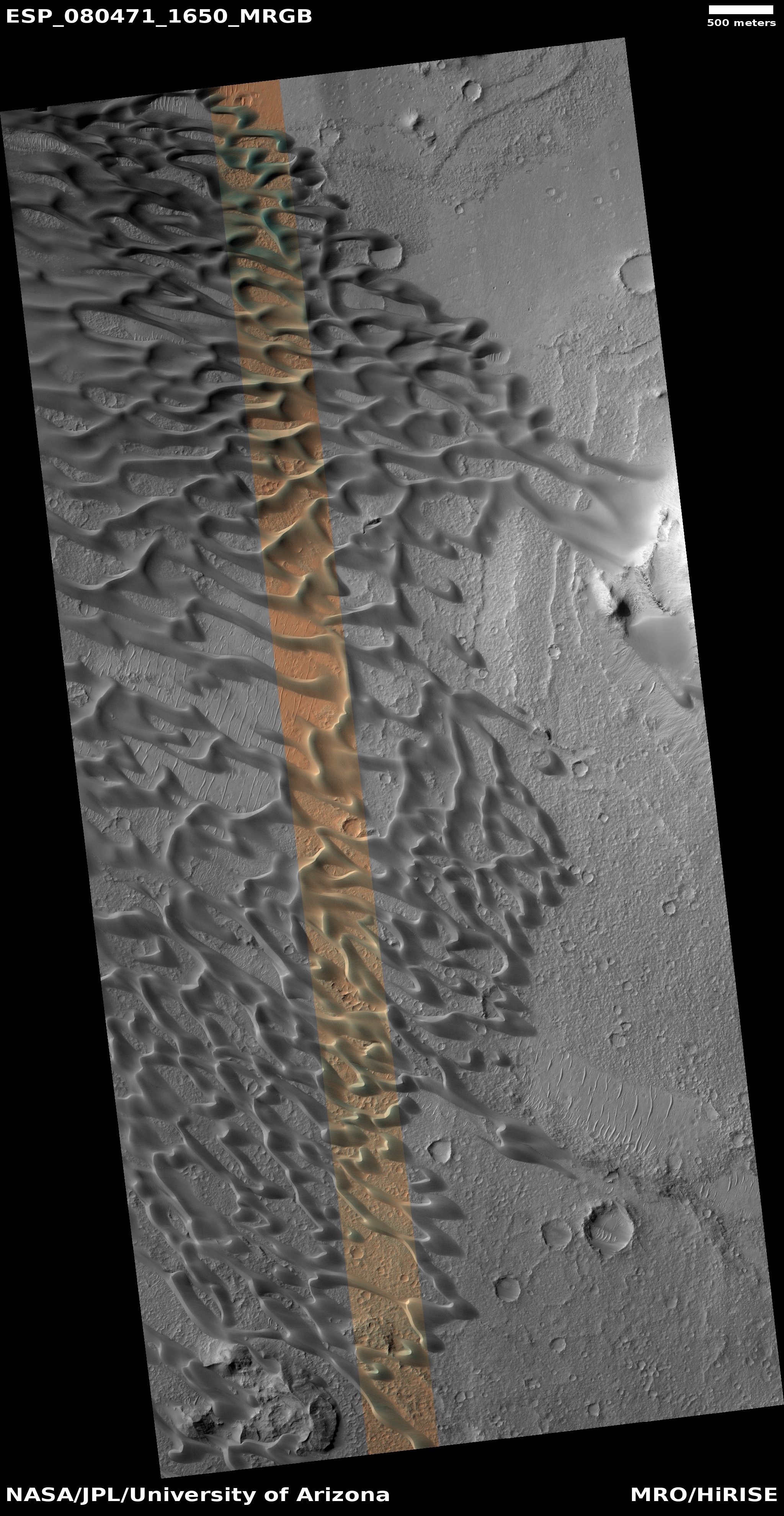
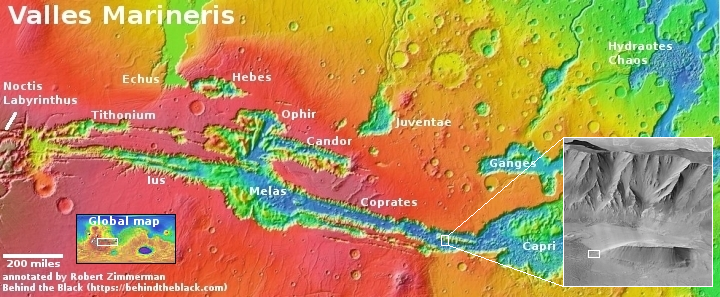
Cool image time! The picture to the right, cropped, reduced, and sharpened to post here, was taken on July 9, 2024 by the high resolution camera on Mars Reconnaissance Orbiter (MRO). The white dot on the overview map above marks the location, inside the deep enclosed and very large 130-mile-wide depression dubbed Juventae Chasma.
The mountain in the picture raises above the sand sea that surrounds it from 1,000 to 2,300 feet, depending on direction, as the downhill grade of the sand sea is to the east. Thus, on the west the mountain rises less, while on the east the height is the greatest.
The inset illustrates the extent of the sand sea. It covers the ground for many miles in all directions. The way the sand surrounds these mountains suggests the prevailing winds blow from the west to the east. In fact, the facts suggest that this sand is volcanic ash that was blown into Juventae from many eruptions that occurred over time to the west, where it got trapped. The wind and gravity deposited the sand into the 20,000 to 25,000-foot-deep chasm, where the wind was insufficient to lift it out again.
One wonders how deep that sand sea might be. The lack of any surface features at all suggests it could be quite deep, burying everything but the highest peaks. In fact, if a geologist could drill a core through that sand I suspect he or she might be able to document the entire eruption history of much of Mars.
Italy has now decided to re-open its long unused San Marco spaceport facility off the coast of Kenya, resuming launches from its off-shore launch platform.
During its active life beginning in 1967 a total of eight launches occurred from this site, with the last flight occurring in 1988.
In late 2023, the Minister of Enterprise and Made in Italy, Adolfo Urso, first proposed reopening the facility for rocket launches. While unsubstantiated by other sources, local publication MalindiKenya.net reported at the time that the move would be used to create an “ideal launch base for the Italian Vega launcher, thus avoiding paying France for the use of the French Guiana base.”
In October 2024, during a presentation just before the 75th International Astronautical Congress kicked off, Minister Urso explained that the country had decided to move ahead with its plans to once again launch rockets from the Luigi Broglio Space Center.
The present plans will have the site managed by the Kenya Space Agency, established in 2017, with Italy providing the rockets and satellites, all of which are expected to be smallsats. It appears that the rocket company Avio, which builds the Vega-C rocket, might be aiming to use this site as an commercial launchpad, thus allowing it to bypass the French-run French Guiana spaceport. Located close to the equator and on the coast, this site would offer satellite companies a very wide range of orbits.
The past twelve hours was quite busy at spaceports worldwide, with two American companies completing three different launches from three different spaceports, while China added one of its own.
First China launched two radar-mapping satellites, its Long March 2C rocket lifting off from its Jiuquan spaceport in northwest China. No word on where its lower stages, that use very toxic hypergolic fuels, crashed inside China. Though this launch was first, it actually took place in the early morning of November 25th, in China.
Next, Rocket Lab completed two launches, though one was not an orbital flight. First it completed its second of four planned launches of its HASTE suborbital version of its Electron rocket, lifting off from Wallops Island in Virgina. HASTE had been quickly improvised by the company when it realized there was a real market for hypersonic suborbital testing, and Electron could be refitted for that purpose. This launch actually occurred prior to the Chinese launch.
Then Rocket Lab launched five more satellites for the satellite company Kineis, the third of five, its Electron rocket lifting off from one of its two launchpads in New Zealand.
Finally, SpaceX in the early morning of November 25th launched 23 Starlink satellites, its Falcon 9 rocket lifting off from Cape Canaveral in Florida. The first stage completed its thirteenth flight, landing on a drone ship in the Atlantic.
The leaders in the 2024 launch race:
121 SpaceX
54 China
14 Russia
13 Rocket Lab
American private enterprise now leads the rest of the world combined in successful launches 140 to 81, while SpaceX by itself leads the entire world, including American companies, 121 to 100.