
The progressive “climate of hate:” An illustrated primer, 2000-2010
Want to tone down the rhetoric? Maybe the left should look at itself: The progressive “climate of hate:” An illustrated primer, 2000-2010.
Want to tone down the rhetoric? Maybe the left should look at itself: The progressive “climate of hate:” An illustrated primer, 2000-2010.
The shooting in Tucson might cause NASA to drop Congresswoman Giffords’ husband as commander of Endeavour’s last mission this spring.
An evening pause: Projected in a museum in Vienna.
Russian scientists are about to drill into Lake Vostok, a lake buried for the last 14 million years beneath the almost two and a half mile thick Antarctic icecap.
The next time someone begins ranting about how the money from “big oil” is used to attack the science of global warming, tell them to take a look at this post, which outlines in detail the more than $2 billion that the U.S. government plans to spend on climate change research in 2011 alone (too much of which is unfortunately used by partisans like James Hansen to try to prove the Earth is warming).
Here are two links that I think are worth reading in connection with the aftermath of yesterday’s tragic shootings in Tucson:
Two sicknesses on display in Arizona.
Disgusting partisanship on display after shooting.
Above all, these murders are horrible and a terrible tragedy. For anyone from either party to try to make political gain from them is beyond despicable.
I should also note that, unlike most Islamic terrorists attacks where either no one in the Muslim community protests while many Muslim leaders express joy or agreement with the violence, I can find no one who is happy about yesterday’s murders. The general response from across the American political spectrum is horror and agony. Such things are wrong and should not happen. It is this distinction that separates Western culture from modern Islam. Until the Islamic community finally stands up to its medieval bullies, I will continue to consider it a threat to civilization and freedom.
An evening pause:
In a paper published today in Geophysical Research Letters of the American Geophysical Union, scientists describe how they have been able to produce remarkably detailed images of the ground buried almost a mile under the ice sheet of Greenland. These radar techniques are the same used in the past by spacecraft to image the hidden surface of Venus, only far more sophisticated.
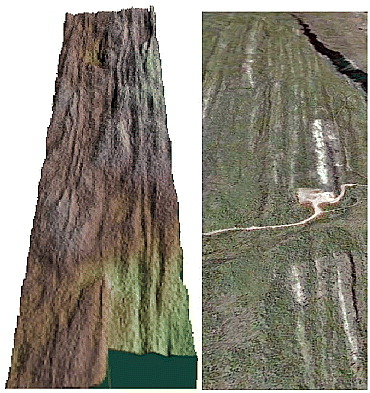
This image from the paper compares the radar image of the Greenland surface (on the left) to an photograph of a known surface feature in the Northwest Territories of Canada, produced thousands of years ago by the giant icesheets of the last Ice Age. Both are at the same scale, about a third of a mile across, and are looking at the surface at an oblique angle of about 45 degrees. With the radar-produced image on the left, sunlight is simulated as coming from the right, with the elevation increasing as the colors go from green (lowest) to yellow to brown to purple (highest).
The long grooves, generally 30 to 100 feet deep and extending sometimes several miles, are produced as the icesheet slides across the ground. In the radar image, however, these grooves are slowly being ground out now.
It is the resolution of this technique that is so exciting. That they can look through ice almost a mile thick and resolve objects that are only tens of feet across tells me that someday it will be possible for spacecraft to map the smallest features on the surface of Venus or Titan. More exciting, this suggests that the technology will one day exist to even map the unknown surface of gas giants like Jupiter or Saturn, and do it in breathtaking detail.
Yowza!
What does this tell us about the quality of his journalism degree? A freelance writer and journalism graduate of Columbia University has been caught fabricating material for an article in the Village Voice.
From Watts Up With That: Data from the Argos ocean floats says that the Earth’s climate, as measured by the heat content of the ocean, has been cooling since 2001, not warming as predicted by climate models. You can download the actual science paper, “The Energy Balance of Earth,” here.