
A Croatian space mission to the Moon?
A Croatian space mission to the Moon?
A Croatian space mission to the Moon?
Bad news for the space shuttle: The root cause of the cracks on Discovery’s external tank is still not identified.
After more than seven months in orbit, the unmanned X-37B space plan has successfully returned to Earth. Key quote:
“Boeing and the Air Force are building another X-37B vehicle scheduled for launch in the spring of 2011.”
Update: Since several different reports are listing slightly different totals for the number of days in orbit, I’ve edited my note above to be less precise. I could add up the days myself, but that involves more math than I prefer to do!
And damn, do I want to rappel into them!
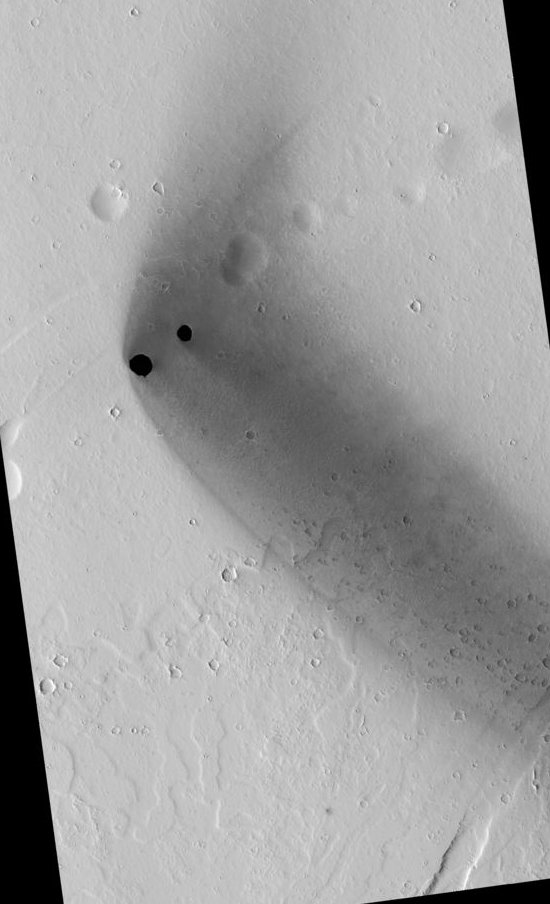
This week’s release of images from the HiRISE camera on Mars Reconnaissance Orbiter included these spectacular photos of two deep pits, approximately 180 and 310 meters in diameter and located aligned with a series of depressions that suggest additional passages at their base.
The first image shows the pits in the context of the surrounding terrain. From the caption:
These pits are aligned with what appears to be larger, degraded depressions. The wispy deposit may consist of dark material that has been either blown out of the pits or from some other source and scattered about by the local winds.
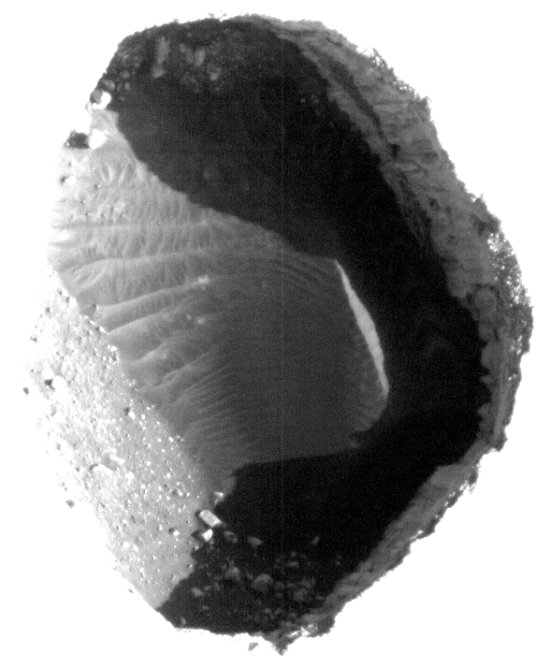
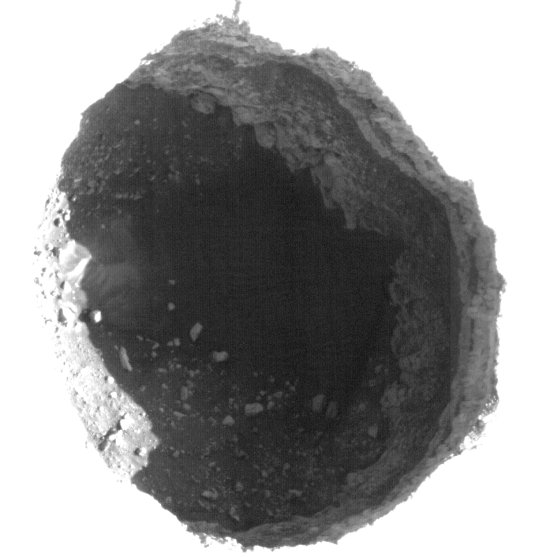
The next two images are heavily processed close-ups of each pit in order to bring out the detail within. From the caption:
The eastern most and smaller of the two pits contains boulders and sediment along its walls and brighter aeolian dune sediments on its floor. The larger, western most pit contains sediment and boulders with faint dune-like patterns visible on the deepest part of the floor. Both pits have steep eastern walls and more gently sloped western walls that transition gradually into the pit floor. Steep resistant ledges containing boulders that overhang and obscure the pit floors form the eastern walls.
An evening pause:
White House initiates a study on whether astronaut corps should be trimmed.
This story is more evidence that I was right when I said Obama was lying when he claimed he loved manned spaceflight. If he was serious about sending humans to asteroids and beyond, he wouldn’t be so eager to find ways to shrink the astronaut corp.
Update: I should emphasize that I am not criticizing the idea of trimming the astronaut corp. I just want it clear that Barack Obama is clearly not a supporter of manned space, and that I believe his proposals (the commercial space subsidies) are merely window-dressing to placate his opponents while he dismantles the program.
More TSA abuse: A woman strips down to her lingerie and still gets a TSA pat down. And it happens twice, the first time forcing her to miss her flight!
The pigs are everywhere! Members of the so-called Tea Party Caucus requested about one billion in earmarks during the now ending 111th Congress.
Who needs laws when you can simply regulate? The EPA moves to bypass Congress.
A commenter to one of my other posts, ZZMike, asked this question today: ” What is NASA’s Secret Astrobiology Announcement?” and quoted this from another website, “Science fans across the Internet are eagerly awaiting an announcement from NASA’s astrobiology team. All NASA will say about the press conference is that it will “discuss an astrobiology finding that will impact the search for evidence of extraterrestrial life.”
Unfortunately, Mike, this great discovery is not the big news that everyone is hoping for, such as the discovery of life on Mars. Instead, it is about the discovery that a certain microbe can eat and digest arsenic, using it as one of the six vital basic components of life (carbon, hydrogen, nitrogen, oxygen, sulfur, phosphorus) in place of phosphorus. This is very significant since it tells us that alien life could very well be far more alien than previously imagined.
What makes this story interesting, however, is not the discovery itself (which is important). Instead, because NASA was so vague in its press announcement it allowed a large number of irresponsible reporters and bloggers to go nuts trying to guess what the story was about. When these rumors began to get out of control, the magazine Science finally sent out a notice to journalists noting the specific paper and discovery so that they at least would know in advance what the conference was about.
As Mike above as well as several other people noted to me in emails, I had written nothing about this story on behindtheblack. This was intentional. Without knowing what the conference was about, I wasn’t going to speculate about it. Once I knew, I still remained silent because the story was under embargo by Science and I respect these embargos. Now that the embargo has been lifted, I can speak.
What I want to speak about is the danger of speculation, especially among journalists. This is a serious problem today. Too often journalists speculate off the cuff, without knowing a goddamn thing about the subject, And all too often, they are downright wrong, and help contribute to misinforming the public. The result: the field of journalism has a terrible reputation with the public. No one trusts what journalists tell us. Worse, this lack of trust is helping fuel the ignorance and anger that seems to be rising in society, as no one knows what to believe about some of the most important issues of our time.
Journalists need to stop doing this. Rather than fantasize what they don’t know, journalists need to focus on what they do know. If they do that, they will significantly help repair the sagging reputation of their field.
Sierra Nevada, one of the new aerospace companies competing for NASA’s commercial crew money, appears to be the frontrunner to use the two X-34 suborbital rockets recently taken out of storage.
The telescope in an airplane flew its first observation mission today.