
Beth Hart – Jazz Man
An evening pause: The studio this was recorded in was once a church, and that apparently gave Hart some extra inspiration.
Hat tip John Jossy.
An evening pause: The studio this was recorded in was once a church, and that apparently gave Hart some extra inspiration.
Hat tip John Jossy.
Courtesy of BtB’s stringer Jay.
Soon thereafter, SpaceX applied for an additional eighteen. All 23 will be in the U.S., thus significantly enhancing access to its Starlink constellation for American customers. It also appears the company is building at least one gateway in the United Kingdom.
The first Wallops launch was delayed until January due to red tape. The company now plans back-to-back Wallops launches. It also plans to continue a launch pace of one launch per month for 2023.

Doesn’t exist any longer in Michigan
Bring a gun to a knife fight: A century-old Catholic parish based in Grand Rapids, the Sacred Heart of Jesus Parish, is suing Michigan preemptively, anticipating that the state will soon require it to hire queers as well as teach the queer agenda in its school, based on the state’s very broad Civil Rights Act that forbids any discrimination based on sex.
The Michigan Supreme Court recently reinterpreted the prohibition on sex discrimination in Michigan’s Civil Rights Act and penal code to include sexual orientation and gender identity. That change requires Sacred Heart of Jesus Parish and its school, Sacred Heart Academy, to hire faculty and staff who lead lives in direct opposition to the Catholic faith, speak messages that violate Church doctrine, and refrain from articulating Catholic beliefs in teaching its students and when advertising the school to prospective students or job applicants.
Additionally, by preventing Sacred Heart from operating its school consistent with its beliefs, state officials are violating the rights of parents—including the three families who have joined the lawsuit—who specifically chose to send their children to Sacred Heart Academy because the school aligns with their values and religious beliefs.
You can read the lawsuit here [pdf]. It notes in detail the hostility to the Catholic Church by the Attorney General of Michigan, Democrat Dana Nessel, who appears eager to use the law to deny all Catholics their first amendment rights.
» Read more

Click for full image.
Cool image time! The photo to the right, cropped to post here, was taken on October 28, 2022 by the high resolution camera on Mars Reconnaissance Orbiter (MRO). It shows what the scientists label as a “layered feature” inside a small 4,500-foot-wide crater.
Located at 36 degrees north latitude, we are likely looking at glacial ice layers inside this crater, with each layer probably marking a different Martian climate cycle. The terraces suggest that during each growth cycle the glaciers grew less, meaning that less snow fell with each subsequent cycle. This in turn suggests a total loss of global water over time on Mars.
The overview map below gives us the wider context.
» Read more
China has announced its plan to build ground-based multi-segmented optical telescope, similar in design to the 10-meter Keck Telescope in Hawaii.
Peking University wants to build the largest optical telescope in Asia and close the gap in astronomy capabilities with the rest of the world.
The project aims to create an initial telescope with an aperture of 19.7 feet (6 meters) by 2024; the mirror will be expanded to 26.2 feet (8 m) by 2030. The project, which in English is called the Expanding Aperture Segmented Telescope (EAST), is being led by Peking University.
Like Keck, the primary mirror would be made of smaller segments, fitted together to create the larger mirror. While not as large as Keck, EAST would be among the largest in the world.
That’s nice of them: The Royal Astronomical Society in Britain last week announced that it has ended its blacklisting of James Webb, the man who headed NASA during the 1960s space race, by once again permitting writers of science papers for its Monthly Notices journal to use the full name of the James Webb Space Telescope.
The Royal Astronomical Society (RAS) previously criticized NASA for not immediately addressing concerns that Webb persecuted queer employees; the NASA-led James Webb Space Telescope (JWST or Webb) that launched in December 2021 is named after him. But with new information to hand suggesting Webb played no direct role in these issues, Webb’s name can now reappear in scientific papers, the RAS stated Dec. 22.
“The RAS will now allow authors submitting scientific papers to its journals to use either ‘James Webb Space Telescope’ or the acronym ‘JWST’ to refer to the observatory,” RAS officials wrote. The major journals of the RAS include the Monthly Notices of the Royal Astronomical Society (MNRAS), one of the top astronomical journals worldwide.
The society backed off from its position after NASA published a long detailed report documenting the utter falsehood of the claim. Too bad this so-called science organization didn’t consider the evidence itself before issuing its blacklist order. One would think scientists above all would consider evidence, not undocumented slanders, as essential before condemning a person.
China today successfully used its Long March 3B rocket to launch from an interior spaceport what its state-run press labeled an “experimental satellite.”
No word on where the rocket’s strap-on side boosters or first stage crashed within China.
The leaders in the 2022 launch race:
62 China
60 SpaceX
21 Russia
9 Rocket Lab
8 ULA
The U.S. still leads China 84 to 62 in the national rankings, but trails the entire world combined 94 to 84.
This launch cements for China the top spot in launches over SpaceX, since SpaceX only has one more launch planned in 2022, scheduled for just before midnight tonight.
An evening pause: The guitar playing is great, but if this is supposed to be a demonstration of the abilities of self-driving cars, to me it is a utter failure. The drive was on a test track, with no other cars. The car itself was probably never going faster than 25 miles per hour.
In fact, if anything this proves the impracticality of self-driving cars. Such technology might work in a completely controlled environment, but as soon as you add any random human element, it can’t work. Thus our options: we continue to drive ourselves, or we give up our freedom to drive so that all vehicles can be autonomous.
But as I say, the guitar playing is great.
Hat tip Wayne Devette.

Click for full image.
Sometimes a cool image goes from bafflement to obvious as you zoom into it. The cool image to the right, cropped to post here, does the opposite. It was taken on October 11, 2022 by the high resolution camera on Mars Reconnaissance Orbiter (MRO). I have purposely cropped it at full resolution, so that its eroded glacier nature is most obvious.
The cracks and hollows are likely caused by the sublimation of the near surface underground ice, breaking upward so that the protective surface layer of debris and dust collapses at some points, and cracks at others.
The overview map below further confirms the likelihood that we are looking at glacial features, but when we also zoom out from this close-up we discover things are not so easily explained.
» Read more
Courtesy of BtB’s stringer Jay.
Scroll down at the link for a look at Firefly’s comparable lunar test facility.
This story seems to be trying to make a tempest in a teapot. NASA awarded two contracts to two different companies, one to Collins for station suits and a second to Axiom for lunar suits. In the end, both will be competing against each other, as both will clearly work to adapt their suits for other uses.
3666 Starlinks launched, 3374 still in orbit, 3063 in licensed operational orbital shells.

Toby Roberts: blacklisted because he once was
a policeman
They’re coming for you next: The mini-computer maker Raspberry Pi has found itself being boycotted because it hired a former policeman.
Toby Roberts, the former policeman, had spent years using Raspberry Pi’s in his policework building covert surveillance devices. As he wrote about his new job, “While I enjoyed my time in the police, it was tough at times, so it’s really pleasant now to be in such a joyful environment.”
The Buzzfeed article at the first link above quotes a small handful of people outraged at this hire. These two comments are typical:
Matt Lewis, a Denver-based site reliability engineer, echoed those sentiments. “I am disgusted that [Raspberry Pi’s] official post on Toby Roberts’ hiring promotes his use of their products to surveil individuals without their consent,” he wrote via Twitter DM. “In my eyes, this behavior is completely unethical and the work Toby has done for 15 years is indefensible. I’m also upset that they have chosen to double down on this position against the community outrage.”
Wikipedia consultant Pete Forsyth, who is from Oregon, also had strong words for Raspberry Pi. “I think this event will mark a turning point in the organization’s reputation,” he wrote via Twitter DM. “It’s hard to see how they can recover the trust they seem to have almost willfully dismantled today.”

Click for full image.
During Juno’s June 7, 2021 close fly-by of Ganymede, scientists used its instruments to obtain the first good image of a part of this Jupiter moon. What made the achievement especially amazing was that the area photographed was only lit by the reflected light from Jupiter, the equivalent of its “earthshine.” From the paper’s abstract:
On 7 June 2021, the Juno spacecraft flew within about 1,000 km of the surface of Jupiter’s largest moon, Ganymede. The Mission used their sensitive navigation camera to photograph the moon’s dark side where it was lit only by scattered sunlight from Jupiter. This new imaging approach revealed multiple surface features, including a patchwork of different surface textures (such as grooved terrain), several craters, and ejecta deposits. These features had not been visible in images collected by previous spacecraft.
The picture to the right is from figure 2 of the paper, cropped and reduced to post here. It shows a region on Ganymede that in the earlier images had shown few details because the lighting was poor and thus features were not easily discerned (as can be seen by the inset in the lower right). In the new picture, the only light was reflected from Jupiter, and its low angle brings out the surface topography.
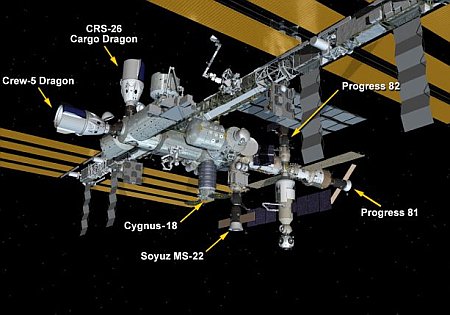
ISS after November 28, 2022 docking of unmanned Dragon freighter.
MS-22 is the Soyuz capsule that is leaking.
The Russian investigators yesterday concluded that the coolant leak on the Soyuz capsule docked to ISS was caused by an external impact, either by a meteroid or a small piece of space junk.
A decision on whether this capsule is still usable for manned flight will be made sometime in January. If not, Russia will move up the launch of the next Soyuz to ISS one month from March to February, but launch it empty. If so, managers will leave the schedule as is.
If the engineers determine the capsule is not flightworthy, it will mean however that until February, ISS is short one lifeboat. At present there are two Dragon capsules docked to ISS, one manned and one cargo. Both return to Earth with a habitable interior, but the cargo capsule is not intended for manned flight. In an emergency however it might be possible to use it.
This situation suggests that NASA should pay to get SpaceX to upgrade the cargo Dragons so that they could always be used as an emergency lifeboat.
SpaceX early today completed its 60th successful launch in 2022, putting 54 Starlink satellites into orbit using its Falcon 9 rocket.
This achievement matches a prediction Elon Musk made early in 2022. More significant, except for two years (1965 and 1966), SpaceX completed more launches in 2022 than the United States achieved each year since Sputnik. And it did it not as a nation, but as a private company, for profit.
SpaceX’s achievement this year also allowed the U.S. to smash its own record for annual launches.
The first stage successfully completed its 11th flight, landing on a drone ship in the Atlantic.
The leaders in the 2022 space race:
61 China
60 SpaceX
21 Russia
9 Rocket Lab
8 ULA
The U.S. now leads China 84 to 61 in the national rankings, but trails the entire world combined 93 to 84.
Only one more launch, by SpaceX, is publicly scheduled for 2022.
An evening pause: Intense.
Hat tip Judd Clark.
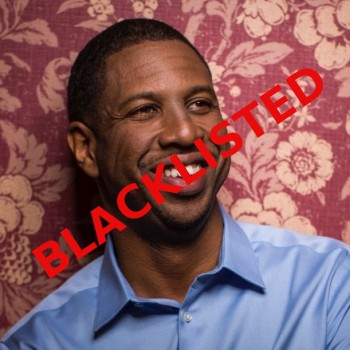
Hakeem Oluseyi, Space Science Education Lead
for NASA’s Science Mission Directorate
They’re coming for you next: Today’s blacklist column describes an effort to not only cancel from history the man who led NASA for almost the entire 1960s space race, but to also blackball a scientist for doing good research that proved the campaign was not based on any facts.
Shortly before the launch of the James Webb Space Telescope last year, a petition was instigated to get it renamed because of accusations that Webb had persecuted homosexuals during his term as NASA administrator in the 1960s. As is now typical of our modern bankrupt intellectual class, as soon as this petition was issued more than 1,700 people signed it, all accepting at face value its accusations against Webb without any further research.
One scientist, who happened to be black, took a more detailed look at those accusations however and found them to be spurious. As Hakeem Oluseyi wrote:
» Read more

Click for full image.
Today’s cool image is a great example of the surprises one can find by exploring the archive of the high resolution pictures that Mars Reconnaissance Orbiter (MRO) has produced since it arrived in Mars orbit back in 2006. The picture to the right, rotated, cropped, and reduced to post here, was taken by MRO’s high resolution camera back on May 4, 2017. I only found it because I had picked out a October 24, 2022 high resolution image that covered a different area of this same flow feature just to the north east. In trying to understand that 2022 picture I dug to see other images had been taken around it, and found the earlier 2017 photo that was even more interesting.
Neither however really covered the entire feature, making it difficult to understand its full nature. I therefore searched the archive of MRO’s context camera, which has imaged the entire planet with less resolution but covering a much wider area per picture. The context camera picture below captures the full nature of this feature.
» Read more
Though the Iranian government opposes their use, according to a tweet by Elon Musk SpaceX now has almost 100 Starlink terminals working in Iran.
Elon Musk announced that SpaceX has almost 100 Starlink terminals active in Iran. SpaceX activated Starlink services in Iran in September, supporting the United States’ stance on providing internet freedom and free flow of information to Iranians.
Unlike Ukraine, SpaceX does not have the cooperation of the Iranian government to expand Starlink services in the country. In Ukraine, President Volodymyr Zlenskyy and the Minister of digital transformation Mykhailo Feorov have actively supports Starlink connection during the war with Russia.
In contrast, the Iranian government is actively trying to limit its citizens’ internet access. The United States government has taken a stance against the Iranian government’s decision regarding internet access for its people.
SpaceX has routinely cooperated with foreign governments before selling terminals, likely because to do otherwise would get it in trouble with the U.S. State Department. In this case however the State Department appears to have approved this action, and SpaceX then made it happen.
China today successfully launched a classified Earth observation satellite using its Long March 4B rocket.
As the launch was from an interior spaceport, the rocket’s lower stages landed somewhere in the interior of China.
The leaders in the 2022 launch race:
61 China
59 SpaceX
21 Russia
9 Rocket Lab
8 ULA
The U.S. still leads China 83 to 61 in the national rankings, but trails the entire world combined 93 to 83.
At the moment, the only known remaining launches in 2022 are two SpaceX Falcon 9 launches. However, China routinely launches a lot in the November/December timeframe, so we should not be surprised if they complete one or two launches as well in the next few days.
An evening pause: A truly talented singer who has sometimes been her own worst enemy.
Hat tip Wayne Devette.